 English
 Le français
 Türkçe

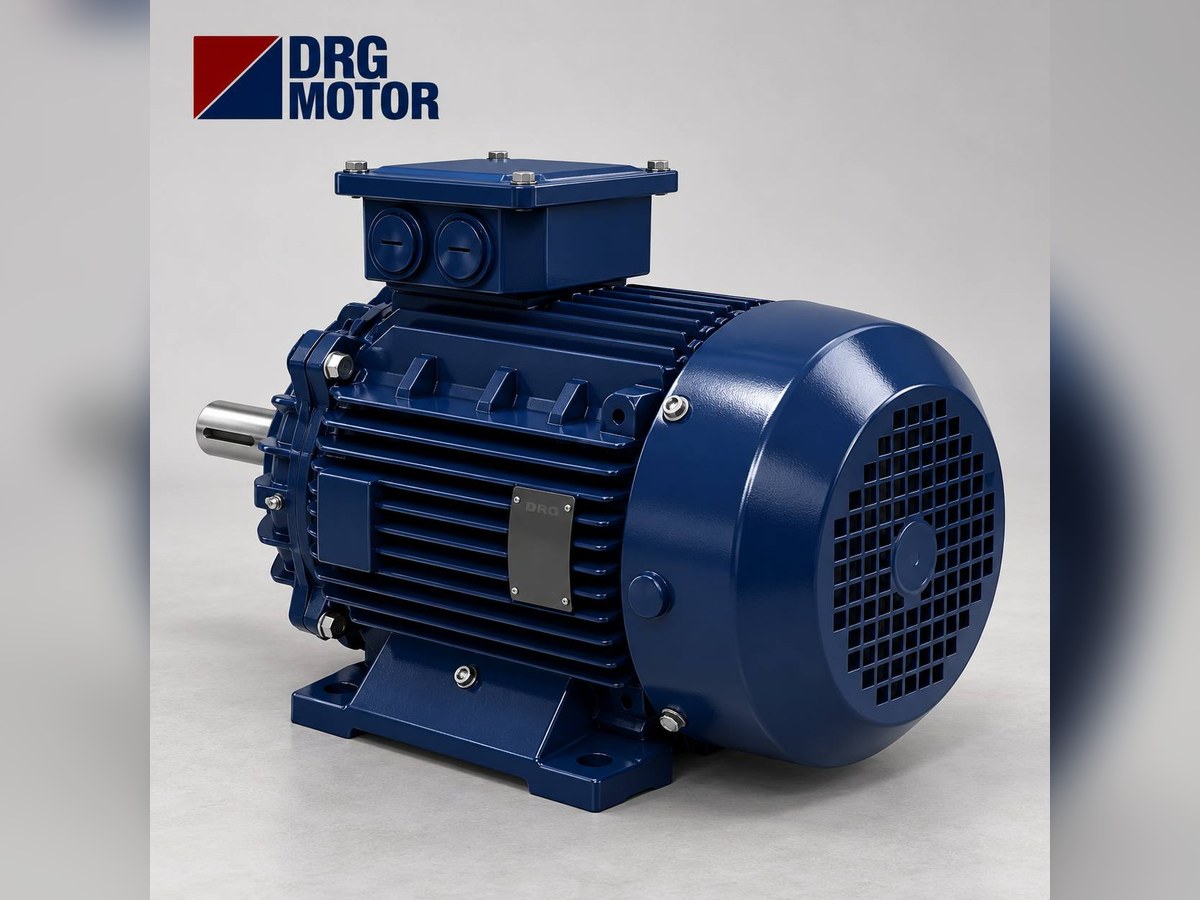
A marble sizing machine is a multi-blade cutting line that produces pieces of one size in series from slabs or strips: while the stone moves on the belt, blades set side by side split it into lengthwise strips, and the blades of the next station cut those strips across to length. Each blade arbor usually has its own electric motor; per blade, catalogues list motors of 7.5 to 11 kW, and single-arbor multi-saw machines go as high as 22 kW. The belt and bridge drives are separate from these.
DRG Motor is a manufacturer, supplier and seller of electric motors. We do not sell the sizing machine, belt gearbox, drive (inverter), electrospindle or servo axes; we supply the standard three-phase motors that turn the blade arbors, the belt and the bridge. Options are on Buy Electric Motors Online.
What is a sizing line, and how does it differ from a bridge saw?
A bridge saw cuts a slab laid on its table in any programmed direction with a single blade: very flexible per piece, slow per unit. On a sizing line the size is set in advance and the stone never stops flowing. Blade spacing is fixed to the strip width and hundreds of identical pieces come off while the belt runs at constant speed. In short, the bridge saw does project work and the sizing line does series production. A line may also include a head-cutting station that trims the irregular strip ends; that station has its own page.
Lengthwise (width) sizing
As the slab or wide strip moves along the belt, two or more blades set parallel to the belt split it into strips of the required width. The blades do not travel; the stone passes under them. The blade motor is loaded without a break during the cut, and the load depends on belt speed and stone thickness.
Crosswise (length) sizing
Strips are cut across into modular lengths. The blades are lined up on a bridge or beam; the strip is stopped, all blades cut at once as the bridge passes over, then the belt carries the pieces out. Blade motors keep turning while the cutting load comes and goes with each cycle.
Slab length-width line
For large slabs two machines are installed one after the other, one cutting lengthwise and one crosswise. On one maker’s slab line one length head and two width heads each run on 11 kW motors, while the motor that positions the heads is only 0.25 kW.
Blade arbor motors: how many blades, how many motors?
There are two basic layouts. In the first, every blade has its own motor and arbor; motor count grows with blade count and total line power rises almost in proportion. In one catalogue the 3–4 blade model totals 27–35 kW while the 9–10 blade model reaches 72–79.5 kW, with a 7.5 kW motor per blade throughout. In the second, many blades sit on one long arbor turned by a single large motor; one maker’s single-arbor machine runs 3 to 22 blades on one 22 kW motor.
Why one motor per blade helps
With separate motors, a failed motor stops only its own blade; that blade can be taken out and the line keeps running with one strip fewer. Small motors are also easy to hold as spares: one motor type in one frame fits every arbor. The drawback is that starting current is multiplied by the number of blades.
Care points on a single-arbor layout
With one large motor the load is the sum of all blades on the arbor; when several blades hit a hard vein together the motor sees a sudden rise. Here the torque that the arbor, bearings and belts can carry matters as much as motor power; ask the machine builder before upsizing the motor.
Belt and bridge motors
Belt speed has a direct effect on cut quality: a fast belt raises output, but on hard stone the blade struggles and edges may chip. The belt motor is therefore mostly used with a gearbox and an inverter to set speed. Catalogues list belt motors of 1.5–3 kW and about 1.5 kW for the forward-back motor of a cross-cutting bridge. DRG does not supply gearboxes or inverters; what we can deliver is a 4-pole motor matching the input flange of that gearbox.
Water and slurry on the belt side
Every blade on a sizing line has its own water curtain, and stone slurry travels along the line with the belt. The belt drive motor usually sits at one end of the line, where the slurry flows out. Our IP55 motors are protected against water jets; even so, mount it above the slurry run-off, with its gland pointing down, and clean the fins on a schedule.
Click to see current electric motor prices and order nowSEE PRICES →
How many kW on a sizing machine? Market figures
A) Motor powers given in maker catalogues for sizing lines:
| Line type / blades | Motor power | Single / total | Note |
|---|---|---|---|
| Edge trimming, 2–3 blades, Ø350 mm | 7.5 kW per blade; belt 1.5 kW | Total 16.5–24 kW | maker catalogue, strip width |
| Multi-blade length sizing, 3–10 blades, Ø350 mm | 7.5 kW per blade; belt 3 kW; bridge 1.5 kW | Total 27–79.5 kW | same catalogue, by blade count |
| Slab length-width sizing, 1 length + 2 width heads, Ø400 mm | 11 kW per head; belt 1.5 kW | Total 36 kW | same catalogue, slab line |
| Belt-fed multi-blade sizer, single head, Ø300 mm | 15 HP (≈11.2 kW) | Single head motor | second maker data sheet |
| Single-arbor multi-saw, 3–22 blades, Ø350 mm | 22 kW saw; belt 1.5 kW | Total 24 kW | third maker |
| Sizing machine, Ø400 mm blade | 10 HP (≈7.5 kW) saw; 2 HP hydraulic | Single blade | fourth maker |
Depending on model and blade count, these lines use roughly 7.5–11 kW per blade, or 22 kW on single-arbor types, and the total installed power climbs from 16.5 kW to 79.5 kW with the number of blades. Total power should never be read as one motor.
B) Where DRG fits: 7.5, 11 and 22 kW blade motors are covered by our 2-pole and 4-pole cast iron models, and 1.5–3 kW belt and bridge motors by our 4-pole models. Where ratings are quoted in HP (15 HP ≈ 11.2 kW), a standard kW size is chosen from the old nameplate.
Example: starting current on a six-blade line
Take a six-blade length sizing line with 7.5 kW per blade. As an example, the blade motor is a DRG-132S2-2 (13.7 A at 400 V, starting current 7.9 times rated), the belt motor a DRG-100L2-4 (6.02 A) and the bridge motor a DRG-90L-4 (3.3 A):
| Case | Working | Current | Comment |
|---|---|---|---|
| 6 blades running | 6 × 13.7 A | 82.2 A | blade motors only |
| Belt + bridge added | 82.2 + 6.02 + 3.3 | 91.5 A | normal line draw |
| All 6 blades start together | 6 × 13.7 × 7.9 | ≈ 649 A | supply and breaker are stressed |
| Staggered start, last motor | 13.7 × 7.9 + 5 × 13.7 + 9.3 | ≈ 186 A | peak falls below one third |
Starting six motors together puts needless stress on the main breaker and the transformer. A control that switches the blade motors on one after another a few seconds apart cuts the peak from about 649 A to 186 A. Each blade motor here is above 4 kW, so its 400/690 V winding can also take a star-delta start; try our star-delta starting tool.
DRG motors and replacement checks
When a blade arbor motor is replaced, note the kW and speed of the old motor, shaft diameter and key, flange or foot mounting, pulley or coupling size and the direction of the cable entry. If every blade on the line runs on the same motor type, the new motor must have the same speed; otherwise the strips will not come out with the same quality.
| Model | Power / speed | Frame · shaft D×E | Current 400 V |
|---|---|---|---|
| DRG-132S2-2 | 7.5 kW / 2930 rpm | 132S cast iron · 38×80 | 13.7 A |
| DRG-132M-4 | 7.5 kW / 1460 rpm | 132M cast iron · 38×80 | 14.3 A |
| DRG-160M1-2 | 11 kW / 2945 rpm | 160M cast iron · 42×110 | 19.6 A |
| DRG-160M-4 | 11 kW / 1465 rpm | 160M cast iron · 42×110 | 20.4 A |
| DRG-180M-2 | 22 kW / 2955 rpm | 180M cast iron · 48×110 | 38.5 A |
| DRG-100L2-4 | 3 kW / 1450 rpm | 100L cast iron · 28×60 | 6.02 A |
| DRG-90L-4 | 1.5 kW / 1445 rpm | 90L cast iron · 24×50 | 3.3 A |
Our motors come at 1000/1500/3000 rpm and are IP55. Order notes specify the mounting: foot B3, flange B5 or B14, combined B34/B35, or one of the vertical forms. If the blade arbor is the motor’s own shaft, meaning the blade is fitted straight onto it, we compare the old dimensions with our catalogue because special long shafts are not in our range.
B5 dimensions for flange blade motors
B5 dimensions (mm) of frames often found on sizing lines, from our catalogue:
| Frame | Shaft D×E | Flange P / M / N | Hole S |
|---|---|---|---|
| 90S/90L | 24×50 | 200 / 165 / 130 | 12 |
| 100L/112M | 28×60 | 250 / 215 / 180 | 14.5 |
| 132S/132M | 38×80 | 300 / 265 / 230 | 14.5 |
| 160M/160L | 42×110 | 350 / 300 / 250 | 18.5 |
Live price table
Current shop prices for the ratings chosen for blade, belt and bridge drives:
| Model | Power / speed | Frame · current 400 V | Price |
|---|---|---|---|
| DRG-90S-41.5 HP | 1.1 kW · 1500 rpm | Cast iron 90S · 2.48 A | $124.09 (€110.82) Details & buy → |
| DRG-90L-42 HP | 1.5 kW · 1500 rpm | Cast iron 90L · 3.3 A | $144.14 (€128.73) Details & buy → |
| DRG-100L2-44 HP | 3 kW · 1500 rpm | Cast iron 100L · 6.02 A | $203.84 (€182.05) Details & buy → |
| DRG-132M-410 HP | 7.5 kW · 1500 rpm | Cast iron 132M · 14.3 A | $394.89 (€352.66) Details & buy → |
| DRG-132S2-210 HP | 7.5 kW · 3000 rpm | Cast iron 132S · 13.7 A | $369.43 (€329.92) Details & buy → |
| DRG-160M-415 HP | 11 kW · 1500 rpm | Cast iron 160M · 20.4 A | $568.76 (€507.94) Details & buy → |
| DRG-160M1-215 HP | 11 kW · 3000 rpm | Cast iron 160M · 19.6 A | $527.95 (€471.49) Details & buy → |
| DRG-200L1-240 HP | 30 kW · 3000 rpm | Cast iron 200L · 52.1 A | $1,273.02 (€1,136.88) Details & buy → |
DRG MOTOR motors are guaranteed against material and manufacturing defects for 2 years from the delivery date (warranty certificate).
Motors in this power range
- DRG-132S2-2 – 7.5 kW – 2930 rpm – 132S cast iron
- DRG-160M1-2 – 11 kW – 2945 rpm – 160M cast iron
- DRG-160M-4 – 11 kW – 1465 rpm – 160M cast iron
- DRG-100L2-4 – 3 kW – 1450 rpm – 100L cast iron
- DRG-90L-4 – 1.5 kW – 1445 rpm – 90L cast iron
Click to see current prices and order these motors nowSEE PRICES →
Browse the motors, request a quote: If you need the same motor for every blade, pick from the models on Buy Electric Motors Online or ask for a quote with a nameplate photo via WhatsApp; phone +90 (542) 666 11 11.
Frequently asked questions
Is a marble cross-cutting motor the same as an edge-trimming motor?
Often close in power, but the load differs: in width trimming the blade is loaded continuously, in length cutting the load comes and goes with each cycle. Take dimensions and speed from the old motor when replacing it.
Does adding a blade to a natural stone sizing machine need a motor?
On a motor-per-blade layout, yes: each new blade needs its own motor and total line current rises. On a single-arbor layout, check the main motor power and arbor torque again.
A blade motor keeps tripping. What should I do?
First check belt speed, blade sharpness and water flow; if they are fine, measure motor current and compare it with the nameplate. If current is normal, the overload setting may be wrong.
Questions: +90 (542) 666 11 11, info@drgmotor.com or our contact page. All models for sizing machine motors are on Buy Electric Motors Online.


