 English
 Le français
 Türkçe

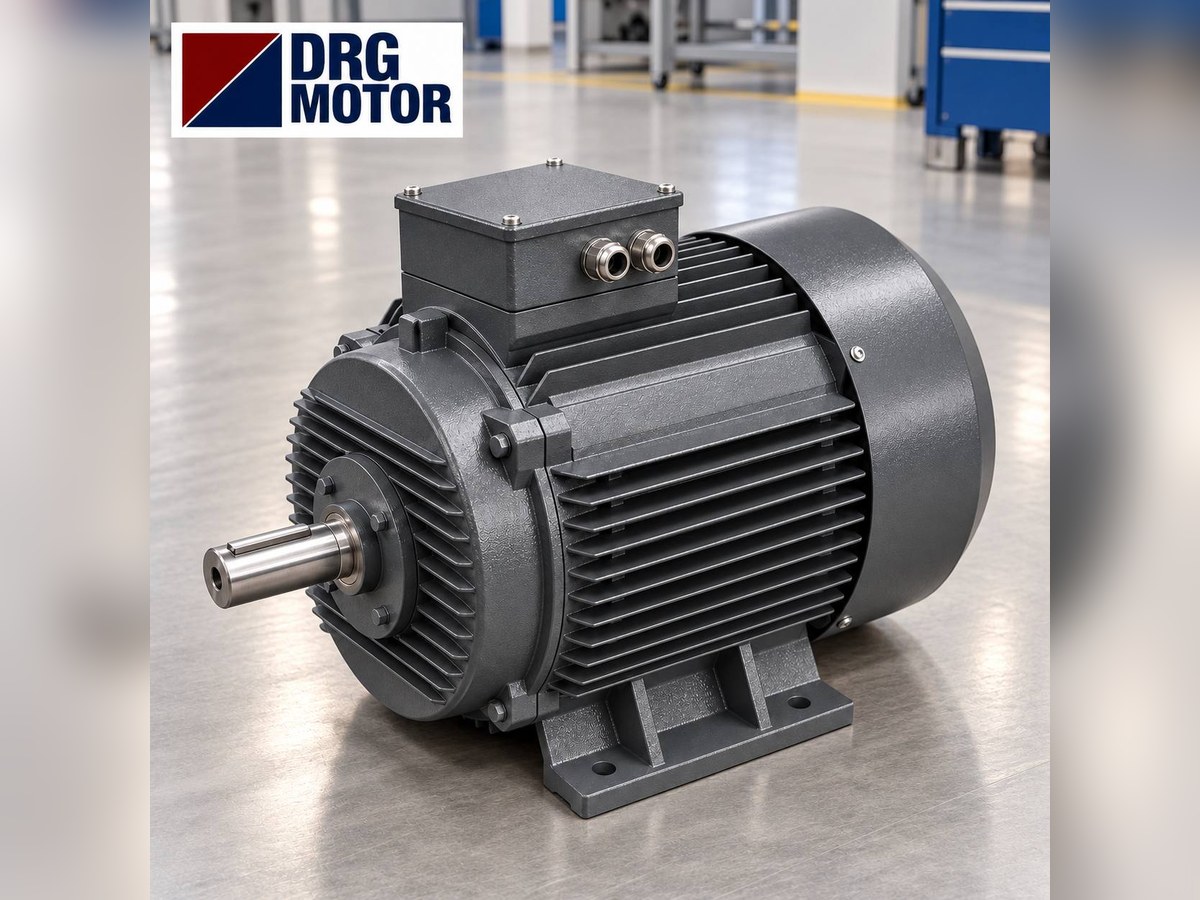
A multistage pump motor is a standard three-phase induction motor that turns several impellers stacked on one shaft: the pump builds its high delivery head through the number of stages, while the motor supplies the combined shaft power of those stages. In vertical multistage ranges on the market the motor is mostly 2-pole, about 2900 rpm, and its rating grows step by step as stages are added to the same pump size: in one manufacturer's catalogue the 10 m³/h model comes with 0.75 kW at 2 stages and 11 kW at 23 stages [2].
This page explains how a multistage pump differs from a single-stage centrifugal pump, how the motor is connected in vertical and horizontal designs, which motor ratings appear in commercial models, and which motors in the DRG range match them. You can see suitable motors and current prices among the 120 models on Buy Electric Motors Online. Overview: Pump Motors.
What is a multistage pump and where does it sit in the system?
By operating principle a multistage pump is a centrifugal pump. The difference is that instead of one impeller it has several impellers on the same shaft, each followed by a diffuser chamber. Water leaves the first impeller with added pressure, the diffuser turns its velocity into pressure, and it enters the eye of the next impeller. Each stage adds roughly the same pressure while the flow stays the same. That is why, for a given pump size, head and shaft power rise together as stages are added.
There are two families by layout. In vertical (in-line) multistage pumps the suction and discharge ports are level at the base, the stages sit one above the other inside a stainless sleeve, and the motor is flange-mounted on top with its shaft pointing down. Horizontal multistage pumps use a ring-section casing; the motor is either coupled on a common baseplate or flanged directly to the pump casing. The purpose is usually pressure boosting: the pump is chosen to deliver the pressure a network, a boiler or a membrane requires.
Where is it used?
- Steam boiler feed: the pump must exceed boiler pressure to push water in.
- Reverse osmosis (RO) and desalination: high inlet pressure for the membranes.
- Water pressure boosting sets in buildings and industry: most booster sets are built with vertical multistage pumps.
- High-pressure washing, cleaning and process water lines.
How it differs from other pump types
A single-stage centrifugal pump (end-suction or split case) gives large flow with limited head; to reach the same pressure with one impeller, impeller diameter or speed must grow. A multistage pump instead connects several small impellers in series. A single-stage in-line pump may look similar but has only one impeller. Circulation, booster and fire pump are names of applications; such systems may contain a multistage pump, for example the jockey pump of a fire set is often a vertical multistage pump.
How the motor drives the pump: vertical and horizontal layouts
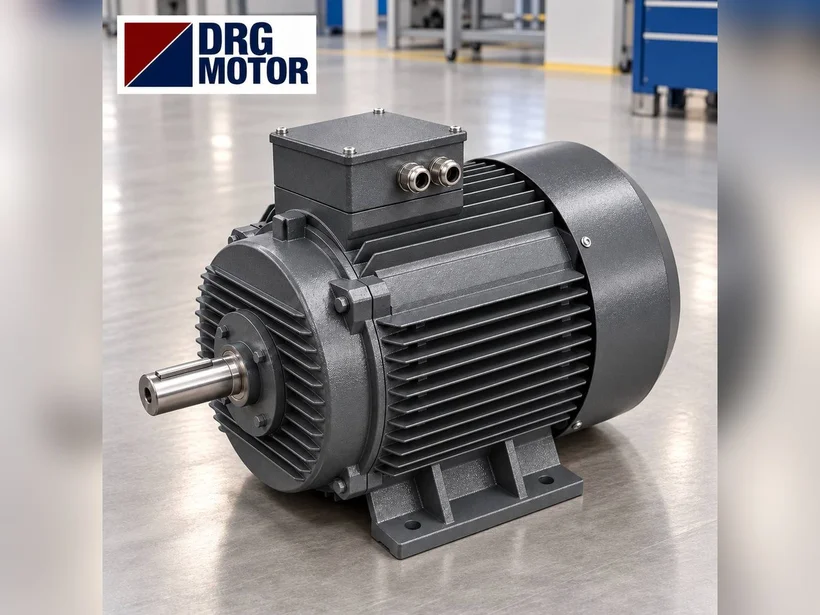
On a vertical multistage pump the motor is flanged to the lantern on top of the pump head, with a rigid coupling between motor shaft and pump shaft; a foot-mounted motor is not used. In one manufacturer's catalogue motors up to 4 kW have a small flange (V18, the vertical use of a B14 flange) and motors from 5.5 kW have a large flange (V1, the vertical use of a B5 flange) [1]; another manufacturer gives the same limit as B14 and B5 [2]. Measure the old motor's flange before ordering a replacement.
In vertical operation the motor weight and the hydraulic thrust of the impellers act downwards. In some designs the motor's fixed bearing carries this thrust; in one ring-section range the fixed bearing is in the motor for small sizes and in the pump lantern for larger sizes [3]. For vertical operation the motor must therefore be ordered as suitable for vertical mounting, and the axial load must be confirmed with the pump manufacturer.
Horizontal multistage pumps come in two arrangements: a foot-mounted (B3) motor with a flexible coupling on a common baseplate, or a close-coupled design where the motor is flanged to the pump casing. In the same ring-section range the coupled horizontal types are listed with B3 motors and the vertical type with V1 motors [3]. The exact mounting is taken from the pump manufacturer's drawing.
On speed the picture is clear: the vertical ranges reviewed list 2-pole motors at about 2900 rpm [1][2], while large ring-section ranges are also catalogued at 1450 rpm [3]. Pressure per stage changes with the square of speed. Fitting a 4-pole motor in place of a 2-pole one cuts the head to roughly a quarter and the pump can no longer do its job. For the relation between speed and pressure see our article on affinity laws.
Click to see current electric motor prices and order nowSEE PRICES →
Number of stages and motor power: commercial models
A) Motor power seen in commercial pump models
| Model group / capacity | Motor power | Single / total | Source |
|---|---|---|---|
| Maker B vertical, 1 m³/h class, 2–39 stages | 0.37–2.2 kW | Single motor | [2] |
| Maker B vertical, 10 m³/h class, 2–23 stages | 0.75–11 kW | Single motor | [2] |
| Maker D vertical range, all sizes | 0.37–55 kW | Single motor | [4] |
| Maker A vertical, 120–150 m³/h class | 11–75 kW | Single motor | [1] |
| Maker C ring-section, vertical type | up to 400 kW | Single motor | [3] |
In this pump group, motor options of roughly 0.37–400 kW are seen depending on the manufacturer's model and capacity [1][3]. Within one model the flow class is fixed and the number of stages sets the head; as capacity (m³/h) grows, the impeller widens and power per stage rises. That is why 39 stages in the 1 m³/h class need only 2.2 kW, while the 120–150 m³/h class starts at 11 kW. In booster sets several pumps run in parallel; each pump has its own motor, the installed power of the set is multiplied by the number of pumps, but the motor is selected on the power of a single pump.
B) Motors with a match in the DRG range
The part of range A that overlaps DRG's 0.25–355 kW, 1000/1500/3000 rpm range is 0.37–355 kW. All vertical ranges (0.37–75 kW) fall inside this overlap, and 2-pole 3000 rpm class motors exist in the range from 0.25 kW to 355 kW. Large ring-section pump motors above 355 kW are outside the DRG range. Integrated motors with a frequency converter on the motor and pump makers' special-shaft motors are not in the range either; on such a pump, switching to a standard motor is done only after the shaft and flange dimensions are confirmed with the pump manufacturer.
Worked example: how adding stages changes the motor
Shaft power is found with P = ρ·g·Q·H / η_pump (ρ kg/m³, g 9.81 m/s², Q m³/s, H m, P W). Example: 12 m³/h of water is to be delivered at 160 m head to the membranes of a reverse osmosis unit. With an assumed pump efficiency of 0.62, P = 1000 × 9.81 × (12/3600) × 160 / 0.62 ≈ 8.4 kW. With a 10% margin the need is about 9.3 kW; the next standard rating is an 11 kW 2-pole motor.
If this pump delivers 160 m with 16 stages, each stage gives about 10 m. As the membranes foul, the required head rises to 200 m and the pump maker adds 4 stages. With the same formula shaft power rises to about 10.5 kW, or 11.6 kW with margin; the 11 kW motor is no longer enough and 15 kW is needed. A manufacturer table shows the same steps: in the 10 m³/h class, 12 stages come with 5.5 kW, 16 stages with 7.5 kW and 22 stages with 11 kW [2]. You can run your own values in the Pump & Fan Motor Power calculator.
| Model | Power / speed | Frame · current 400 V | Price |
|---|---|---|---|
| DRG-801-21 HP | 0.75 kW · 3000 rpm | Cast iron 80 · 1.64 A | $87.39 (€78.04) Details & buy → |
| DRG-90S-22 HP | 1.5 kW · 3000 rpm | Cast iron 90S · 3.06 A | $119.41 (€106.64) Details & buy → |
| DRG-90L-23 HP | 2.2 kW · 3000 rpm | Cast iron 90L · 4.35 A | $154.45 (€137.93) Details & buy → |
| DRG-100L-24 HP | 3 kW · 3000 rpm | Cast iron 100L · 5.71 A | $177.89 (€158.87) Details & buy → |
| DRG-112M-25.5 HP | 4 kW · 3000 rpm | Cast iron 112M · 7.45 A | $225.65 (€201.52) Details & buy → |
| DRG-132S1-27.5 HP | 5.5 kW · 3000 rpm | Cast iron 132S · 10.1 A | $338.72 (€302.50) Details & buy → |
| DRG-132S2-210 HP | 7.5 kW · 3000 rpm | Cast iron 132S · 13.7 A | $369.43 (€329.92) Details & buy → |
| DRG-160M1-215 HP | 11 kW · 3000 rpm | Cast iron 160M · 19.6 A | $527.95 (€471.49) Details & buy → |
| DRG-160M2-220 HP | 15 kW · 3000 rpm | Cast iron 160M · 26.5 A | $570.23 (€509.25) Details & buy → |
| DRG-180M-230 HP | 22 kW · 3000 rpm | Cast iron 180M · 38.5 A | $857.53 (€765.83) Details & buy → |
Data needed for motor selection, and starting
How much water and how much head you get is decided by the impellers and stages; the motor's part is shaft power at the design speed. Before asking for a motor for a multistage pump, collect the following:
- Flow, head and number of stages from the pump nameplate; the new power need if stages were changed.
- The old motor's nameplate: kW, speed, IEC frame and voltage (230/400 V or 400/690 V).
- Flange: small (B14/V18) or large (B5/V1); shaft diameter, shaft length and key size.
- Layout: vertical shaft-down or horizontal; whether the motor or the pump carries the axial load.
- Liquid temperature: with boiler feed water, heat passes from the pump casing to the motor flange.
- Starting method: direct-on-line, star-delta, soft starter or inverter.
The rotating mass of a multistage pump is small; the motor reaches speed quickly and starting is not heavy. At larger ratings star-delta or a soft starter is used to ease the supply. On a 400 V network, star-delta needs a 400/690 V winding; one manufacturer lists 4 kW and above at 400/690 V [2], and in the DRG range 4 kW and above are at this voltage too. Details: star-delta starting.
Matching with DRG motors
DRG Motor is a manufacturer, supplier and seller of electric motors. For multistage pumps the relevant part of the range is the 2-pole 3000 rpm class: 0.25–11 kW in aluminium frames, 0.55–355 kW in cast iron; 3-phase, 230/400 V or 400/690 V; mounting B3, B5, B14 and B35, with vertical use stated in the order. The table below shows the models matching the power steps in the example.
| Model | Power / speed | Frame | Current 400 V |
|---|---|---|---|
| DRG-90L-2 | 2.2 kW – 2895 rpm | 90L cast iron | 4.35 A |
| DRG-112M-2 | 4 kW – 2905 rpm | 112M cast iron | 7.45 A |
| DRG-132S2-2 | 7.5 kW – 2930 rpm | 132S cast iron | 13.7 A |
| DRG-160M1-2 | 11 kW – 2945 rpm | 160M cast iron | 19.6 A |
| DRG-160M2-2 | 15 kW – 2945 rpm | 160M cast iron | 26.5 A |
For the 11 kW need in the example, DRG-160M1-2 (2945 rpm, 19.6 A at 400 V) fits; with 4 stages added, DRG-160M2-2 (15 kW, 26.5 A at 400 V) fits. For a vertical pump, state V1 mounting, flange type and shaft size in the order. DRG MOTOR motors are guaranteed against material and manufacturing defects for 2 years from the delivery date (warranty certificate). For a general checklist on water pumps see choosing a motor for a water pump.
DRG motors for multistage pumps
- DRG-90L-2 – 2.2 kW – 2895 rpm – 90L cast iron
- DRG-100L-2 – 3 kW – 2895 rpm – 100L cast iron
- DRG-112M-2 – 4 kW – 2905 rpm – 112M cast iron
- DRG-132S1-2 – 5.5 kW – 2930 rpm – 132S cast iron
- DRG-132S2-2 – 7.5 kW – 2930 rpm – 132S cast iron
- DRG-160M1-2 – 11 kW – 2945 rpm – 160M cast iron
- DRG-160M2-2 – 15 kW – 2945 rpm – 160M cast iron
Click to see current prices and order these motors nowSEE PRICES →
Multistage pump motor: frequently asked questions
What speed motor does a multistage pump use?
In the vertical ranges reviewed the motor is 2-pole, about 2900 rpm. Large horizontal ring-section pumps may also run at 1450 rpm.
Does the motor change when stages are added?
Usually yes. In one manufacturer table the same 10 m³/h class comes with 5.5 kW at 12 stages and 11 kW at 22 stages. Ask the pump maker for the new power need before adding stages.
Can a foot-mounted motor be fitted to a vertical multistage pump?
No. On a vertical pump the motor sits on the lantern by its flange (B14/V18 at small ratings, B5/V1 at larger ratings). The motor must be ordered as suitable for vertical mounting and the axial load confirmed with the pump manufacturer.
How many amps does an 11 kW 2-pole pump motor draw?
DRG-160M1-2 draws 19.6 A at 400 V and 20.6 A at 380 V.
Send us the pump nameplate, the number of stages and the old motor's nameplate; we will settle on the right DRG model together. Phone +90 (542) 666 11 11, e-mail [email protected], contact page. For all models and current prices, see Buy Electric Motors Online.
Sources
- Grundfos – CR, CRI, CRN, CRE, CRIE, CRNE Data Booklet, 50 Hz – motor power ranges for CR 1s–150 (0.37–75 kW), 2-pole standard motor, V18 up to 4 kW, V1 from 5.5 kW.
- Ebara – EVMS 1–90 Vertical Multistage Pumps, full range brochure – motor 0.37–45 kW, about 2900 min⁻¹, 2-pole; B14 flange up to 4 kW, B5 from 5.5 kW; motor power by number of stages.
- KSB – Multitec / Multitec-RO type series booklet – ring-section high-pressure pump; up to 400 kW standardised motor for type V, B3 and V1 mounting, 1450 and 2900 rpm curves, fixed bearing location.
- Xylem – Lowara e-SV range (makale) – vertical multistage range, standard motors 0.37–55 kW, head up to 330 m.


