 English
 Le français
 Türkçe

A technical drawing ensures that the work to be done on the machine side starts from the right dimensions before the motor arrives. If the baseframe, pulley hub, coupling, guard or flange adapter is not made to the motor's actual dimensions, the mistake only shows up on installation day and the downtime gets longer.
Typical mistakes the drawing prevents
- Base holes: A baseframe made with wrong A, B and K dimensions has to be redrilled or corrected by welding.
- Axis misalignment: In a coupled drive, the H value must match the driven machine; a difference of a few millimetres calls for shimming.
- Hub size: If the shaft diameter and keyway are wrongly assumed, the pulley or coupling has to be re-machined.
- Terminal box orientation: The position of the box can block the cable entry or a part of the machine.
- Fan cover clearance: If the overall length L and the air gap at the rear are not taken into account, the motor ends up in a place prone to overheating.
The difference between a catalogue table and a drawing
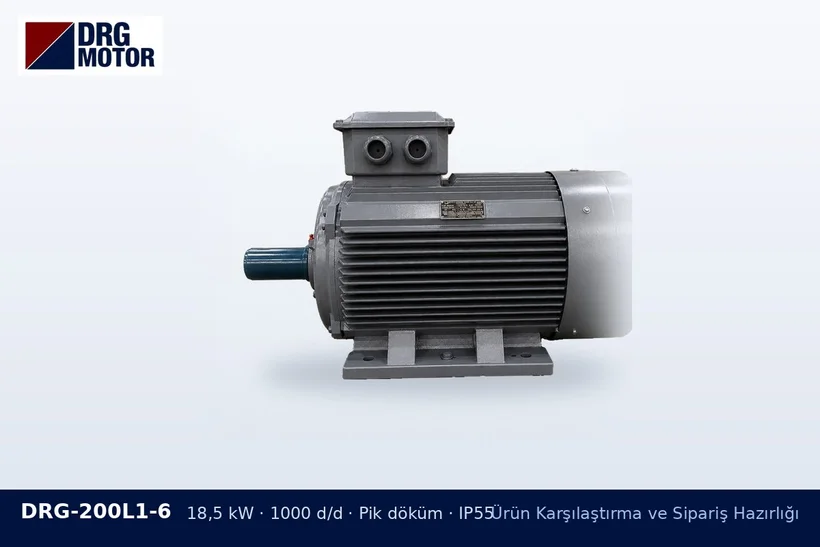
A catalogue table gives summary values per frame; a drawing relates all dimensions of the model you have chosen in a single view. Details such as key size, terminal box height and flange pitch circle are read most clearly on the drawing. For example, the 30 kW 4-pole DRG-200L-4-GG model has a 55×110 mm shaft, a 200 mm shaft height and an overall length of 779 mm; the 2-pole 37 kW model is in the same frame, but it is a different model and its drawing must be checked separately.
Which drawing, and from whom?
For project and machine design, the DRG technical drawing page offers 2D dimensioned drawings and 3D STEP files that can be imported into CAD. After downloading the drawing, compare its model code with the code in the order before starting fabrication; if the code changes, the drawing changes too. If the drawing differs from the old motor you have, tell the fabricator in writing which part (baseframe, hub, guard) the difference affects.
When the drawing is not enough
Requests such as a special flange or a different shaft end fall outside the standard drawing, and products prepared specifically for the buyer are not covered by returns. For this reason, looking for a solution within standard dimensions is usually the safer path.
You can verify the model whose drawing you have reviewed on the 30 kW 200L cast iron product page or among all three-phase motor models.