 English
 Le français
 Türkçe

A specification should define the motor with measurable values and show how each clause is to be proven in the tender. Power, speed, voltage, frame, mounting, protection and insulation class, environmental conditions and starting method are the core clauses; these values are written instead of a brand or model name.
Core clauses
- Type: Three-phase, squirrel-cage induction motor with a frame to IEC dimensions.
- Power and speed: Shaft output in kW and number of poles; load character (steady, shock loading, heavy starting).
- Electrical: Supply voltage and frequency, connection, starting method (direct-on-line, star-delta, soft starter or drive).
- Mechanical: Mounting arrangement, IEC frame number, shaft diameter, shaft height and, where needed, maximum overall length.
- Protection and cooling: Degree of protection (e.g. IP55), insulation class (e.g. F), cooling method (e.g. IC411 self-ventilated).
- Environment: Ambient temperature range, altitude, dust, humidity, outdoor installation or corrosive atmosphere.
- Duty profile: Daily operating hours, starts per hour, expected short-time overload.
Document, warranty and delivery clauses
List the documents to be supplied with the tender (dimensioned drawing, nameplate data, warranty certificate and so on) and make it a requirement that the supplier states in writing which of them it can provide. The warranty period and scope should also appear as a clause; DRG motors carry a 2-year warranty against material and manufacturing defects from the date of delivery. The delivery point, packaging and who bears the freight are set out in a separate clause.
Wording that weakens a specification
- Unmeasurable phrases such as “first-class material” or “high quality”
- Copying a single brand's catalogue number as a clause
- Stating only the kW without giving the environment and load data
- Leaving compatibility with the panel and protection arrangement to the supplier; that assessment is the job of qualified electrical personnel
A sample clause
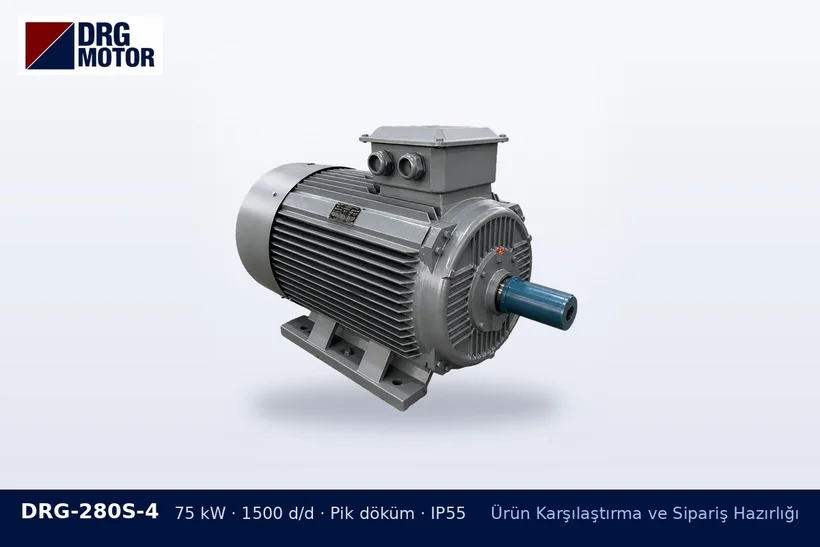
“55 kW, 4 poles, to run in Δ connection at 400 V, wound for 400/690 V, B3 mounting, IEC 250M frame, IP55, class F insulation, cast iron frame.” This definition can be compared directly with the values of a model such as DRG-250M-4-GG. If the load and environmental conditions are different, the values change; the clause is still written in the same way.
You can see the values on which the specification is based in the 55 kW 250M cast iron product record or on the general-purpose industrial motor family page.