 English
 Le français
 Türkçe

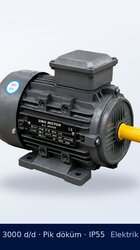
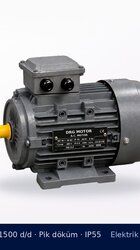
What needs confirming today is whether the motor's rated voltage matches the output voltage of the drive to be used later, whether cooling will be adequate across the planned speed range, and what mechanical provision exists for fitting extra equipment if needed. If these three points are settled from the outset, there is no need to change the motor when the drive is added.
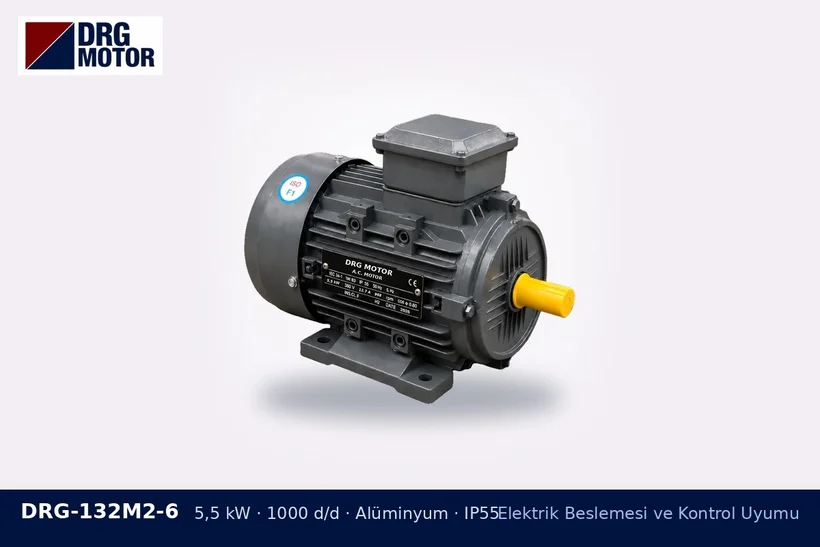
Matching voltage and connection
Most drives with a three-phase input supply the motor with up to 400 V, whereas small drives with a single-phase input deliver around 230 V. The motor nameplate must offer a connection option that works at this voltage. Which connection to use depends on the nameplate, the drive documentation and the judgement of qualified electrical personnel.
Write down the planned speed range now
- Long operation at low speed: On a self-ventilated (IC411) motor, the fan slows down too. If the load demands high torque at low speed, heating increases and a power margin must be allowed; forced-ventilation cooling is not available in DRG's standard range.
- Going above nominal: Above 50 Hz the torque falls, and bearing and balancing conditions gain importance. How far you can go should be confirmed with the manufacturer's data.
- Load type: For fans and pumps, torque drops with speed; for conveyors and mixers it stays roughly constant. The latter puts more strain on the motor at low speed.
Mechanical and electrical preparation
- If an encoder or a separate fan may become necessary, take into account from the start that these are not offered as ready options on DRG's standard models; assess their suitability with the system integrator.
- At higher powers, bearing currents may become an issue in drive operation; discuss this with the drive supplier.
- Record the cable route and length between the panel and the motor.
DRG motors have class F insulation; DRG does not sell frequency inverters, so the drive is sourced separately. You can explore how torque and power vary with frequency in the frequency-torque-power tool, and compare suitable models in the three-phase induction motor family.