 English
 Le français
 Türkçe

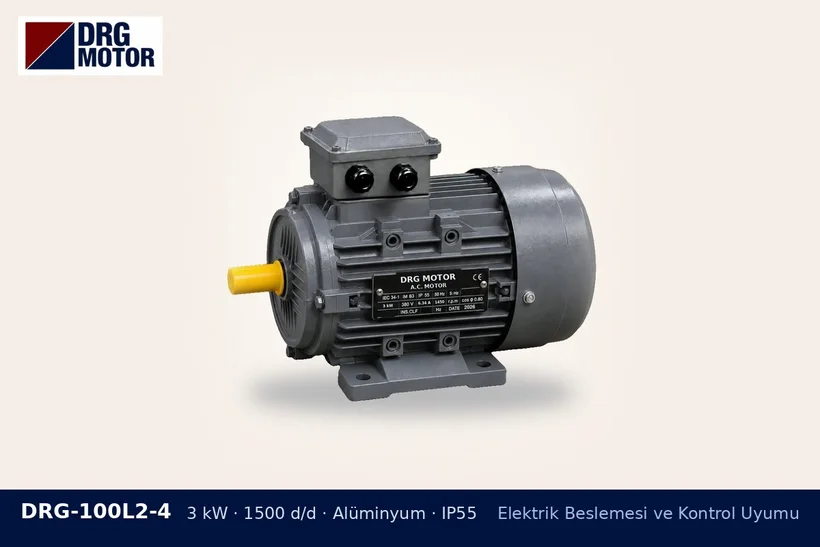
Nothing is needed on the motor; this behaviour depends entirely on the control circuit. An induction motor turns as soon as voltage arrives and has no memory of its own. For the machine not to start up by itself when power returns, the start command must be cleared by the interruption, meaning the operator has to press the start button again.
Where does an unintended restart come from?
- Maintained-position switch: A rotary cam switch left in the on position feeds the motor immediately when power returns.
- Automatic control signal: If a float switch, pressure switch or PLC output stayed active during the outage, the motor runs again.
- Drive setting: On frequency inverters, the restart-on-power-up function may be enabled.
Arrangements that prevent it
The classic approach is a contactor that is energised by the start button and held in by its own auxiliary contact. When power is lost the contactor drops out, and even when power returns it does not pull in again until the start button is pressed once more. In more sensitive applications an undervoltage relay or a safety relay is added. For loads that are meant to run automatically, such as pumps and fans, restarting is deliberately allowed; however, a delay is set so that several motors do not start at the same time.
On which machines should this be treated as a must?
On machines the operator touches by hand, such as saws, planers, lathes, presses and mixers, an unexpected restart carries a serious risk of injury. On these machines, the design and implementation of the control circuit depend on machinery safety rules, the motor nameplate and the judgement of qualified electrical personnel.
For an application close to workshop machinery, see the circular saw machine motors page, and review low-power models in the three-phase motor shop.