 English
 Le français
 Türkçe

It can. Every induction motor draws inductive reactive power from the supply for magnetisation; a new motor increases this demand. If the automatic power factor correction panel has a free step and enough capacitor power, the controller covers the difference and the bill does not change. If the steps are already all in use, the reactive ratios can exceed the limit and a charge appears on the bill.
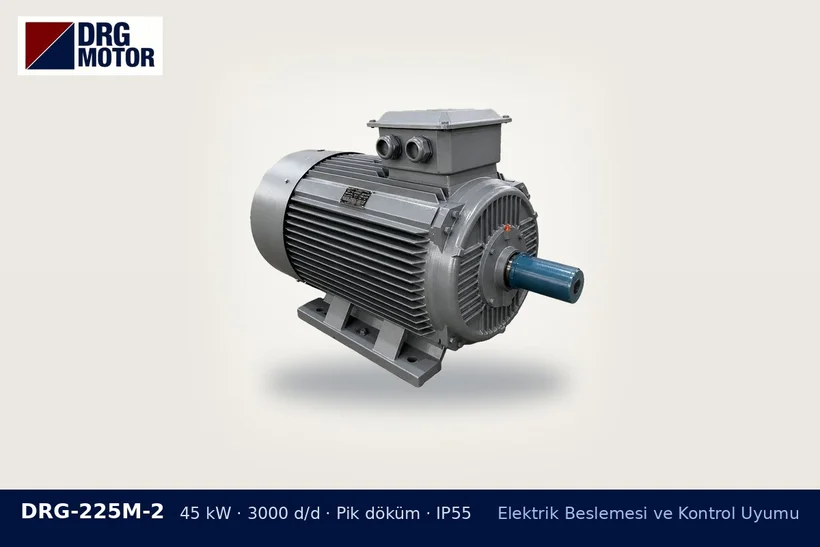
Conditions that increase a motor's reactive demand
- Low load: The magnetising current of an induction motor is almost independent of load. A motor chosen larger than necessary and running lightly loaded has a lower power factor.
- Pole number: At the same power, a 6-pole motor generally draws more reactive power than a 2- or 4-pole one.
- Idling: Reactive consumption continues even while the machine turns without doing any work.
What to check on the correction side
- The reactive controller's records for recent months and how many steps are switched in at the busiest hour,
- The actual capacity of the capacitors; ageing capacitors no longer deliver their rated value,
- The power factor and expected operating load of the new motor,
- If the site has harmonic-generating loads such as frequency inverters, the need for a harmonic filter.
Individual or central?
For large motors that run continuously, individual correction with the capacitor placed next to the motor can be applied; on sites with variable load, a central automatic panel is more flexible. Which one is suitable, and the capacitor rating, depend on the site design and the calculation of a qualified electrical engineer.
To get a first idea of the capacitor power needed for the new motor, you can use the motor power factor correction calculator. Choosing a motor whose power is close to the actual load also limits reactive consumption; compare power and speed options in the three-phase motor shop.