 English
 Le français
 Türkçe

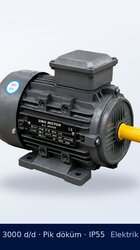
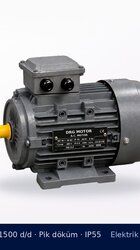
Single-phase motors are powered from a 220–230 V single-phase supply and are generally preferred for low-power applications up to 2.2 kW, such as small pumps, compressors and household equipment. Three-phase motors are powered from a 380–400 V three-phase supply; producing continuous and balanced torque, they are ideal for industrial applications requiring high power.
Difference in operating principle
When three voltages displaced by 120° are applied to a three-phase winding, they create a magnetic field that rotates by itself inside the stator. That is why a three-phase induction motor starts without any extra device. On a single-phase supply, the field only pulsates and does not rotate on its own, so the motor needs an auxiliary winding plus a capacitor (start and/or run capacitor) or a centrifugal switch in order to start. These additional parts are also potential points of failure.
Performance and practical comparison
- Torque: three-phase motors deliver smooth, balanced torque; single-phase torque pulsates, which shows up as more vibration and noise.
- Efficiency and life: at the same power, three-phase motors are more efficient, quieter and longer-lasting, and usually have a smaller frame size.
- Current: for the same output, a single-phase motor draws a higher line current, so cable cross-section and fuses must be sized accordingly.
- Control: three-phase motors are easily controlled with star-delta starters, soft starters and frequency inverters.
Which one should you choose?
For homes, small workshops or rural sites without a three-phase connection, a single-phase motor is a practical solution at low power. In factories and for machines running continuously, a three-phase motor is the better choice in every respect. For this reason, DRG Motor's industrial range mainly consists of three-phase asynchronous motors, while single-phase motors are also part of the range.
To find the right motor for your supply and load, contact us on +90 (542) 666 11 11 (WhatsApp) or at info@drgmotor.com.