 English
 Le français
 Türkçe

It can, but the motor does not run by being plugged straight into a single-phase socket; a converter has to be placed in between. For small powers, the most common route is a frequency inverter with a single-phase 230 V input and a three-phase 230 V output. As the power grows and the workshop expands, obtaining a three-phase supply from the local utility becomes the sounder solution.
Comparing the options
| Method | When it suits | Point to watch |
|---|---|---|
| Frequency inverter with single-phase input | A single machine, low power | The motor nameplate must offer a 230 V connection option; drive power is limited |
| Capacitor supply | A small, lightly loaded machine used occasionally | The motor stays well below its rated power and starting torque is weak |
| Rotary phase converter | Several three-phase machines | Requires extra investment and space |
| Three-phase supply connection | A growing workshop, higher power | Requires an application to the local utility and wiring work |
Where do DRG motors fit in this scenario?
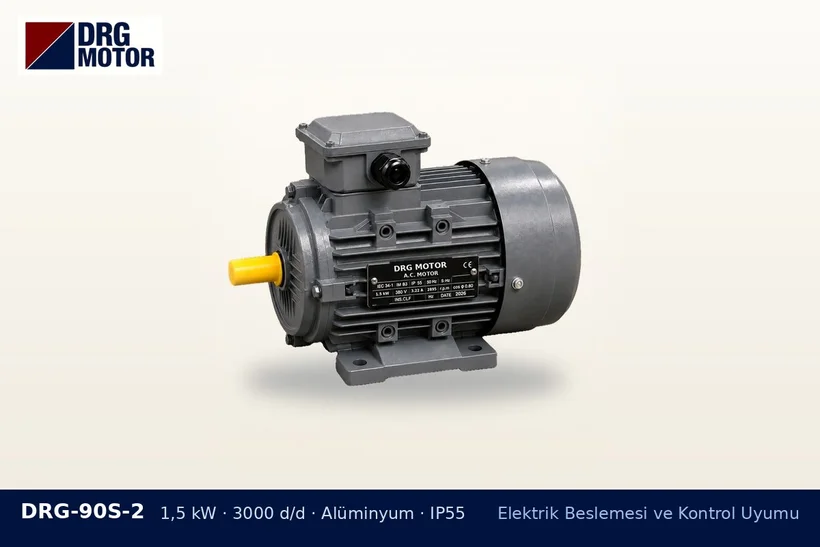
In the DRG range, models up to 3 kW carry a 230/400 V nameplate; these motors have a connection option suited to running from a drive with a 230 V output. Models of 4 kW and above are rated 400/690 V and cannot deliver full power from a 230 V drive output. DRG does not sell single-phase motors or frequency inverters, so you will need to source the drive separately. The connection and drive settings depend on the motor nameplate, the drive documentation and the judgement of qualified electrical personnel.
Before deciding
- What power and starting torque does the machine actually need?
- Does the fuse rating of the workshop's single-phase line cover the input current of the drive?
- Will other three-phase machines be added in the near future?
You can read about the differences between single-phase and three-phase motors in the article on single-phase and three-phase motors, and review the low-power models with a 230/400 V nameplate in the aluminium frame motor family.