 English
 Le français
 Türkçe

If the nameplate cannot be read, the new motor is identified by combining the dimensions of the old frame, the speed the machine requires and the demand of the driven load. The order matters: settle the mechanical dimensions first, then the speed, and the power last. Most mistakes are made when estimating the power.
What does the frame tell you?
Even without a nameplate, the cast frame still carries information. The distance from the underside of the feet to the shaft centre gives the IEC frame number: a motor measuring 90 mm is a 90 frame, one measuring 132 mm is a 132 frame. The shaft diameter and the length of shaft protruding from the motor confirm this estimate; in the DRG range, 132-frame models have a 38×80 mm shaft and 100-frame models a 28×60 mm shaft. If you spot an embossed number on the end shield or the frame, write it down as well.
Finding the pole count by measuring speed
If the motor can still run, measure the shaft speed under load with a tachometer. An induction motor turns slightly below synchronous speed, so a reading of around 1440, for example, points to a 4-pole motor in the 1500 rpm class. If the motor has burnt out, you can work backwards from the known operating speed of the machine and the pulley diameters.
Do not base the power on a single clue
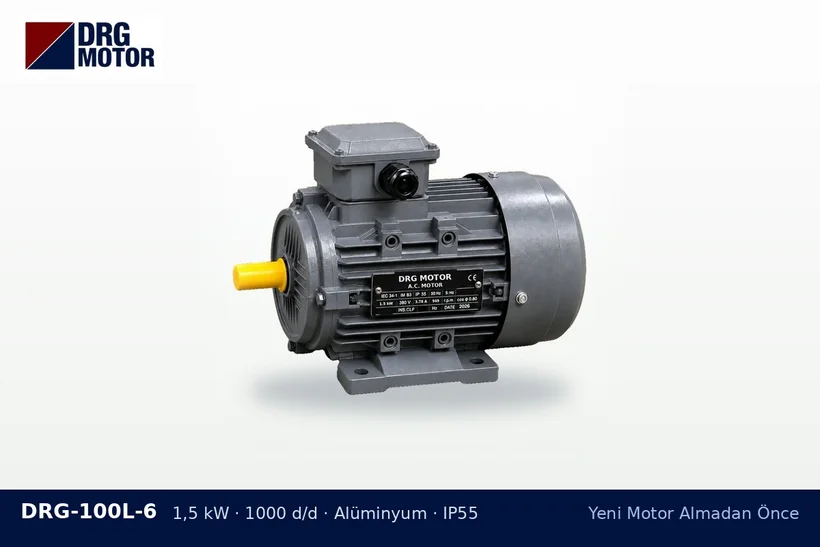
The same frame number can correspond to more than one power rating. In the DRG range, the 100L frame includes both a 1.5 kW 1000 rpm model and a 3 kW 3000 rpm model. To determine the power, weigh these sources together:
- The power requirement on the nameplate of the driven pump, fan or compressor
- The machine catalogue, or the motor fitted to another unit of the same model
- The current drawn by the old motor, measured under load
- The supply cable and the control panel components (only as a rough indication)
Interpreting panel and current data depends on the motor nameplate, the manufacturer's documentation and the assessment of qualified electrical personnel.
Do not forget the voltage class
On DRG models, windings are 230/400 V up to 3 kW and 400/690 V from 4 kW upwards. Because this difference can affect the existing starting arrangement, it should be confirmed with someone who knows the control panel.
With the shaft height, shaft and speed data you have gathered, you can make a first selection in the motor selection wizard, then compare three-phase motor models and their dimensions in the shop.