 English
 Le français
 Türkçe

The code supplied by a machine manufacturer is usually that company's own stock or part number; on its own it does not correspond to another brand's product. Once the technical data behind the code (power, speed, frame, mounting arrangement, shaft and voltage) has been obtained, the right product can be matched with confidence.
Tell the types of code apart
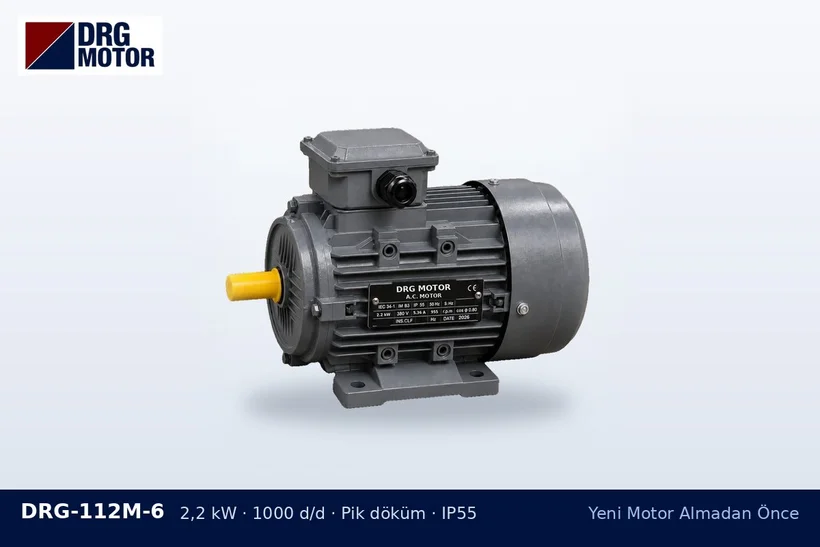
The code you have can be one of three kinds. A part number only has meaning within that machine maker's spare parts list. A motor supplier's type code, on the other hand, usually contains frame and pole information; in DRG codes, for example, “DRG-112M-4” indicates a 112M frame and 4 poles. The third kind is a general classification tied to the machine model, and it carries the least information.
The data sheet to request from the manufacturer
Once you have the code, ask the manufacturer or the seller for the following in writing:
- Shaft power (kW) and rated speed
- Voltage, frequency and connection (Δ/Y)
- Mounting arrangement: foot, flange or both
- Shaft diameter, length and keyway dimensions
- For flange motors, the bolt circle and spigot diameter
- Degree of protection and ambient conditions
The risk of relying on the code alone
Even when the code correctly shows the frame and number of poles, the flange type, shaft length or key may differ. On some machines the manufacturer has fitted an extended shaft or a special flange to a standard frame. In that case a standard model with the same frame number can be considered among the alternatives only after the dimensions have been compared; a similar code is no guarantee by itself.
When you have the data sheet, look through the ordering guide by mounting arrangement and browse three-phase models with the right frame and speed in the shop. For a 112M frame requirement, the 4 kW, 4-pole cast iron frame model can serve as a starting point for comparing dimensions.