 English
 Le français
 Türkçe

If the machine shaft speed is close to one of the standard pole speeds (3000, 1500 or 1000 rpm), the motor is chosen from that class and can be connected directly with a coupling. If the speed is far from these values, a transmission (belt and pulley or gearbox) is planned first, and then the number of poles is chosen to keep the transmission ratio reasonable.
Options for example speeds
| Machine shaft | Possible motor | Transmission |
|---|---|---|
| About 2900 rpm | 2-pole (3000) | Direct via coupling |
| About 1450 rpm | 4-pole (1500) | Direct via coupling |
| About 700 rpm | 4-pole or 6-pole | Belt: about 2:1 or 1.4:1 |
| 100 rpm and below | 4 or 6-pole | Gearbox required |
Under load, induction motors turn a little slower than synchronous; base the target speed calculation on the rated rpm printed on the plate.
The number of poles also sets the torque
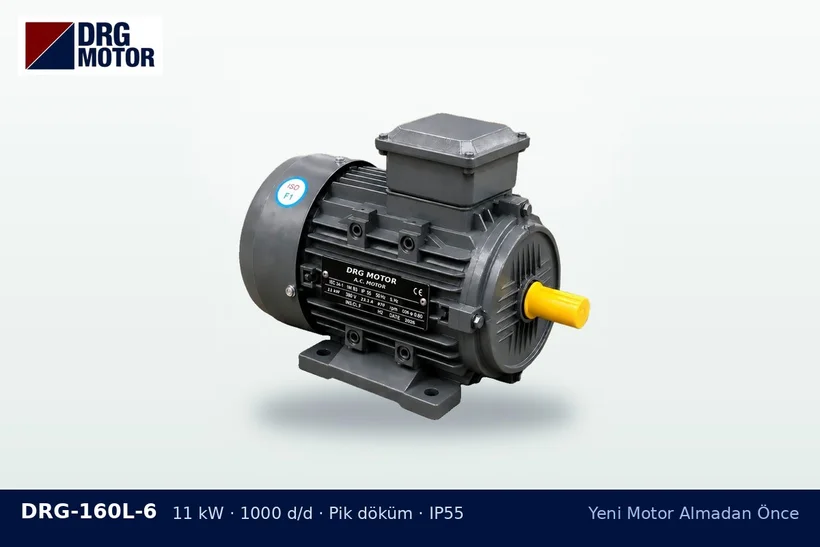
At constant power, the torque available at the shaft rises as speed falls. The approximate calculation is: torque (Nm) ≈ power (kW) × 9550 / speed (rpm). An 11 kW motor in the 1500 rpm class gives about 72 Nm, and one in the 1000 rpm class about 108 Nm. When speed is reduced by a belt, torque increases in the same ratio; the shaft, key and bearings on the machine side must withstand this torque.
Which combination is preferable?
- As the transmission ratio grows, the small pulley gets very small and belt life shortens.
- For a given output, six-pole motors tend to need a bigger frame; check that it fits the layout.
- Very low speeds require a gearbox; DRG does not sell gearboxes, and the motor is chosen to suit the gearbox's input flange and shaft size.
- If speed adjustment is wanted, a frequency inverter is considered; inverters are not part of the DRG range.
For geared solutions, the output speed and torque calculator provides a preliminary check. Based on the speed you have settled on, you can compare the 2, 4 and 6-pole models in the shop.