 English
 Le français
 Türkçe

In a belt drive, machine speed is found with this relationship: nmachine = nmotor × Dmotor pulley / Dmachine pulley. When choosing motor speed, first define the speed the machine needs, then work out the pulley diameters that give this speed with the chosen motor; motor and pulley are decided together.
A worked example
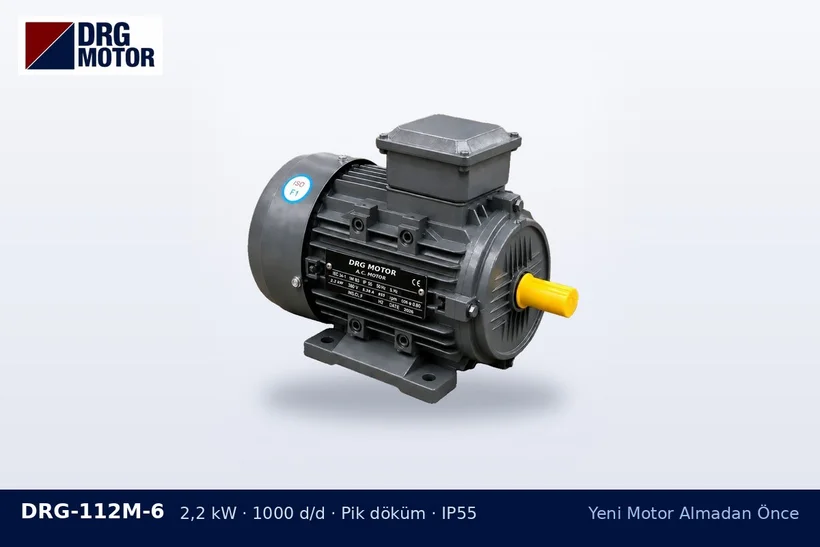
Say a mixer shaft must turn at about 480 rpm and the machine pulley is 300 mm. With a 6-pole motor rated at about 960 rpm, the motor pulley required is 300 × 480 / 960 = 150 mm. If the same job is done with a 4-pole motor rated at about 1440 rpm, the pulley shrinks to 100 mm. Both solutions give the same machine speed; the difference lies in pulley size and the belt's angle of wrap.
Which should you choose?
- The small pulley should not go below the minimum diameter allowed by the belt profile; otherwise the belt fatigues quickly.
- As the ratio grows, the wrap angle on the small pulley decreases and the risk of slip increases.
- A higher-speed motor can be smaller and lighter for the same power; a lower-speed motor works with a smaller ratio.
- Belt speed rises with motor speed; check the limits given by the belt and pulley manufacturer.
Keeping the ratio when changing the motor
If you are going to run an existing machine with a motor of a different pole count, leaving the old pulley as it is will change the machine speed. A motor moving from the 1500 class to the 3000 class drives the machine roughly twice as fast with the same pulley; on fans and pumps this raises the power demand far more steeply. With a change of this kind, do not run the machine until the pulley has been recalculated.
You can verify the diameter and speed calculation with the pulley and belt calculator, read more in the article on motor selection for belt drives, and review models with the right speed in the shop listing.