 English
 Le français
 Türkçe

The environment should not be described in an order with vague terms such as “normal” or “harsh conditions”; instead, list the temperature range, altitude, humidity and contact with water, the type of dust, chemical effects, vibration and the air space around the motor one by one. This shows clearly whether a standard motor is adequate.
Description template
- Temperature: The extreme summer and winter values; is there a furnace, boiler or sun-exposed sheet-metal roof near the motor?
- Altitude: In metres, if the site is well above sea level.
- Water and humidity: Is there washdown, does condensation occur, is the motor cleaned with a hose?
- Dust: Its type, such as flour, sawdust, cement or metal dust, and how much builds up.
- Chemicals: Ammonia, chlorine, acid vapour or salt-laden air.
- Vibration: Is it mounted on a vibrating structure such as a screen or crusher?
- Air space: Is the motor inside a closed cabinet, is the area behind the fan cover open?
How far does a standard motor go?
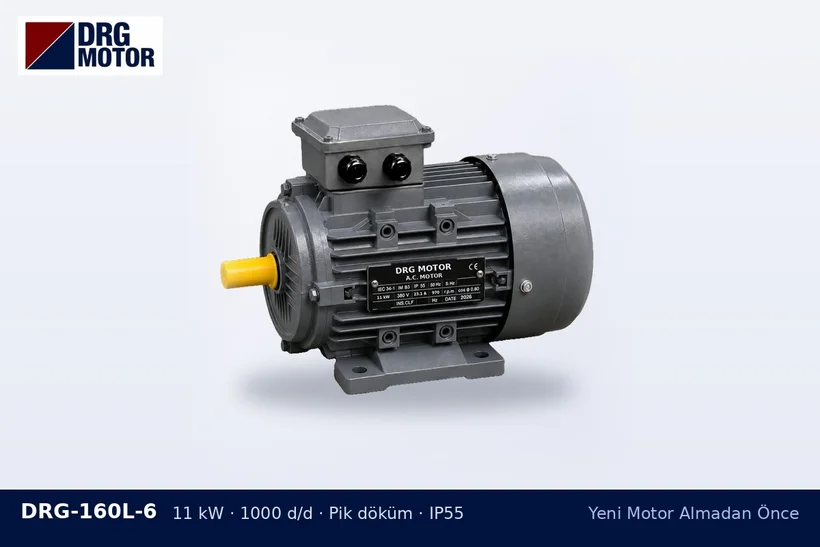
DRG motors are built to IP55, with class F insulation and self-ventilation (IC411). IP55 means protection against harmful amounts of dust and against water jets from any direction; it does not make the motor suitable for immersion or pressure washing. Self-ventilated cooling relies on air circulating freely behind the fan cover; in a closed, hot cabinet this condition is weakened.
Situations outside the standard range
Explosive gas or dust atmospheres call for a specially certified motor; such motors are not in the standard DRG range. Corrosive environments and constant contact with water also affect the warranty terms, so they should not be left out of the description.
Once the environment is clear, you can assess the general-purpose industrial motor options and the three-phase models in the shop within this framework.