 English
 Le français
 Türkçe

When looking for a motor for a second-hand machine, start with the machine itself rather than a motor catalogue: answer three questions first — does the machine turn freely by hand, is a suitable supply available at your site, and is the fitted motor the original one? A motor bought before these points are clear may not fix the real source of the problem.
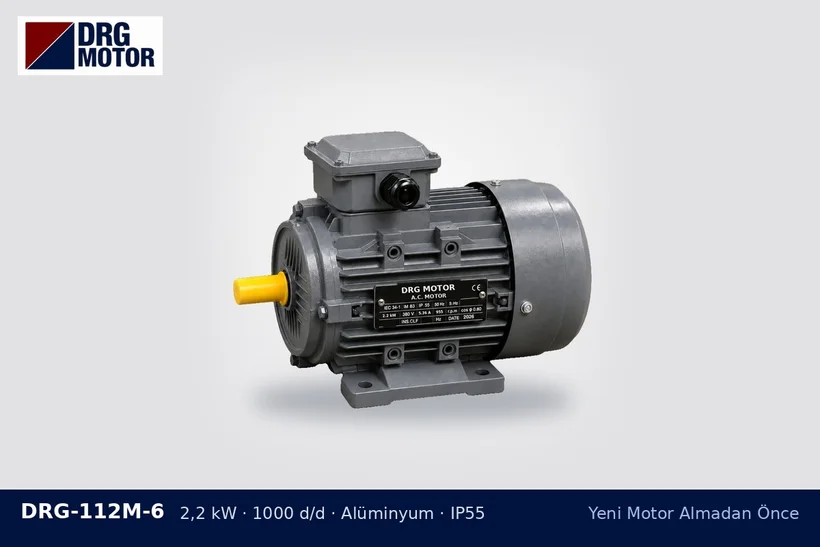
Check the machine before blaming the motor
On a machine the seller describes as having a “burnt-out motor”, the real fault may be a seized bearing, a broken gear or a jammed pump impeller. With the power off, turn the driven side by hand; if it turns heavily or unevenly, mechanical repair comes first. Otherwise the new motor will struggle under the same load.
Is the fitted motor the original?
Previous users may have fitted whatever motor was to hand after a breakdown. The following signs point to this:
- Newly drilled holes next to the old ones on the base
- Sheet packing or blocks added under the motor at a later date
- A bush or adaptor piece in the pulley hub
- A colour and brand clearly different from the machine's other motors
In such a situation, work from the values given by the machine manufacturer rather than those of the motor currently fitted.
Is the supply at your site suitable?
The DRG range consists solely of three-phase motors. If you will use the machine somewhere with only a single-phase supply, assess this from the outset; single-phase motors are not part of the standard DRG range. Machines brought in from abroad may also present you with 60 Hz or a different voltage.
Once the machine's requirement is clear, you can explore the three-phase induction motor family and compare models in the shop listing with the right frame and speed.