 English
 Le français
 Türkçe

A spare motor must match the existing motor in power, speed, supply voltage and frequency, type of mounting, shaft diameter and length, and foot or flange fixing dimensions. If these agree, the spare can be placed on the base without extra work when a breakdown happens; brand, colour or frame material come second.
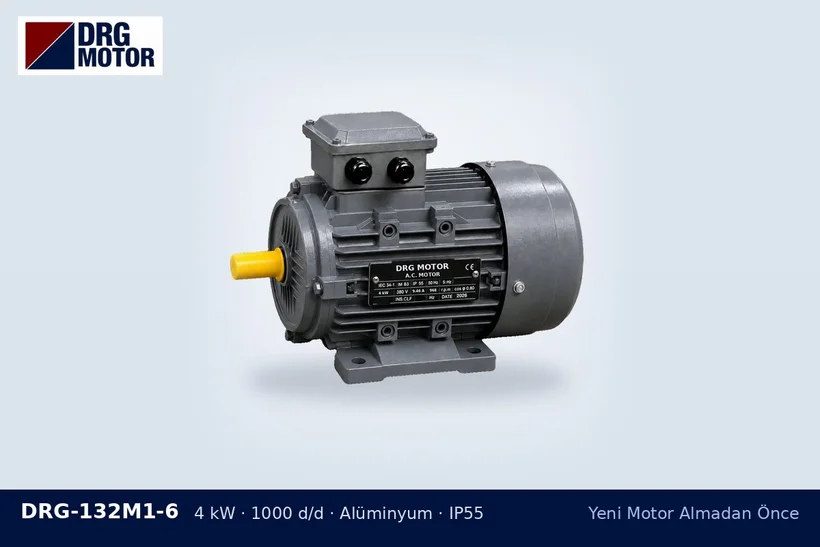
What must match
| Feature | What happens if it differs? |
|---|---|
| Power (kW) | If lower, the motor is overloaded; if higher, the frame may be larger |
| Speed (number of poles) | The machine speed changes and product quality suffers |
| Voltage and frequency | It may not work with the existing control panel |
| Mounting arrangement and flange | The motor cannot be attached to the machine |
| Shaft diameter, length, key | The pulley or coupling will not seat |
| Shaft height and foot holes | Alignment is lost and the base has to change |
Where some flexibility is acceptable
The position of the terminal box, the frame material and the external appearance may differ, but each has a practical effect. If a cast iron spare is chosen in place of an aluminium-frame motor, the weight increases and lifting arrangements may be needed. If the terminal box ends up on the opposite side, the existing cable may be too short.
Extra notes for a motor kept on the shelf
A spare motor usually sits unused for months. It is advisable to store it in its original packaging somewhere dry and free from vibration and to have it checked by qualified personnel before commissioning. Plants using the same frame on several machines can cover several positions with a single spare type; drawing up a dimension list of the motors helps with this.
Using your current motor's values, you can compare models side by side or, for example, review the dimensions of the 132M-frame 7.5 kW, four-pole aluminium model and assess the spare motor options in the shop.