 English
 Le français
 Türkçe

If the machine uses an IEC-dimensioned motor, finding a replacement is generally possible. Frequency, voltage, the unit of power and the shaft measurement system should be checked first; on machines built for America or some Asian markets, these four points can hold surprises.
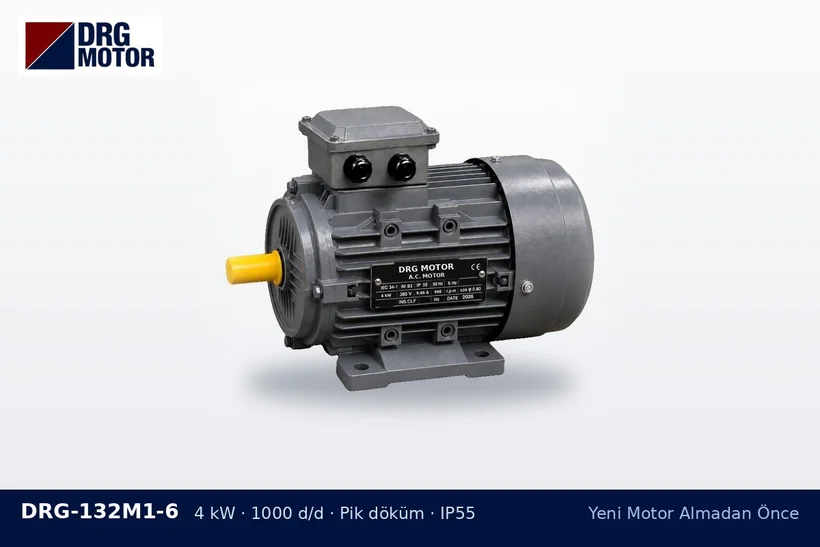
If you see a 60 Hz nameplate
Induction motor speed follows the supply frequency. Built for 60 Hz, a four-pole machine reaches 1800 rpm synchronous; connected to 50 Hz mains it drops into the 1500 rpm class. What matters, therefore, is the speed at which the machine actually runs on your supply. If the machine has so far worked without trouble on a 50 Hz grid, a 50 Hz motor with the same number of poles keeps the current speed. If the machine was set up for the 60 Hz speed, the difference can be offset with the pulley ratio; on pumps and fans, a change in speed directly affects flow and power.
HP, voltage and measurement system
- Power: One horsepower (HP) is roughly 0.746 kW. A motor marked 10 HP corresponds to approximately the 7.5 kW class.
- Voltage: Values such as 460 V, 380 V or 220 V may be shown; compare them with the voltage at your site.
- Measurement system: Motors to the NEMA standard have inch shafts and foot dimensions that differ from IEC frames. In this case the pulley hub or the base may need adapting.
The missing piece when choosing a replacement
The data most often missing is the flange type. Certain machines hold their motor by means of a flange unique to that maker; a standard motor can then be considered among the alternatives only after the dimension drawings have been compared.
If you plan to compensate for the speed difference with pulleys, you can use the pulley and belt calculator and browse IEC-dimensioned three-phase motors in the shop by frame and shaft size.