English
 Le français
 Türkçe




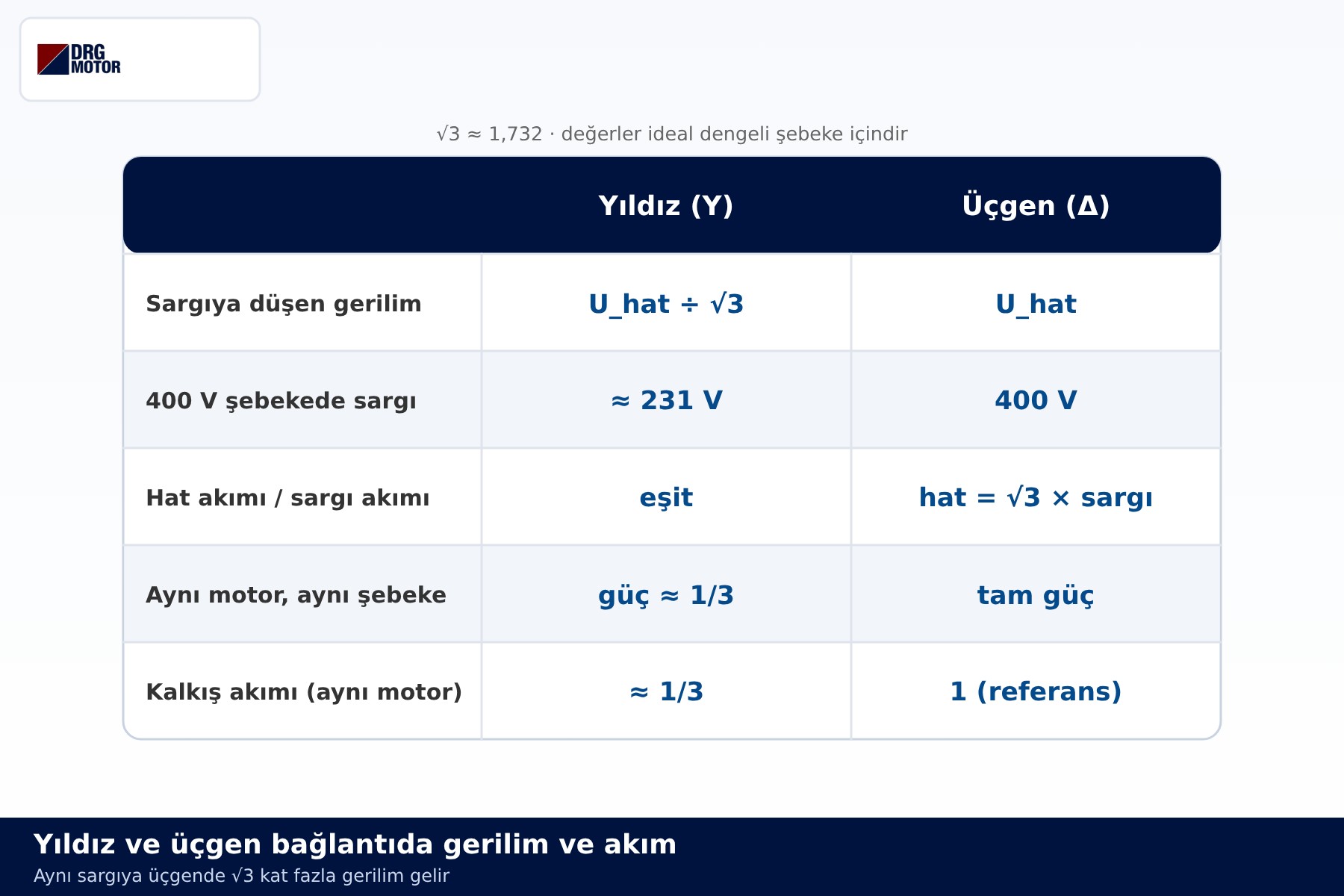

A star-delta connection describes two ways of connecting the three windings of a three-phase motor to the supply: in star, one end of each winding is joined at a common point; in delta, the windings are linked end to end to form a closed loop. The key difference is the voltage across each winding — in star it is the line voltage divided by √3, in delta it is the full line voltage. That is why the same motor on the same supply draws roughly one third of the current at start when connected in star.
This article covers the concept: what a winding is, why line and phase voltages differ, where √3 comes from, how power and current relate, and which motors suit star-delta starting. For a step-by-step reading of the full diagram, see the electric motor star-delta connection diagram guide; the circuits themselves are explained in star-delta power circuit and star-delta control circuit.
Three Windings, Six Terminals: The Basis of the Connection
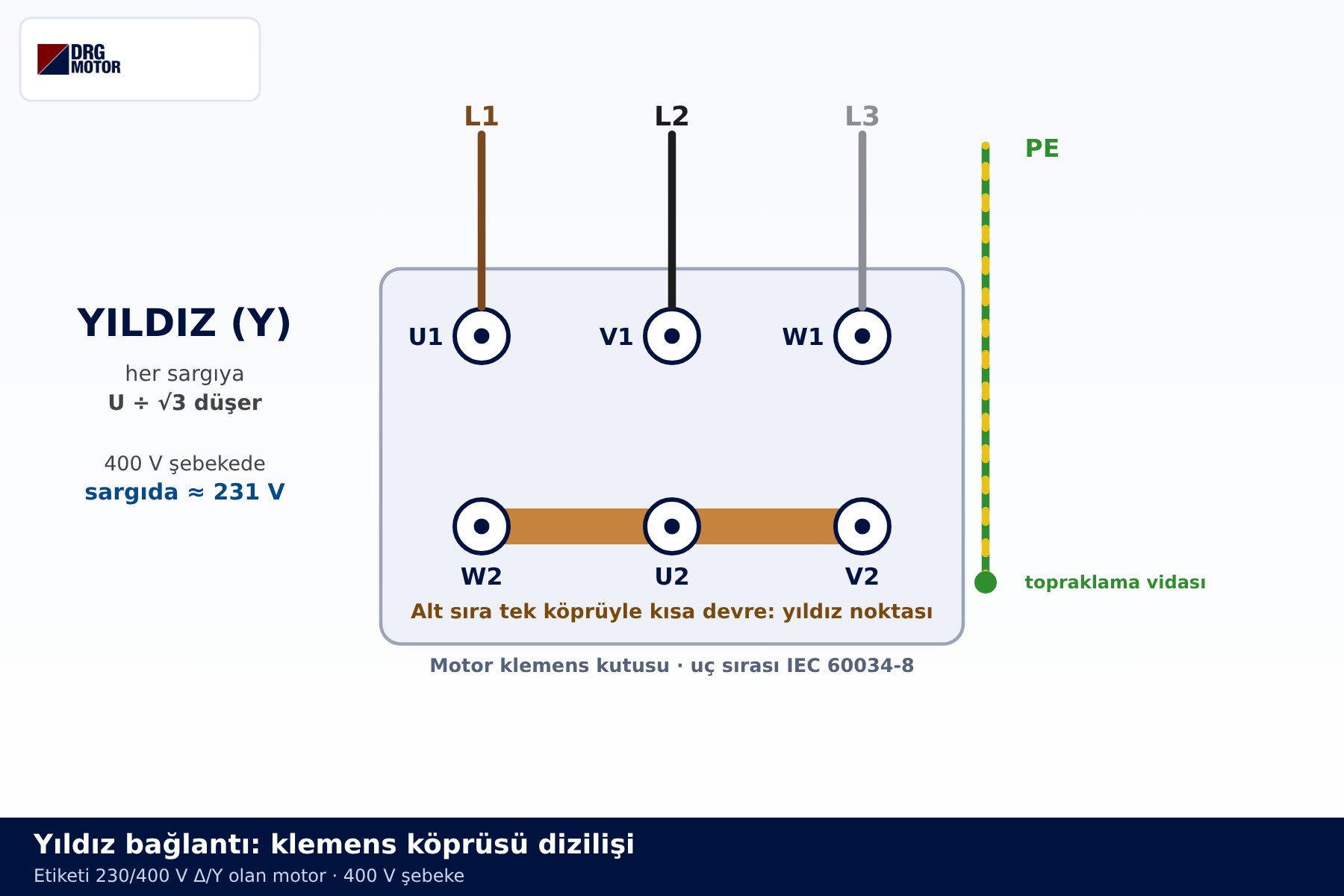
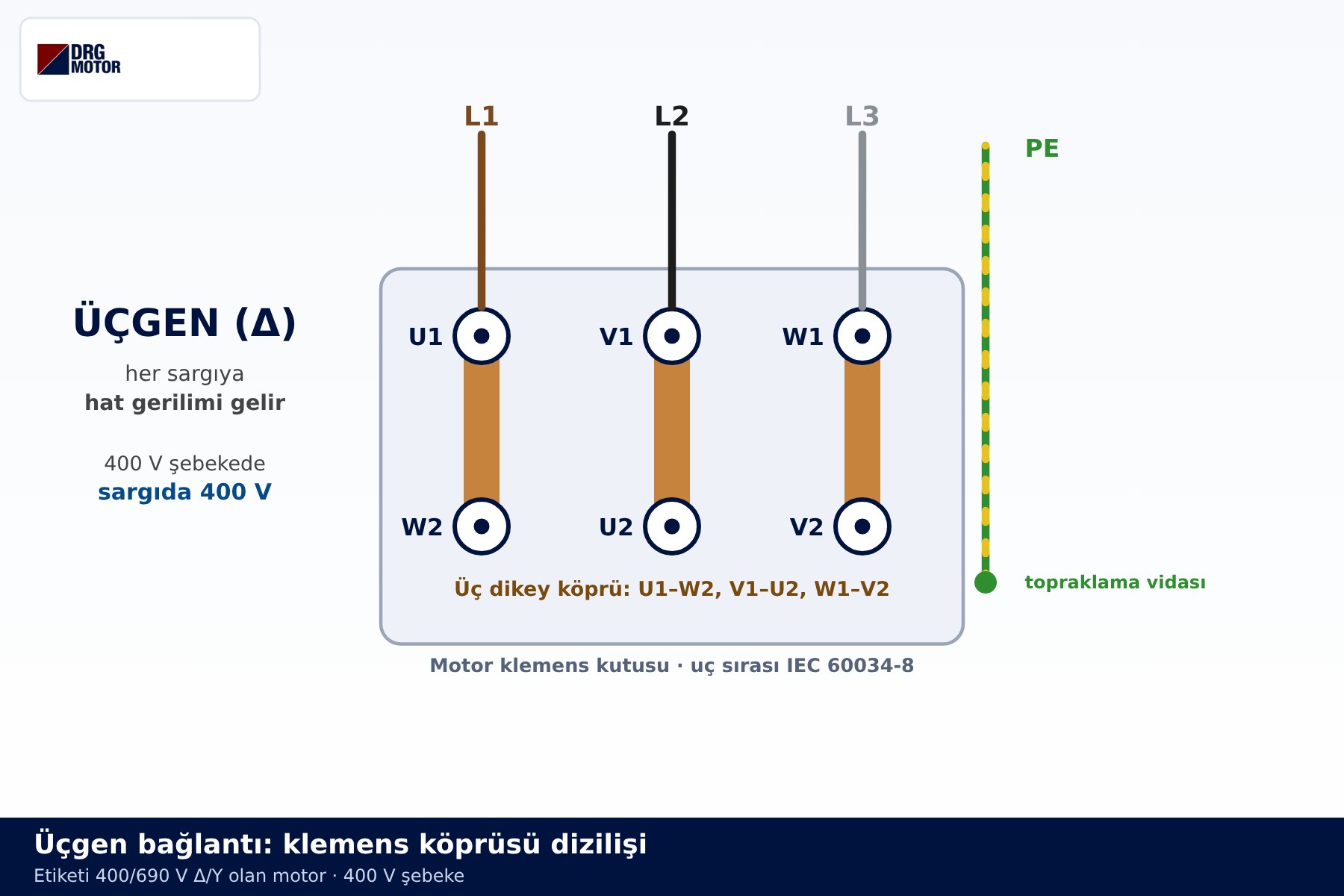
The stator of a three-phase induction motor carries three winding groups displaced by 120 degrees. They are named U, V and W, and each has a start (U1, V1, W1) and a finish (U2, V2, W2). All six ends are brought out to the terminal box: U1 V1 W1 on the upper row, W2 U2 V2 on the lower row.
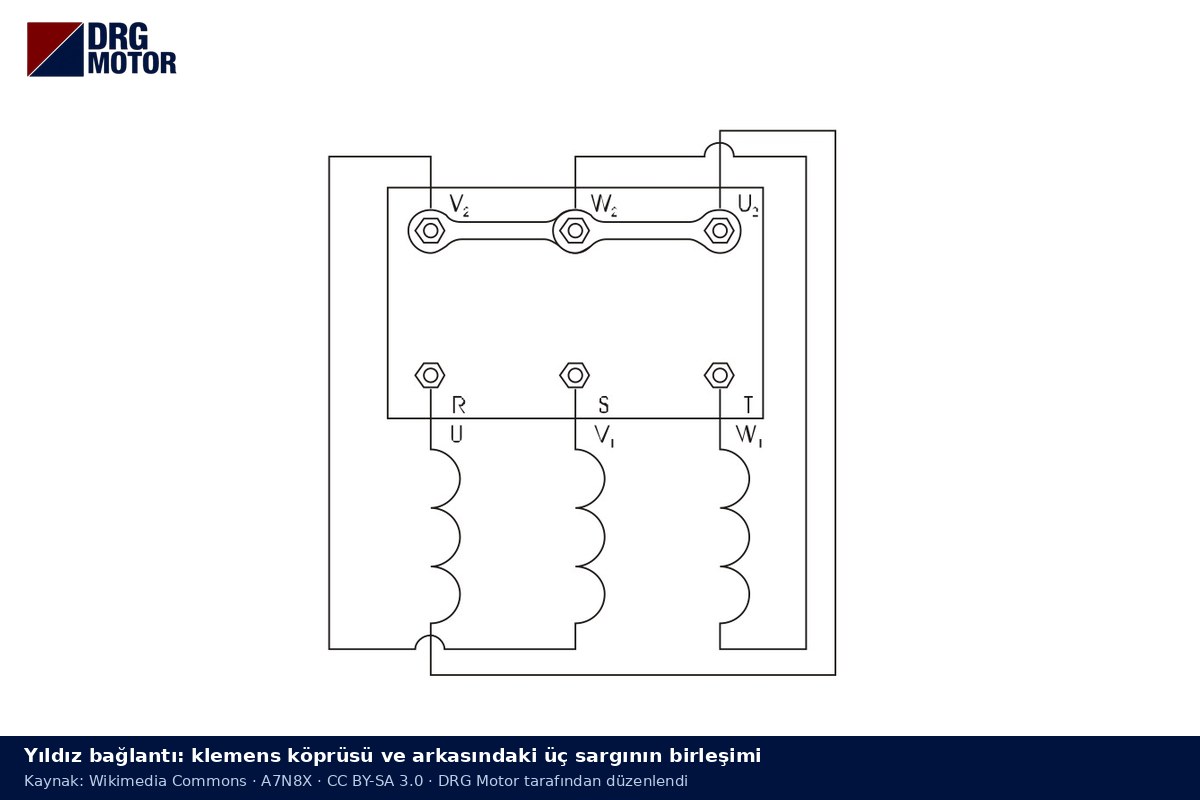
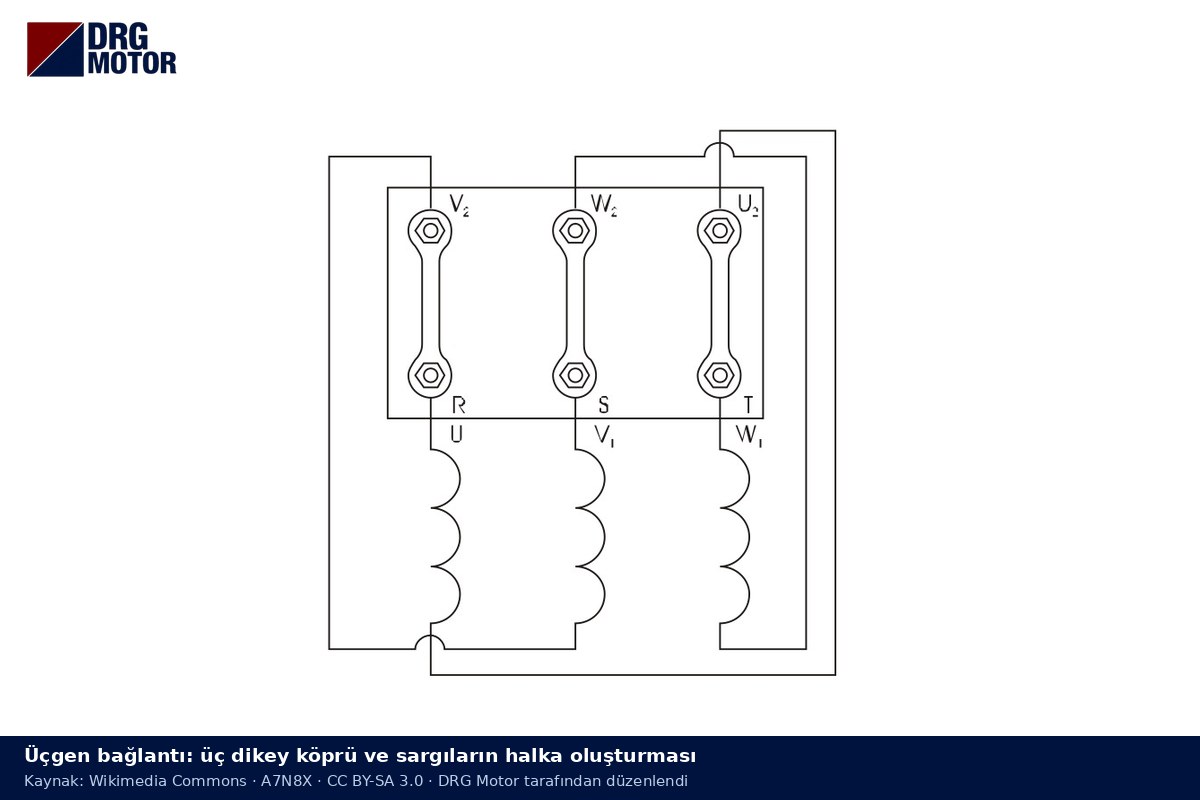
The shifted order of the lower row is deliberate. It lets the three delta links sit vertically, while for star the three lower terminals are joined with a single horizontal link. The motor itself never changes — only the way its six ends are connected to each other and to the supply.
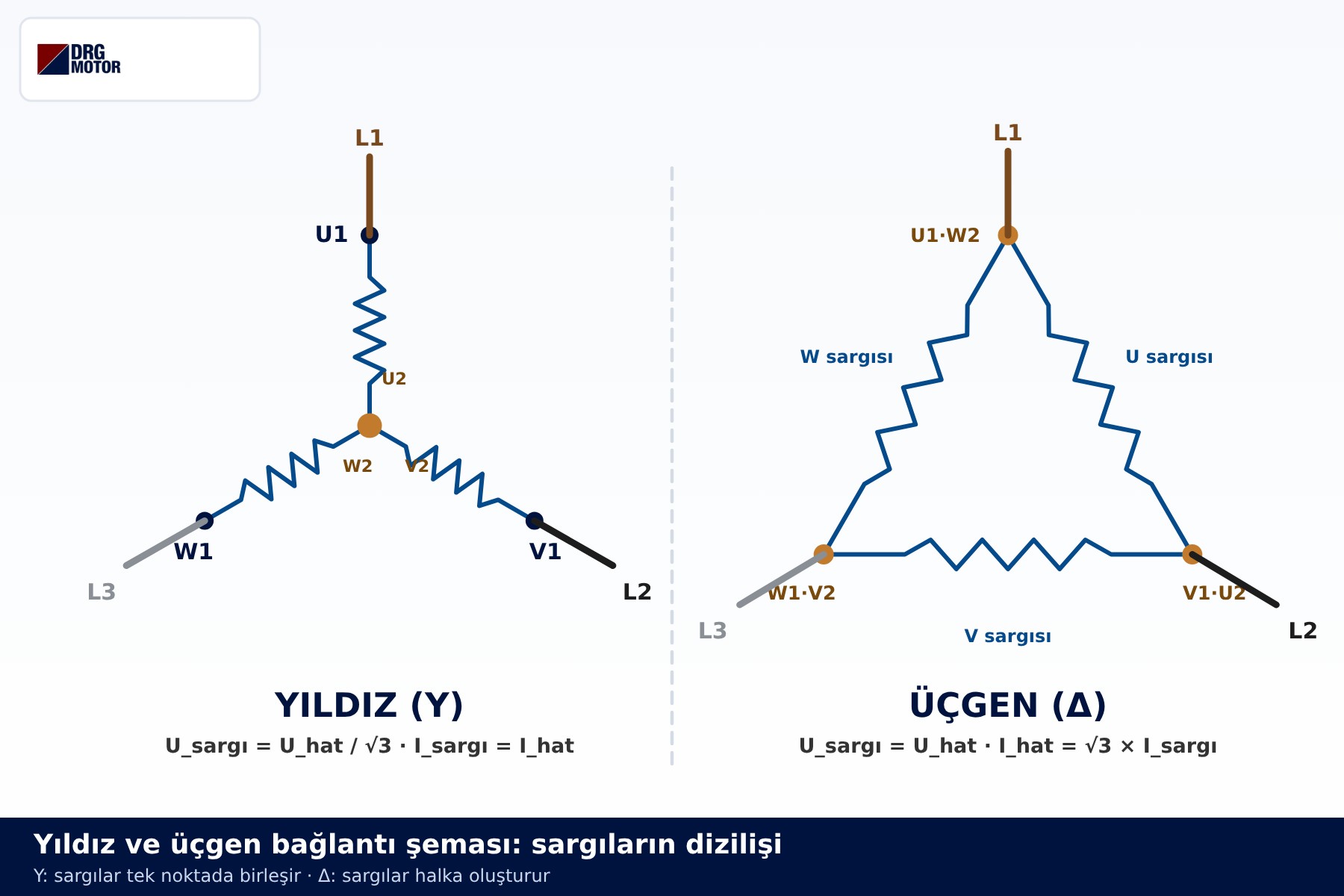
On the left, the three windings meet at the star point; on the right, each corner of the delta joins two windings. The practical side of terminal links is covered separately in motor terminal star-delta connection and 3-phase motor wiring diagram and terminal links.
The drawings below show how the windings join behind the terminal links: first star, then delta.
Line Voltage, Phase Voltage and the √3 Factor
A three-phase supply has two kinds of voltage. Line voltage is measured between two phase conductors — 400 V on a typical European low-voltage network. Phase voltage is measured between one phase and the star point (neutral), about 231 V.
The ratio between them is √3 ≈ 1.732. Because the phases are displaced by 120 degrees in time, the difference between two phase voltages is √3 times the size of a single phase voltage. Hence 400 / 1.732 ≈ 231 V.
For the motor winding this means:
- In star, each winding sits between one phase conductor and the star point, so it sees Uline / √3. The line current flows straight through the winding, so line current equals winding current.
- In delta, each winding is connected between two phase conductors and sees the full line voltage. Each line conductor feeds a corner where two windings meet, so line current is √3 times winding current. If 10 A flows in each winding, about 17.3 A flows in the line.
Power and Current: What the Same Motor Does in Each Connection
Three-phase power is calculated the same way for both connections: P = √3 × Uline × Iline × cos φ. That formula alone does not tell you whether star or delta is "stronger". What matters is whether the winding receives the voltage it was designed for. A motor delivers its rated power when it is connected as its nameplate specifies for that supply voltage.
So what happens if the same motor on the same supply is connected once in star and once in delta? In star, the winding voltage drops by √3, so the winding current also drops by roughly √3. On top of that, line current equals winding current in star, whereas in delta it is √3 times larger. Multiply the two effects and line current falls to about one third. Torque varies with the square of the voltage, so starting torque also falls to about one third.
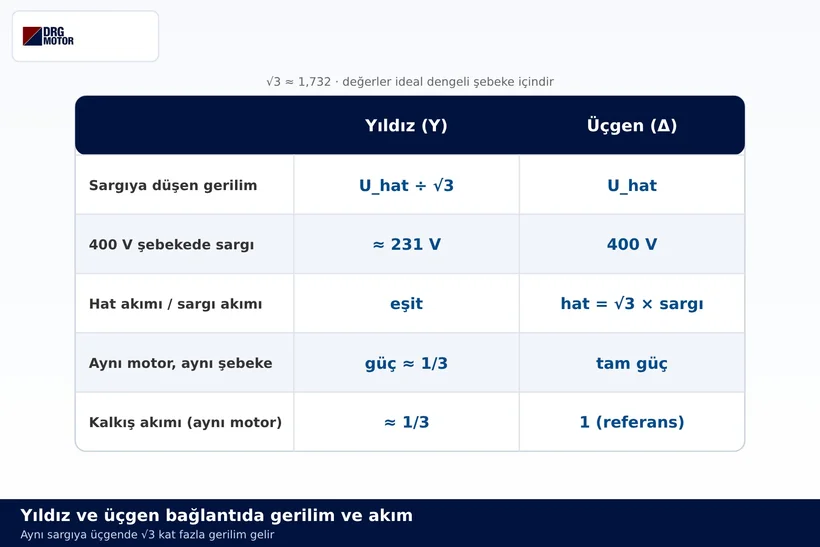
| Quantity | Star (Y) | Delta (Δ) |
|---|---|---|
| Winding arrangement | One end of each winding joined at a common point | Windings joined end to end in a closed loop |
| Voltage across each winding | Uline / √3 | Uline |
| Winding voltage on a 400 V supply | ≈ 231 V | 400 V |
| Line current vs winding current | Equal | Line = √3 × winding |
| Starting current, same motor | ≈ 1/3 | 1 (reference) |
| Starting torque, same motor | ≈ 1/3 | 1 (reference) |
Values assume an ideal, balanced supply. A real motor deviates slightly, but the ratios describe the concept correctly.
Click to see current electric motor prices and order nowSEE PRICES →
What Does the Nameplate Tell You?
A three-phase nameplate usually shows two voltages and two connection symbols: 230/400 V Δ/Y or 400/690 V Δ/Y. The rule: the lower voltage belongs to delta, the higher one to star. The lower voltage is also the voltage a single winding is built for.
- A 230/400 V Δ/Y motor has 230 V windings. On a 400 V supply it is connected in star, so each winding receives ≈ 231 V.
- A 400/690 V Δ/Y motor has 400 V windings. On a 400 V supply it runs in delta; star is the running connection only on a 690 V supply.
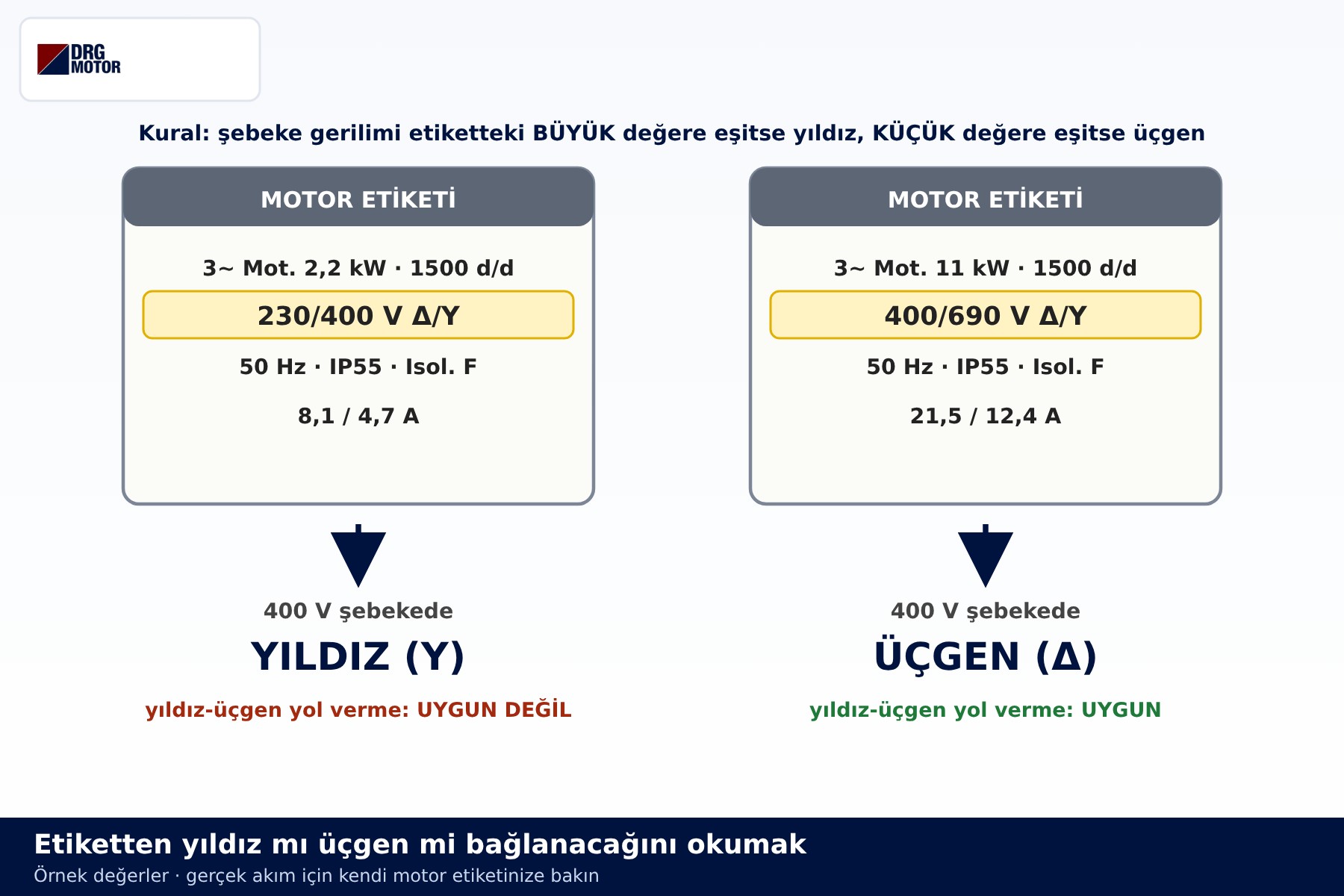
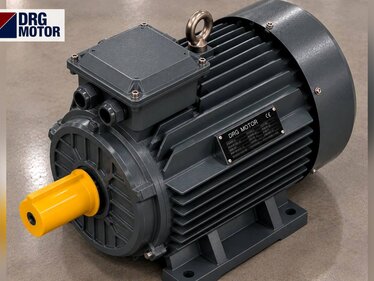
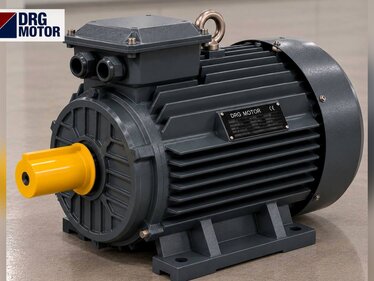
DRG Motor is an electric motor manufacturer, supplier and seller. In the three-phase asynchronous electric motors family, models up to 3 kW are wound 230/400 V Δ/Y and models from 4 kW upwards are wound 400/690 V Δ/Y. The reasoning behind this split is explained in which kW motor uses star or delta connection.
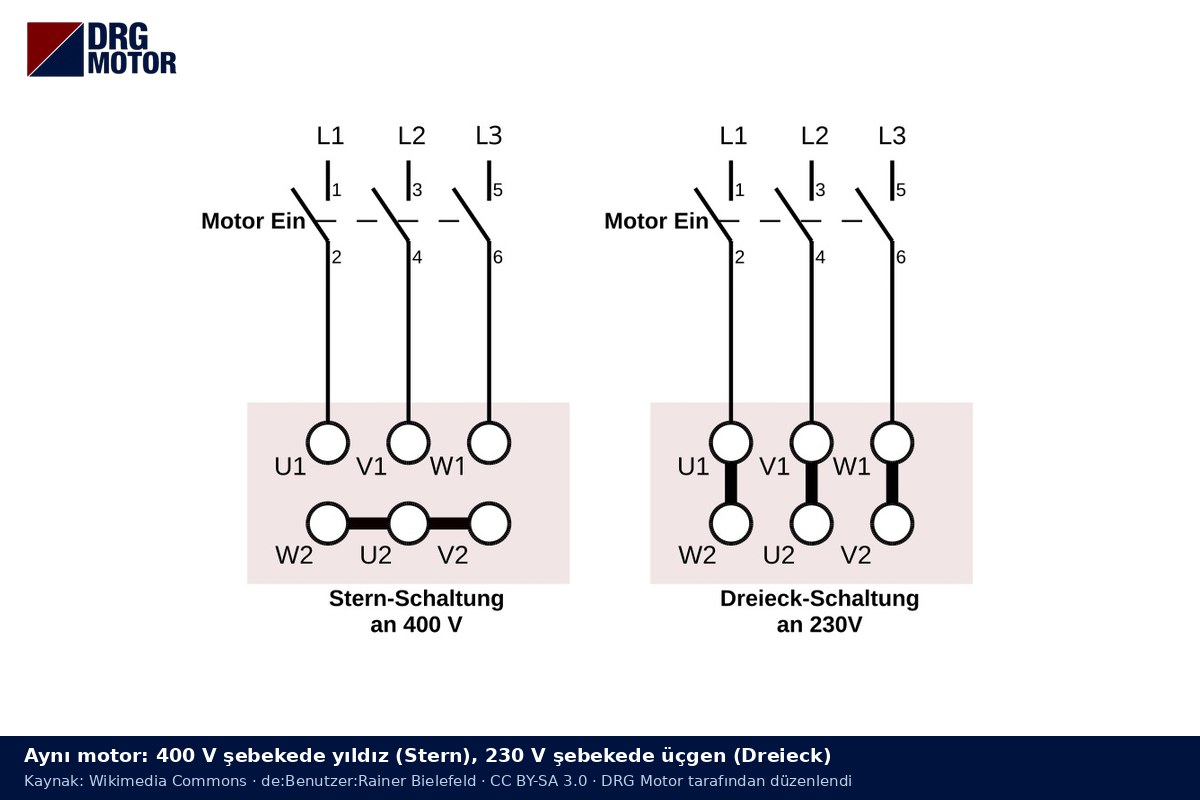
In the terminal box the two cases look like this: in star, W2-U2-V2 on the lower row are joined by one link; in delta, three vertical links join U1–W2, V1–U2 and W1–V2, and the supply goes to the corners L1→U1·W2, L2→V1·U2, L3→W1·V2.
Below, the same 230/400 V motor on two supplies: star on 400 V (Stern-Schaltung), delta on 230 V (Dreieck-Schaltung).
Why Use a Star-Delta Starter?
When an induction motor is switched directly onto the supply, it draws several times its rated current for the first moments. That surge can cause voltage dips, disturb other equipment on the same feeder and trip protection unnecessarily. A star-delta starter exists to reduce that peak.
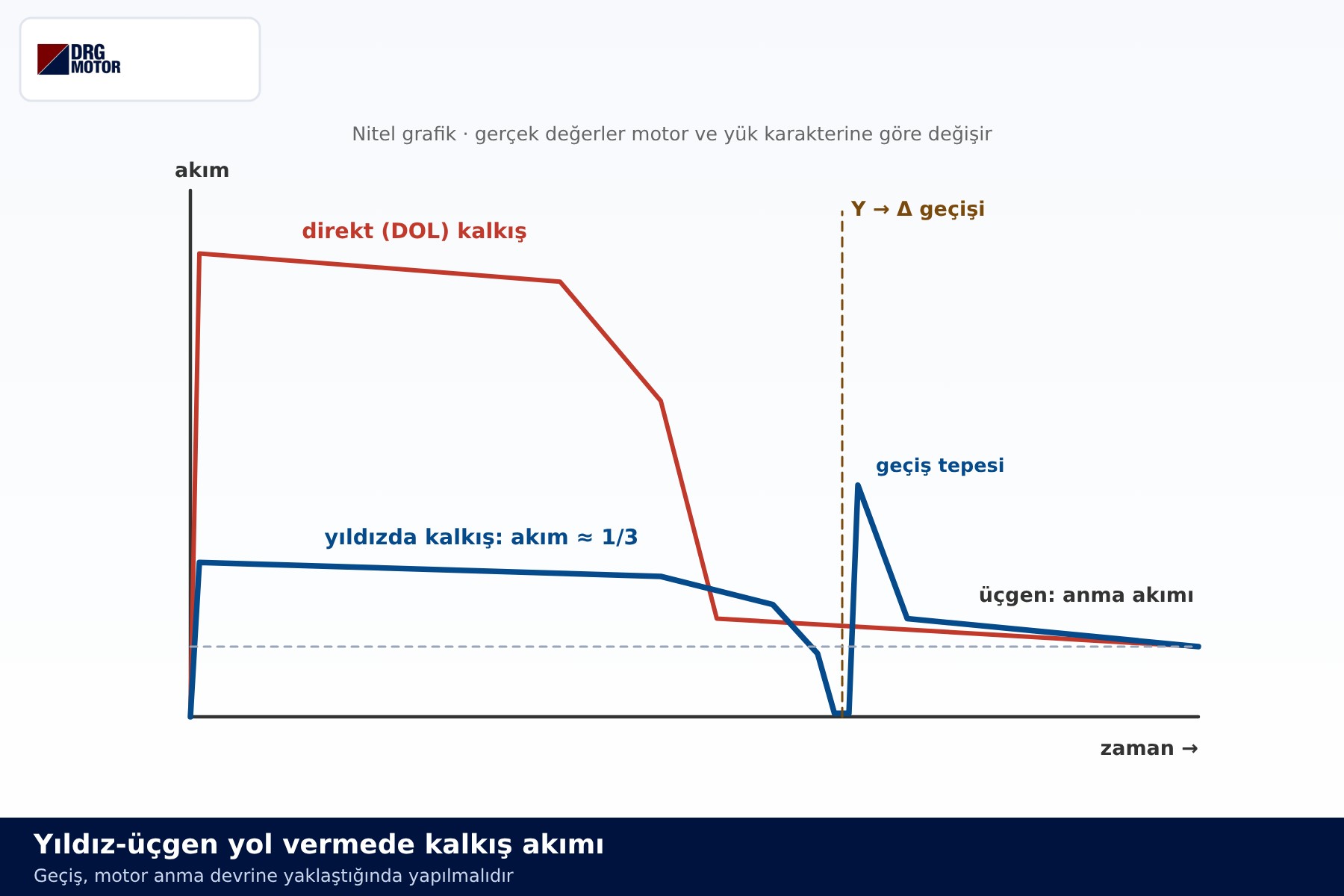
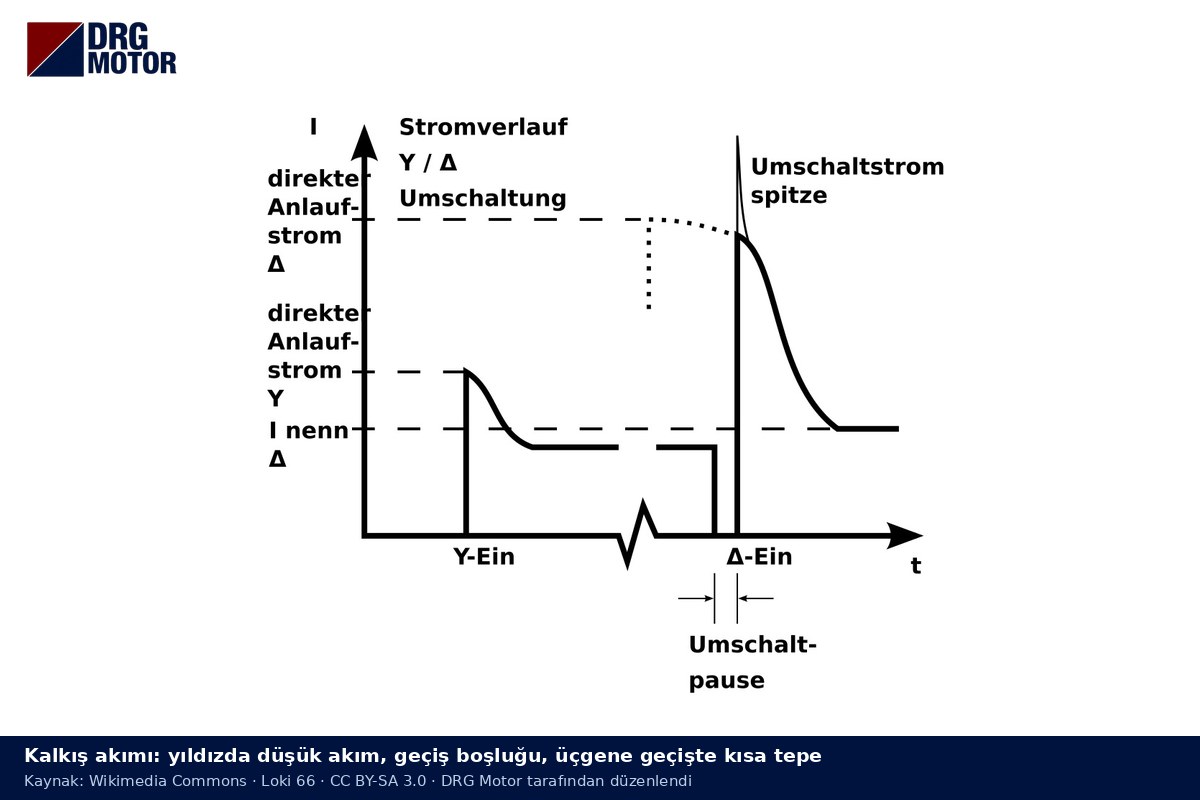
The idea: a motor that normally runs in delta is started in star. During this stage the windings see reduced voltage, and both supply current and torque are about one third. Once the motor is close to full speed, the connection changes to delta and the motor carries on at full voltage. A second, smaller current peak appears at the changeover.
The one-third torque also sets the limit of the method. It works well on machines that start lightly loaded — fans, centrifugal pumps, compressors starting unloaded — but a loaded conveyor or any high-breakaway load may not accelerate enough in star. To compare options, read star-delta vs soft starter.
Which motors are suitable for star-delta starting?
One condition: the motor's running connection at the supply voltage must be delta. On a 400 V network that means a 400/690 V Δ/Y motor, so DRG models from 4 kW upwards are suitable for star-delta starting. A 230/400 V Δ/Y motor already runs in star on 400 V; switching it to delta would put 400 V across a 230 V winding. DRG models up to 3 kW are therefore not suitable for star-delta starting.
The starter consists of main, star and delta contactors, a timer and an overload relay; their roles are explained in the power and control circuit articles, with a worked example in 22 kW motor star-delta starting. DRG does not sell contactors, overload relays or timers — source them from a switchgear supplier. The diagrams explain the concept; actual installation depends on the motor nameplate, the manufacturer's documentation and the judgement of qualified electrical personnel.
This curve shows why current stays low when starting in star and why a short peak appears at the change to delta (Y-Ein = star, Δ-Ein = delta).
Short Glossary
- Winding: A coil group in the stator; a three-phase motor has three, named U, V and W.
- Line voltage: Voltage between two phase conductors (400 V on a 400 V supply).
- Phase voltage: Voltage between one phase and the star point (≈ 231 V).
- Star point: The common junction of the three windings in star.
- Link: A metal strap in the terminal box that joins two terminals.
- Δ/Y: Nameplate symbol listing the delta voltage first, then the star voltage.
- Starting method: How the motor is brought from standstill to running speed.
- Contactor, overload relay, timer: Panel devices for switching, overcurrent protection and timing the star-to-delta changeover.
To see all diagrams in one file, open the star-delta wiring diagram PDF guide or go straight to the PDF file.
DRG Motors Suitable for Star-Delta Starting
The models below are wound 400/690 V Δ/Y; they run in delta on a 400 V supply and are therefore suitable for star-delta starting. All share IP55 protection, class F insulation and IC411 cooling. Every power and speed option is listed on the buy electric motors online page.
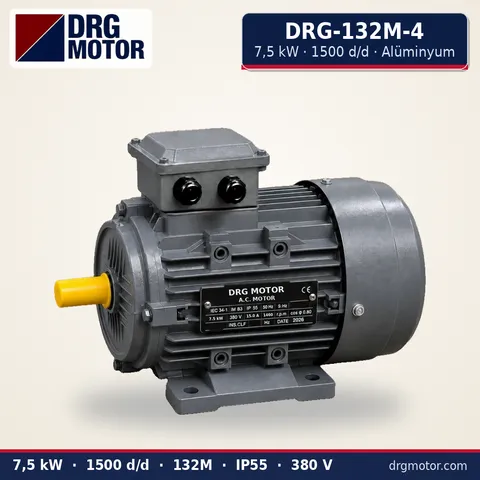
7.5 kW Three-Phase Motor 1500 rpm – DRG-132M-4 Aluminium
- 7.5 kW · 1500 rpm (4 poles)
- Aluminium frame · IEC 132M
- Mounting: B3 · B5 · B14 · B35
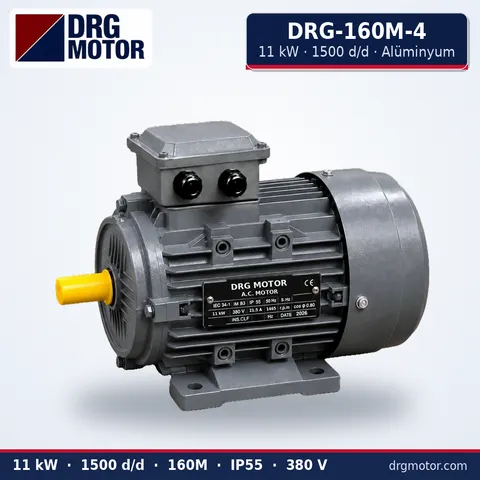
11 kW Three-Phase Motor 1500 rpm – DRG-160M-4 Aluminium
- 11 kW · 1500 rpm (4 poles)
- Aluminium frame · IEC 160M
- Mounting: B3 · B5 · B14 · B35
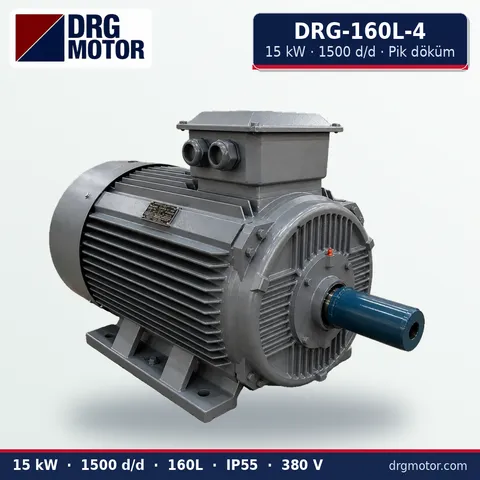
15 kW Three-Phase Motor 1500 rpm – DRG-160L-4 Cast Iron
- 15 kW · 1500 rpm (4 poles)
- Cast iron frame · IEC 160L
- Mounting: B3 · B5 · B14 · B35
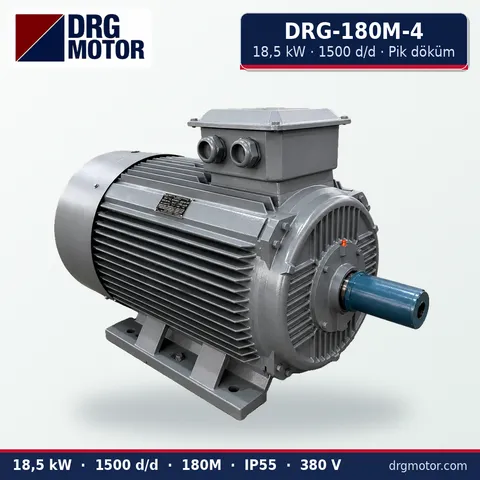
18.5 kW Three-Phase Motor 1500 rpm – DRG-180M-4 Cast Iron
- 18.5 kW · 1500 rpm (4 poles)
- Cast iron frame · IEC 180M
- Mounting: B3 · B5 · B14 · B35
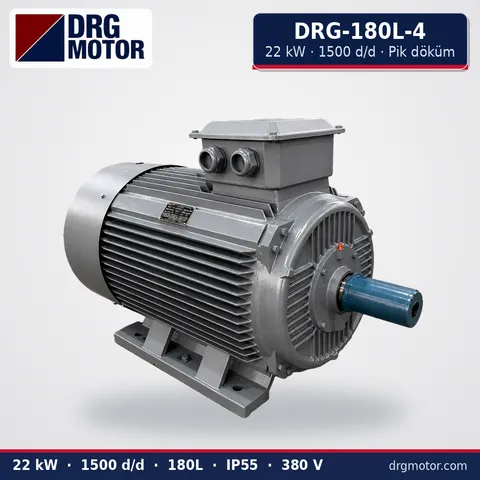
22 kW Three-Phase Motor 1500 rpm – DRG-180L-4 Cast Iron
- 22 kW · 1500 rpm (4 poles)
- Cast iron frame · IEC 180L
- Mounting: B3 · B5 · B14 · B35
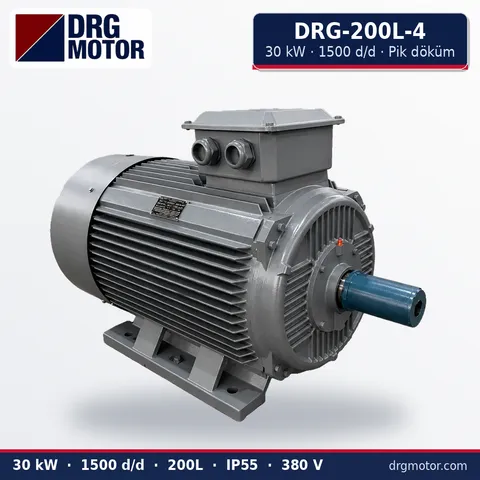
30 kW Three-Phase Motor 1500 rpm – DRG-200L-4 Cast Iron
- 30 kW · 1500 rpm (4 poles)
- Cast iron frame · IEC 200L
- Mounting: B3 · B5 · B14 · B35
Click to see current prices for these motors and order nowSEE PRICES →
Frequently Asked Questions
What is the difference between star and delta connection?
In star, one end of each winding meets at a common point and each winding sees the line voltage divided by √3. In delta, the windings form a loop and each sees the full line voltage. Line current equals winding current in star and is √3 times larger in delta.
Can a 230/400 V motor be started star-delta?
Not on a 400 V supply. Its running connection on 400 V is already star; switching to delta would apply 400 V to a 230 V winding and overstress it.
What happens if a 400/690 V motor is left in star on 400 V?
It turns, but each winding sees only ≈ 231 V and torque drops to about one third. Under load the speed falls, current rises and the motor overheats. For this motor on 400 V, star is only the starting stage.
Why does √3 appear in star-delta calculations?
The three phases are displaced by 120 degrees, so the voltage between two phases is √3 ≈ 1.732 times a single phase voltage. The same factor links line current and winding current in delta.