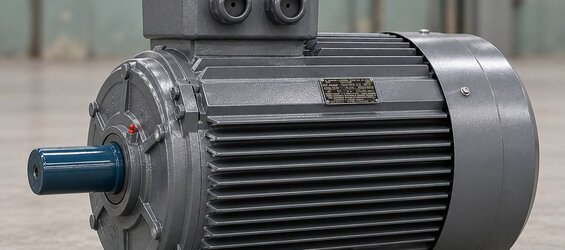
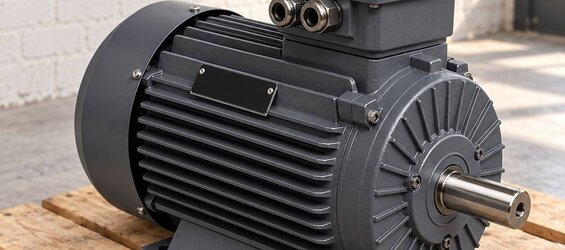
Speed Measurement and Tachometers in Electric Motors
Knowing how fast an electric motor turns is the foundation of production quality and system safety in most applications. The motor's number of revolutions per minute (rpm) is one o... More Details
Knowing the basics is essential to choosing the right motor. In this category you will find guide content on the electric motor working principle, motor types, efficiency classes and selection criteria. Get to know the world of motors with the technical knowledge of the DRG Motor expert team.
For the right motor, power (kW), speed (rpm), efficiency class, body material and mounting type should be considered together. Our high efficiency motors page guides you on efficiency and the power and speed options page on power/speed.
What is the difference between asynchronous and synchronous motors? In an asynchronous motor the rotor turns slightly slower than the magnetic field; in a synchronous motor it turns at the same speed.
Why is motor efficiency important? High efficiency does the same work with less electricity, lowering operating costs.
DRG Motor supports businesses on both the product and knowledge side. By reviewing this guide content you can choose the right motor more consciously, and contact us via drgmotor.com for technical questions.
Motor efficiency is classified as IE1 (Standard), IE2 (High), IE3 (Premium), IE4 (Super Premium) and IE5 (Ultra Premium). The higher the class, the lower the energy loss and the greater the savings. Which class suits you is determined by your running hours and power needs; review our guide content for details.
Which mounting type is needed? Foot (B3) mounting is used in most applications, while flange (B5) or combined (B35) mounting is preferred where direct coupling is required.

Knowing how fast an electric motor turns is the foundation of production quality and system safety in most applications. The motor's number of revolutions per minute (rpm) is one o... More Details

Thanks to frequency inverters, it is possible not only to slow an electric motor down but also to speed it up by going above its rated speed. However, making a motor turn faster is... More Details

The majority of failures that take an electric motor out of service start not in the windings or the control board, but in its mechanical heart: the bearings. A bearing is the part... More Details

The power and efficiency values printed on an electric motor's nameplate do not, on their own, tell you how the motor will behave in the real world. A motor heats up while running ... More Details

A three-phase induction motor works exactly as designed when all three phases are supplied with voltages of equal magnitude and a precise 120-degree phase angle between them. This ... More Details

Belt-and-pulley drive is one of the most common ways to transfer a motor's power to a load. From a ventilator to a stone-crushing line, from a machining tool to a conveyor, many sy... More Details

One of the most critical components determining the life and reliability of an electric motor is the bearing system. This element carries the shaft, makes rotation possible and tra... More Details

Choosing the right electric motor is not enough on its own; the cable that feeds that motor must also be chosen correctly. A wrongly chosen supply cable becomes the weak link of th... More Details

How quickly a motor can bring a load to the desired speed depends on a critical quantity that is often overlooked yet determines both the starting behavior and the life of the moto... More Details

How much load an induction motor can carry, how long it will last and under which conditions it can operate safely are all tightly bound to a single physical phenomenon: the temper... More Details

When evaluating the noise of an electric motor, there are two concepts frequently encountered in catalogs and on nameplates: sound power and sound pressure. These two quantities, w... More Details

The most critical mechanical component that determines the lifespan of an AC induction motor is the bearing, and the vast majority of these bearings are lubricated with grease. Gre... More Details

When the weight of a rotor turning thousands of times per minute is not evenly distributed at every point, a silent war begins inside even though the motor appears to run flawlessl... More Details

An electric motor is designed to run at the single voltage and frequency value written on its nameplate; however, in the real world the supply conditions never stay exactly fixed a... More Details

The moment an electric motor is first energized is one of the most demanding moments it experiences throughout its working life. A stationary asynchronous motor draws a current far... More Details

Connecting an electric motor to the supply correctly is the first condition for safe and efficient operation. In three-phase asynchronous motors, this connection is made in the ter... More Details

One of the most fundamental decisions when selecting a motor to drive a machine is this: should the motor be connected directly, or should a gearbox be placed in between? This choi... More Details

Whether an electric motor is mounted horizontally or vertically may at first look like nothing more than a layout preference. In reality, this choice directly affects many mechanic... More Details

When you run an electric motor for years, you come to know its behavior intuitively: which sound is normal, what temperature to expect, how it responds under a given load. The conc... More Details

When an electric motor fails or its efficiency drops, the first question that usually comes to mind is "should I buy a new one?" Yet a motor's life does not end with its first faul... More Details