English
 Le français
 Türkçe




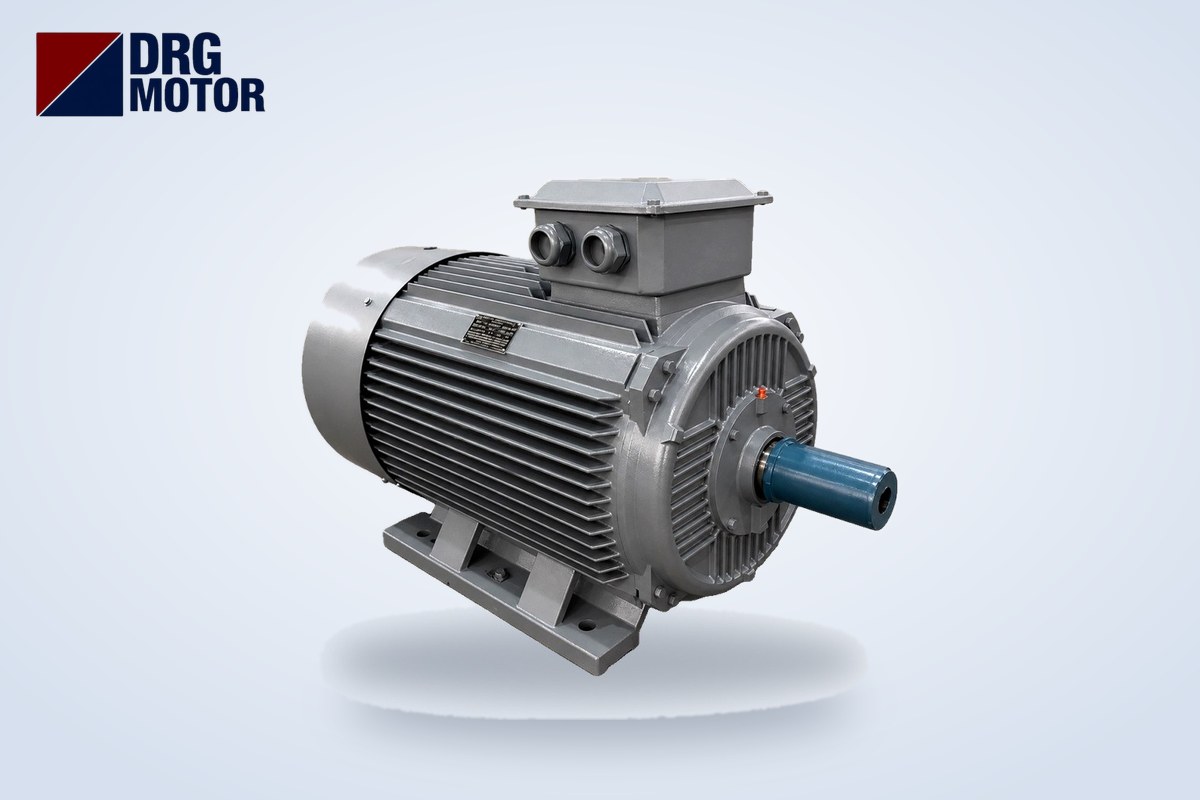

When you start a 22 kW, 1500 rpm (4-pole) three-phase motor with star-delta, the calculation begins with the nameplate current: the DRG-180L-4 draws 41.8 A at full load on 380 V. The line and delta contactors each carry 1/√3 of that current, about 24.1 A; the star contactor is only closed during starting and is sized on In/3 ≈ 13.9 A. If the overload relay is connected after the line contactor, in the winding circuit, it is set to about 24.1 A, not 41.8 A. In the star stage the starting current drawn from the supply falls from about 326 A with direct-on-line starting to around 108.7 A.
These ratios only apply to a motor that runs in delta on a 380–400 V supply, that is, a motor with 400/690 V (Δ/Y) on its nameplate. The overload setting, contactor currents and timer logic below are calculated from the catalogue values of three 22 kW models with 2, 4 and 6 poles. To compare the nameplate data with your own motor or to choose a 22 kW model directly, see the products on the Buy Electric Motors Online page. Panel work must be carried out by a qualified electrician; the values below are worked examples.
How Many Amps Does a 22 kW Motor Draw in Star-Delta?
For all three pole numbers, the 22 kW motors have 400/690 V windings and cast iron frames. In the table, In is the nameplate current (380 V) and Is is the direct-on-line starting current (Is = In × Is/In). In the star stage the line current is Is/3.
| Model | Rated speed | In (380 V) | In/√3 (line and delta contactor) | In/3 (star contactor) | Is/In | DOL starting Is | Star starting Is/3 | |
|---|---|---|---|---|---|---|---|---|
| DRG-180M-2 | 2955 rpm | 40.5 A | 23.4 A | 13.5 A | 8.2 | 332.1 A | 110.7 A | See Prices |
| DRG-180L-4 | 1470 rpm | 41.8 A | 24.1 A | 13.9 A | 7.8 | 326.0 A | 108.7 A | See Prices |
| DRG-200L2-6 | 980 rpm | 44.8 A | 25.9 A | 14.9 A | 7.4 | 331.5 A | 110.5 A | See Prices |
On a 400 V supply the nameplate current of the same motor is lower: 39.7 A for the DRG-180L-4, giving about 22.9 A for the line/delta contactors and about 13.2 A for the star contactor. Size the panel for the actual supply voltage of the site; the 380 V value is always slightly higher, i.e. on the safe side.
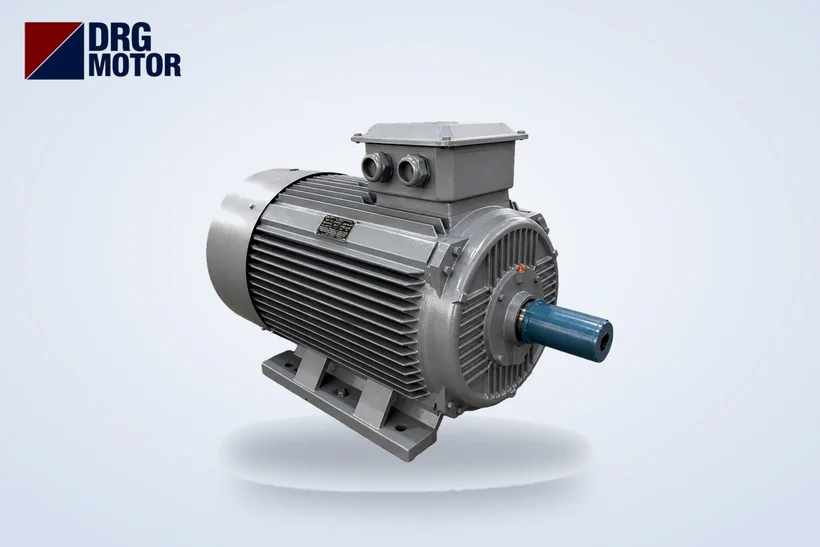
Is the Motor Nameplate Suitable for Star-Delta? The 400/690 V Requirement
Star-delta starting requires the motor to run in delta during normal operation. If the nameplate reads 400/690 V Δ/Y, the winding withstands 400 V in delta; when it is switched to star for starting, each winding receives a voltage lower by a factor of 1/√3. In the DRG store, models of 4 kW and above have 400/690 V windings; all three 22 kW versions belong to this group and are connected in delta on 380 V.
A motor rated 230/400 V already runs in star on a 380 V supply; if star-delta is applied to it and it is switched to delta, the windings see roughly √3 times too much voltage and burn out quickly. Which nameplate works with which connection is explained in detail in Which kW Motor Is Connected in Star or Delta. Check three things:
- Nameplate voltage: 400/690 V (Δ/Y).
- Six terminals in the terminal box (U1 V1 W1 / W2 U2 V2) and removable links. On 22 kW frames the cable entries are 2 × M40×1.5 (frame 180) or 2 × M50×1.5 (frame 200L); the two cable sets enter through separate glands.
- The links must be removed: the contactors make the star and delta connections, and if links are left on the terminal board a short circuit occurs when a contactor closes.
Contactor Selection: Which Current Do the Line, Delta and Star Contactors Carry?
A star-delta circuit has three power contactors. The line (main) contactor K1 connects the supply to terminals U1-V1-W1; the delta contactor K2 connects the supply to terminals W2-U2-V2 and closes the delta; the star contactor K3 shorts W2-U2-V2 together to form the star point. In delta operation the line current is shared between K1 and K2; each carries the winding (phase) current, i.e. In/√3. K3 is only closed during starting, and because the star current is one third of the delta current it is sized on In/3.
| Contactor | Function | Current carried | DRG-180L-4, 380 V | DRG-180L-4, 400 V |
|---|---|---|---|---|
| K1 line | Supply → U1 V1 W1 | In/√3 ≈ 0.58 × In | 24.1 A | 22.9 A |
| K2 delta | Supply → W2 U2 V2 | In/√3 ≈ 0.58 × In | 24.1 A | 22.9 A |
| K3 star | Shorts W2 U2 V2 | In/3 ≈ 0.33 × In | 13.9 A | 13.2 A |
These currents are compared with the contactor's AC-3 rating. AC-3 is the utilisation category for starting squirrel-cage motors and switching them off while running: the AC-3 rated operational current (Ie) in the contactor catalogue, at the operating voltage (400 V), must not be lower than the calculated current. The AC-1 (resistive load) rating is printed higher and is not used for motors. Instead of the size immediately above the calculated value, leave a margin for frequent starts, a warm panel and the current surge at changeover; K1 and K2 are chosen in the same size. Make the final selection from the contactor manufacturer's star-delta coordination table. General contactor selection criteria (coil voltage, auxiliary contacts, service life) are covered in How to Select a Contactor in a Motor Panel; here we focus only on how current is shared in a 22 kW star-delta circuit.
What Current Should the Overload Relay Be Set To?
The overload relay setting depends on where it is connected in the circuit:
- At the output of K1 (on the winding current going to U1-V1-W1): set to In/√3. For the DRG-180L-4, about 24.1 A at 380 V and about 22.9 A at 400 V. This is the most common arrangement; the relay protects the winding in both the star and the delta stage.
- Ahead of K1, on the supply line: set to In, i.e. 41.8 A (39.7 A at 400 V). In this case the overload relay needs a higher current range.
The most frequent mistake on site is connecting the relay in the winding circuit and setting it to the nameplate 41.8 A. With this setting the relay trips late even if the motor is overloaded by about √3 times, and the winding is left unprotected. The opposite, setting a line-connected relay to 24.1 A, causes nuisance tripping when the motor reaches full load. For the principle and the setting method, see What Does a Thermal Overload Relay Do?
Short-circuit protection (fuse or circuit breaker) sits in the common supply of K1 and K2, is sized on the line current and must carry the Is/3 starting current. For a worked sizing example use the Motor Overload, Fuse and Contactor Selection tool; the tool is for direct-on-line starting, so for star-delta correct the contactor and overload values with the 0.58 and 0.33 factors above.
Power and Control Diagram: Connection Sequence
In the power circuit two separate three-core cable sets run to the motor, and each set carries the winding current (In/√3); the PE conductor is connected separately. For the cross-section, enter the In/√3 value in the Motor Cable Size Calculator and have the result checked by an electrical engineer for the run length and installation conditions.
| Supply phase | K1 line contactor output | K2 delta contactor output | K3 star contactor |
|---|---|---|---|
| L1 | U1 | W2 | W2 – U2 – V2 linked together (star point) |
| L2 | V1 | U2 | Inputs from W2 U2 V2, outputs shorted together |
| L3 | W1 | V2 | Closed only during the starting stage |
With this arrangement, when K2 closes U1-W2, V1-U2 and W1-V2 are joined and the delta is complete. The control circuit sequence:
- When the start button is pressed, K3 (star) and the timer are energised, immediately followed by K1 (line); the motor starts turning in star.
- When the timer has elapsed it releases K3; once the normally closed auxiliary contact of K3 has closed, K2 (delta) picks up.
- K2 and K3 must have both electrical interlocking (mutual normally closed contacts) and, where possible, mechanical interlocking; if both close at the same time the supply is short-circuited.
- The stop button and the normally closed contact of the overload relay interrupt the entire control circuit.
- If the direction of rotation is wrong, swap two phases at the K1 input (or at the main supply); changing only one contactor upsets the phase sequence at the changeover to delta.
When Should the Timer Switch to Delta?
The correct star-delta timer setting is not a fixed number of seconds but a moment determined by the load: the changeover should take place when the motor, in star, approaches its rated speed and the current has dropped from the starting peak and settled. With an early changeover the motor is switched to delta while still at low speed, producing a current surge close to direct-on-line starting, which defeats the purpose of installing star-delta.
Torque also drops to one third in star. The starting torque of the DRG-180L-4 is 2.0 × 142.9 Nm ≈ 285.8 Nm; in star it falls to about 95.3 Nm, i.e. 0.67 times rated torque. For the 2-pole DRG-180M-2 the star starting torque is about 47.4 Nm (rated 71.1 Nm), and for the 6-pole DRG-200L2-6 about 142.9 Nm (rated 214.4 Nm). If the breakaway resistance of the load is close to this value, the motor cannot reach rated speed in star and the changeover will be a surge no matter how long the time is set. Find the setting on site as follows:
- Clamp an ammeter on one phase at the K1 output and watch for the moment when the current drops and stabilises in the star stage.
- Set the timer slightly after that moment; repeat the measurement with the machine loaded and cold.
- A short, small jump on the ammeter at changeover is normal; a large and long jump shows that the motor has not reached sufficient speed in star.
- If the motor does not accelerate at all in star, the load is not suitable for star-delta; consider a soft starter or a variable frequency drive.
For the DRG-180L-4 at 380 V the difference between direct-on-line and star-delta can be summarised as follows: direct-on-line starting draws about 326 A and √3 × 0.38 kV × 326.0 A ≈ 214.6 kVA, star draws about 108.7 A and 71.5 kVA, while the apparent power in normal running is about 27.5 kVA. To compare methods, use the Motor Starting Methods: Star-Delta tool.
22 kW Star-Delta Panel Commissioning Checklist
- Is the nameplate 400/690 V Δ/Y and the supply 380–400 V?
- Have the links in the terminal box been removed and are the six terminals connected to the correct cable set (U1 V1 W1 in one set, W2 U2 V2 in the other)?
- Is the AC-3 rating of K1 and K2 ≥ In/√3 (DRG-180L-4: 24.1 A) and of K3 ≥ In/3 (13.9 A), with margins?
- Has the overload relay position been decided? Is it set to In/√3 in the winding circuit, or In on the line?
- Is there electrical and mechanical K2–K3 interlocking; has the control circuit been tested without load using a meter?
- Is the phase sequence of the two cable sets the same? Was the direction of rotation checked with a short trial first?
- Was the timer set on the loaded machine according to the moment the current settles in star?
- Was the running current measured on all three phases, and is it below the nameplate current and balanced?
- Is the PE conductor connected to the motor earthing screw and to the panel?
Motors in This Power Range
- DRG-180M-2 – 22 kW – 3000 rpm – 180M cast iron frame
- DRG-180L-4 – 22 kW – 1500 rpm – 180L cast iron frame
- DRG-200L2-6 – 22 kW – 1000 rpm – 200L cast iron frame
- DRG-180M-4 – 18.5 kW – 1500 rpm – 180M cast iron frame
- DRG-200L-4 – 30 kW – 1500 rpm – 200L cast iron frame
Click to see current prices and order these motors nowSEE PRICES →
Frequently Asked Questions
How many amps does a 22 kW motor draw in star-delta?
The 4-pole DRG-180L-4 draws 41.8 A from the line at full load on 380 V; in delta operation this current is split between the line and delta contactors, each carrying about 24.1 A. During starting, the current drawn in the star stage is about 108.7 A.
What should the overload relay of a 22 kW motor be set to?
If the relay is at the output of the line contactor, in the winding circuit, it is set to In/√3: about 24.1 A at 380 V for the DRG-180L-4. If the relay is on the main line, ahead of the contactors, it is set to the nameplate current of 41.8 A.
What contactor size is needed for 22 kW star-delta?
By calculation, the AC-3 rating of the line and delta contactors must be at least 24.1 A and the star contactor at least 13.9 A (DRG-180L-4, 380 V). A margin is added for frequent starts and panel temperature; the exact size is taken from the contactor manufacturer's star-delta table.
Should a 22 kW motor be started direct-on-line or star-delta?
The motor is suitable for both methods. Direct-on-line starting draws about 326 A; if the supply is weak or site rules limit starting current, star-delta reduces it to about 108.7 A. If the load is heavier than the starting torque of about 95.3 Nm available in star, a soft starter or a variable frequency drive should be considered.
You can send us the nameplate of your 22 kW motor or your panel project: +90 (542) 666 11 11, [email protected], contact page. For all models and up-to-date information, browse the 120 models in our online store.