English
 Le français
 Türkçe




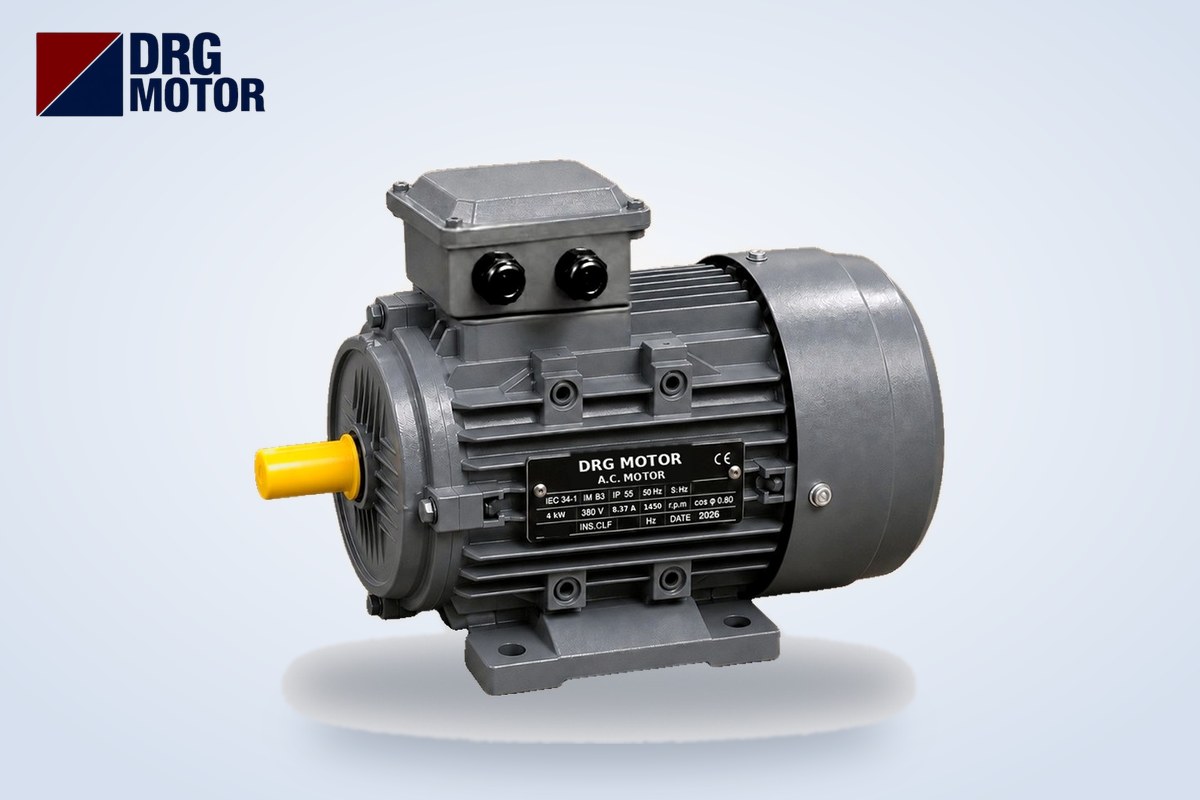

Whether a motor is connected in star or delta is decided by the voltage on its nameplate, not by its power. A motor rated 230/400 V is connected in star on a 380–400 V supply, while a motor rated 400/690 V is connected in delta on the same supply. In the 120 models of our Buy Electric Motors Online store, this split happens to follow power: the 43 models from 0.25 to 3 kW are 230/400 V and therefore star-connected, and the 77 models from 4 to 355 kW are 400/690 V and therefore delta-connected.
The rule of thumb heard on site, "star up to 3 kW, delta above", is therefore only a habit; the real limit is set by the winding. In star, each winding receives the line voltage divided by √3 (about 231 V on a 400 V supply, about 219 V on 380 V), while in delta the winding sees the full line voltage. A 230/400 V motor is wound for about 230 V, a 400/690 V motor for about 400 V. The connection is chosen so that the winding receives its own design voltage.
That is why you should read the nameplate first when replacing an old motor or commissioning one that came from another source. Two motors of the same power may be rated 230/400 V and 400/690 V respectively; connecting the new one in star "because the old one was in star" means running the winding at the wrong voltage.
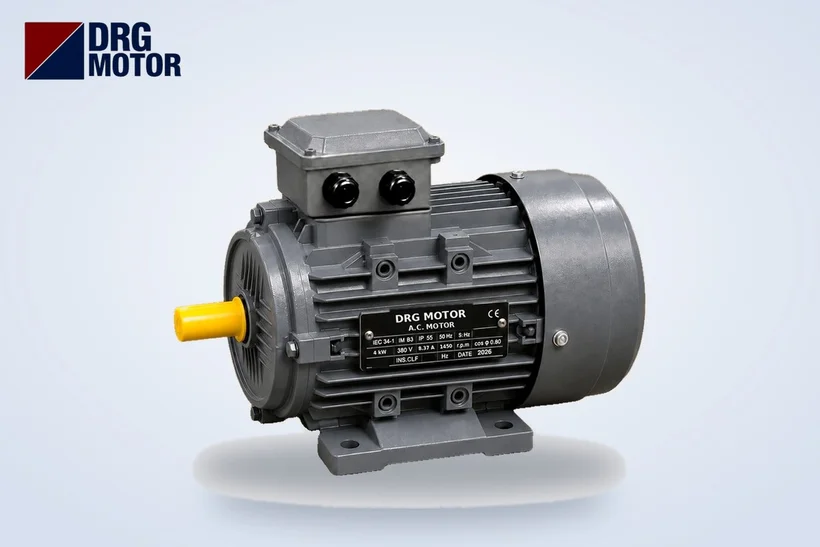
How to read "230/400 V Δ/Y" on the nameplate
The voltage pair and the connection symbols on the nameplate match in the same order: the lower voltage belongs to delta (Δ), the higher voltage to star (Y). "230/400 V Δ/Y" reads as: delta on a 230 V three-phase supply, star on a 400 V supply. "400/690 V Δ/Y" means delta on 400 V and star on 690 V. Since the industrial supply in Turkey is 380–400 V, the practical rule is simple: if the supply voltage matches the higher figure on the nameplate, connect in star; if it matches the lower figure, connect in delta.
| Rated voltage | Voltage the winding is designed for | 220–230 V three-phase supply | 380–400 V supply | 660–690 V supply | Star-delta starting on 380–400 V |
|---|---|---|---|---|---|
| 230/400 V (Δ/Y) | about 230 V | Delta (Δ) | Star (Y) | Do not connect | Not suitable |
| 400/690 V (Δ/Y) | about 400 V | Do not connect (voltage too low) | Delta (Δ) | Star (Y) | Suitable |
One warning to add to the table: whichever connection is used, a 400/690 V motor on a 220–230 V three-phase supply keeps its winding far below its design voltage and cannot carry the load. The right solution in that case is a motor rated for that supply.
Which power comes with which connection in the DRG store?
The table below shows the rated voltage of selected 1500 rpm models and their connection on a 380–400 V supply. The same rule applies to the 1000 and 3000 rpm models: 3 kW and below are 230/400 V (Y), 4 kW and above are 400/690 V (Δ). Current values are the 380 V rated current given on each product page.
| Power (kW) | Model (1500 rpm) | IEC frame | Rated voltage | On a 380–400 V supply | Current at 380 V (A) | Cable entry |
|---|---|---|---|---|---|---|
| 0.75 | DRG-802-4 | 80 | 230/400 V (Δ/Y) | Star (Y) | 1.84 | 1 × M20×1.5 |
| 1.5 | DRG-90L-4 | 90L | 230/400 V (Δ/Y) | Star (Y) | 3.47 | 1 × M25×1.5 |
| 2.2 | DRG-100L1-4 | 100L | 230/400 V (Δ/Y) | Star (Y) | 4.76 | 1 × M25×1.5 |
| 3 | DRG-100L2-4 | 100L | 230/400 V (Δ/Y) | Star (Y) | 6.34 | 1 × M25×1.5 |
| 4 | DRG-112M-4 | 112M | 400/690 V (Δ/Y) | Delta (Δ) | 8.37 | 2 × M32×1.5 |
| 5.5 | DRG-132S-4 | 132S | 400/690 V (Δ/Y) | Delta (Δ) | 11.2 | 2 × M32×1.5 |
| 7.5 | DRG-132M-4 | 132M | 400/690 V (Δ/Y) | Delta (Δ) | 15 | 2 × M32×1.5 |
| 11 | DRG-160M-4 | 160M | 400/690 V (Δ/Y) | Delta (Δ) | 21.5 | 2 × M40×1.5 |
| 22 | DRG-180L-4 | 180L | 400/690 V (Δ/Y) | Delta (Δ) | 41.8 | 2 × M40×1.5 |
| 45 | DRG-225M-4 | 225M | 400/690 V (Δ/Y) | Delta (Δ) | 84.4 | 2 × M50×1.5 |
| 90 | DRG-280M-4 | 280M | 400/690 V (Δ/Y) | Delta (Δ) | 163 | 2 × M63×1.5 |
| 200 | DRG-315L2-4 | 315L | 400/690 V (Δ/Y) | Delta (Δ) | 352 | 2 × M63×1.5 |
An interesting case: two different connections appear on the 132S frame. The 3 kW, 1000 rpm DRG-132S-6 is 230/400 V and connected in star, while the 5.5 kW, 1500 rpm DRG-132S-4 on the same 132S frame is 400/690 V and connected in delta. So frame size does not decide either; the nameplate does. The 3 kW compact DRG-90L-2K is also 230/400 V and is star-connected on a 380 V supply.
Why is star-delta starting only possible with a 400/690 V motor?
In star-delta starting, the motor starts in star, switches to delta once the speed has risen, and keeps running in delta. The motor must therefore be wound to run in delta on a 380–400 V supply. Only a 400/690 V motor meets this condition: its winding receives about 231 V at start and 400 V in operation.
If you connect a 230/400 V motor to a star-delta panel, the start looks normal, but the moment it switches to delta the winding sees about √3 times its design voltage. Current rises quickly and, unless the overload relay trips, the winding overheats and is damaged within a short time. For this reason, the 3 kW and smaller models in our store are started direct-on-line on a 380–400 V supply; if starting current is an issue, a soft starter or a drive is used. For star-delta, six leads must be available in the terminal box, the links removed and each lead taken separately to the contactors in the panel.
Starting current and torque: an 11 kW example
The 11 kW, 1500 rpm DRG-160M-4 has a 380 V rated current of 21.5 A and a starting current ratio (Is/In) of 7.7. With direct-on-line starting, the starting current is about 21.5 × 7.7 ≈ 166 A. In star, the line current at start drops to one third: about 55 A. The price is torque: with a rated torque of 71.7 Nm and a starting torque ratio (Ts/Tn) of 2.2, the starting torque of about 158 Nm in direct-on-line falls to about 53 Nm in star, which is below rated torque. Star-delta therefore works well on machines that start unloaded or lightly loaded; for machines that start under full load, the method must be assessed separately. For your own motor, you can use our star-delta starting calculator.
Terminal links: a short description of both layouts
A standard terminal box has U1, V1, W1 on the top row and, offset, W2, U2, V2 on the bottom row. In both connections the supply phases L1, L2, L3 go to U1, V1, W1 on the top row; only the links change:
- Star (Y): W2, U2 and V2 on the bottom row are joined with two horizontal links. This point is the star point.
- Delta (Δ): three vertical links are fitted: U1–W2, V1–U2, W1–V2. The start of each winding is thus connected to the end of the next.
For a step-by-step guide to fitting the links, see our article Motor Terminal Connection: Star and Delta Wiring; the purpose here is to decide which layout to choose.
Symptoms of a wrong connection
A 230/400 V motor connected in delta on 380–400 V
The winding receives too much voltage. The motor draws high current even at no load, hums harshly and heats up quickly; if the overload relay is set correctly it trips within a short time. If the relay is set too high, the winding may burn. This mistake usually happens when the delta links from an old motor are copied onto the new one.
A 400/690 V motor connected in star on 380–400 V
The winding sees about 231 V, i.e. roughly 1/√3 of its design voltage. Torque drops to roughly one third. At no load the motor seems to run and the measured current may even be low, so the fault goes unnoticed. Once load is applied, speed falls, current exceeds the rated value and the motor overheats. The same picture appears in a star-delta panel if the timer never switches over or the delta contactor fails.
Common mistakes
- Choosing the connection by power without reading the nameplate.
- Photographing the links on the old motor and copying them onto the new one; the old motor's rated voltage may be different.
- Connecting a 230/400 V motor to a star-delta panel.
- Forgetting to remove the terminal links on a motor that will be started in star-delta; if six leads are connected to a linked motor, a short circuit occurs when the contactor closes.
- Setting the overload relay to the motor rated current in a star-delta circuit. If the relay sits in the winding line, it is set to the phase current, i.e. In/√3: for the DRG-160M-4 that is 21.5 / √3 ≈ 12.4 A. Check the setting with the overload relay, fuse and contactor selection tool.
Checklist before commissioning
- Measure the supply line voltage (phase to phase).
- Read the voltage pair and the Δ/Y order on the nameplate; if the supply matches the higher figure, use star; if it matches the lower figure, use delta.
- Fit the links according to the nameplate; they stay in place for direct-on-line starting and are removed for star-delta.
- Check the cable entry and gland against the rated current; for cable size, use our calculation tools.
- On first start-up, measure the current in all three phases with a clamp meter; the values should be close to each other and below the nameplate current.
- All connections must be made by a qualified electrician with the power switched off and locked out; the terminal box is not opened until absence of voltage has been verified.
Store motors connected in star and in delta
The models below represent both connection groups. For all powers and speeds, browse the 120 models in our online store.
- DRG-100L2-4 – 3 kW – 1500 rpm – frame 100L, cast iron – 230/400 V (Δ/Y), star on 380 V
- DRG-90L-2K – 3 kW – 3000 rpm – frame 90L, cast iron – 230/400 V (Δ/Y), star on 380 V
- DRG-112M-4 – 4 kW – 1500 rpm – frame 112M, cast iron – 400/690 V (Δ/Y), delta on 380 V
- DRG-132M-4 – 7.5 kW – 1500 rpm – frame 132M, cast iron – 400/690 V (Δ/Y), delta on 380 V
- DRG-160M-4 – 11 kW – 1500 rpm – frame 160M, cast iron – 400/690 V (Δ/Y), delta on 380 V
- DRG-180L-4 – 22 kW – 1500 rpm – frame 180L, cast iron – 400/690 V (Δ/Y), delta on 380 V
Click to see current prices and order these motors nowSEE PRICES →
Frequently Asked Questions
Is a 3 kW motor connected in star or delta at 380 V?
If its nameplate says 230/400 V, it is connected in star. All 3 kW models in our store (including the DRG-100L2-4) are 230/400 V; they are star-connected on a 380–400 V supply and started direct-on-line.
Is a 5.5 kW motor star or delta?
The 5.5 kW models in the DRG store are 400/690 V; they are delta-connected on a 380–400 V supply. These models are also suitable for star-delta starting.
What happens if a star-connected motor is switched to delta?
If the motor is 230/400 V, switching it to delta on a 380–400 V supply puts too much voltage on the winding; it draws excessive current and overheats. If the motor is 400/690 V, the opposite is true: delta is already the correct connection, and if it was left in star it must be changed to delta.
How many kW should a motor be for star-delta starting?
The deciding factor is not kW but the nameplate: for star-delta starting on a 380–400 V supply, the motor must be rated 400/690 V. In our store, that means the models of 4 kW and above.
If you cannot read your nameplate or want to choose a suitable replacement for your old motor, send us a photo of the nameplate: +90 (542) 666 11 11, [email protected] or our contact page. You can browse the models directly on the Buy Electric Motors Online page.