 English
 Le français
 Türkçe

When a fan impeller turns the wrong way, the motor runs with a normal sound and often with a reasonable current, so the fault goes unnoticed at first glance. However, because the blade profile meets the air at the wrong angle, the pressure and airflow produced by the impeller drop noticeably. The problem lies not in the motor itself but in the direction in which it is made to turn.
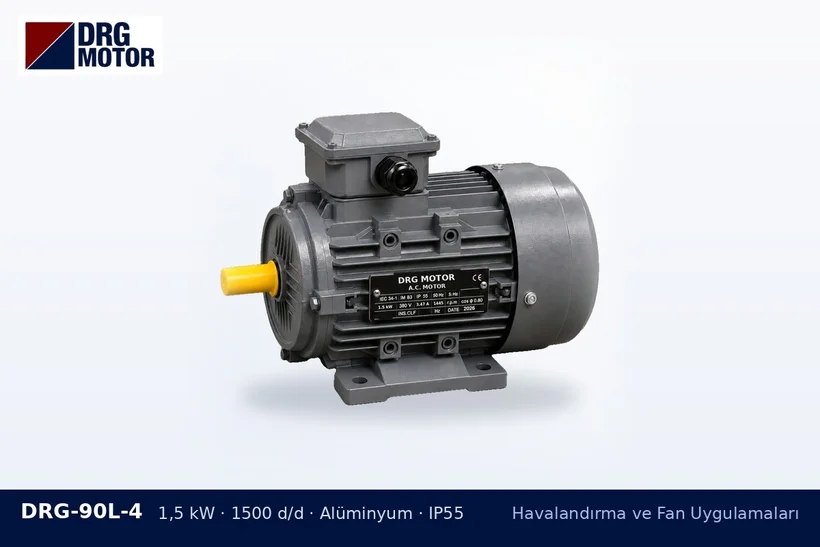
Reverse rotation affects radial and axial fans differently
In scroll-housing radial fans, air still enters through the inlet and leaves through the outlet even when the impeller runs backwards; since the flow direction does not change, the user assumes the system is fine because "air is coming out". In reality, backward-curved blades are forced to work like forward-curved ones, the scroll tries to collect the air the wrong way round, and the resulting airflow stays far below the design value. In axial fans, by contrast, the direction of airflow reverses: an extractor that should draw air out starts blowing air into the room. Because the blade profile is not shaped for reverse flow, this reversed airflow is weak as well.
Why is a low current reading misleading?
Since a reverse-turning impeller does less work, the motor is usually loaded below its rated nameplate current. A measurement suggesting that "the motor is running comfortably" leads people to think the lack of air is caused by the duct or the filter. Checking the direction of rotation before measuring current therefore saves time.
How is the direction verified?
- Find the direction arrow on the fan housing or impeller cover; if there is none, refer to the manufacturer's drawing.
- Run the motor briefly and, as it coasts to a stop, compare the direction in which the impeller slows down with the arrow.
- If the motor has just been fitted or the panel or cabling has been changed, the phase sequence may have changed.
- On a belt-driven fan, the direction of the impeller, not the motor, is what counts.
Reversing a three-phase motor requires work on the connections. How it is done depends on the motor nameplate, the manufacturer's documentation and the assessment of qualified electrical personnel; the general principle is explained in the article on changing the direction of rotation.
If airflow is still insufficient once the direction is confirmed, the problem is related to the impeller, the ductwork or the motor speed. In that case you can review the selection criteria by fan type on the fan motors page and compare three-phase motor models in the shop that match the power and speed of the old motor.