 English
 Le français
 Türkçe

Air volume changes with fan speed, and on a belt-driven fan the main factor setting the fan speed is the pulley ratio. The first step is therefore a pulley change; the motor is replaced only if the power needed at the new fan speed exceeds the existing motor's power, or if the speed ratio cannot reasonably be achieved with pulleys.
Relationship between speed, airflow and power
Fan speed is found from n_fan = n_motor × D_motor pulley / D_fan pulley. According to the approximate fan laws, airflow is directly proportional to speed, pressure varies with the square of speed and power with the cube of speed. An example calculation:
| Fan speed change | Airflow (approx.) | Power required (approx.) |
|---|---|---|
| 10% increase | 10% increase | about 33% increase |
| 10% decrease | 10% decrease | about 27% decrease |
These values assume that the system stays the same; the actual result depends on the impeller type and duct resistance.
When a pulley change is enough
- Reducing airflow: It is enough to make the motor pulley smaller or the fan pulley larger; the motor is relieved.
- Increasing airflow slightly: If the motor load has a reasonable margin, the pulley ratio is increased. The current should be measured after the change.
When a motor change is needed
- If the power at the new speed exceeds the existing motor power
- If the required ratio would make the motor pulley very small (belt wrap angle and slip become a problem)
- If moving to a different number of poles simplifies the pulley arrangement
In every case, the maximum permissible speed of the fan impeller must not be exceeded.
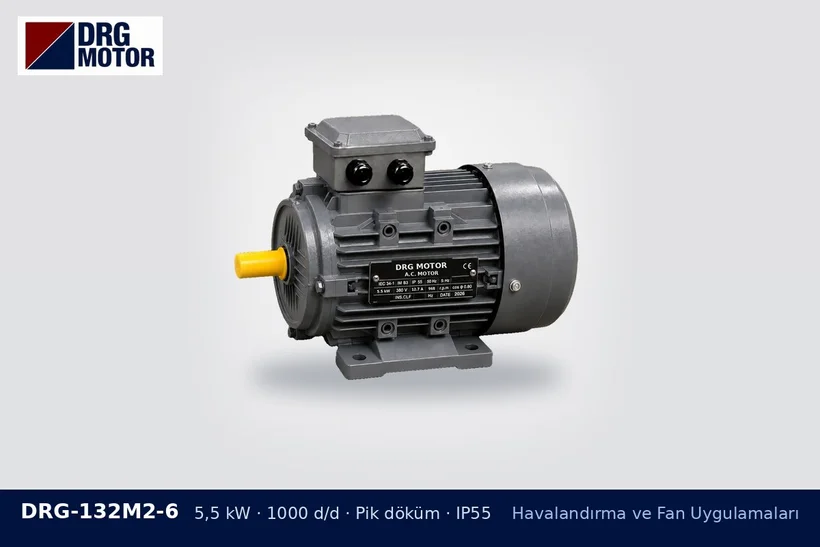
You can test the pulley ratio in the pulley and belt calculator; if the power requirement increases, you can consider fan motors and the higher-power models in the shop list.