 English
 Le français
 Türkçe

Because a worn impeller transfers less energy to the air, airflow and pressure drop, and the motor current usually falls too. The real danger lies not in the load but in the imbalance and vibration created by uneven wear. In addition, when the worn impeller is replaced with a new one, the fan demands full load again; this is when it becomes clear whether the motor rating is sufficient.
Abrasion and build-up have different effects
Hard particles such as sand, metal dust or glass fibre wear down the blade tips and the front shroud; as the blades get shorter, the pressure produced by the impeller falls. With moist, oily or sticky dusts the opposite happens: the layer building up on the blades increases the mass and inertia of the impeller and lengthens the run-up time. When this layer breaks away piece by piece, the impeller suddenly goes out of balance.
The effect of vibration on the motor
If the impeller is mounted directly on the motor shaft, the imbalance force is transmitted to the motor bearings. Rising bearing temperature, grease leakage and vibration of the terminal box cover are the first signs. Replacing the motor at this stage does not solve the problem; with the same impeller, the new motor will soon suffer the same bearing failure. Balancing or renewing the impeller must be dealt with first.
Do not size the motor on the worn condition
If power is to be estimated from current measurements, note the condition of the impeller at the time of the measurement. A low current measured with a worn impeller gives the impression that the motor is oversized. If a smaller motor is fitted and a new impeller is installed later, an overload appears. The correct reference is the shaft power for a new impeller given on the fan data sheet.
- Determine whether the fan sits before or after the filter; a fan after the filter handles cleaner air.
- Record the current difference with a new filter bag and with a clogged one.
- Keep track of the impeller's last balancing date and blade thickness.
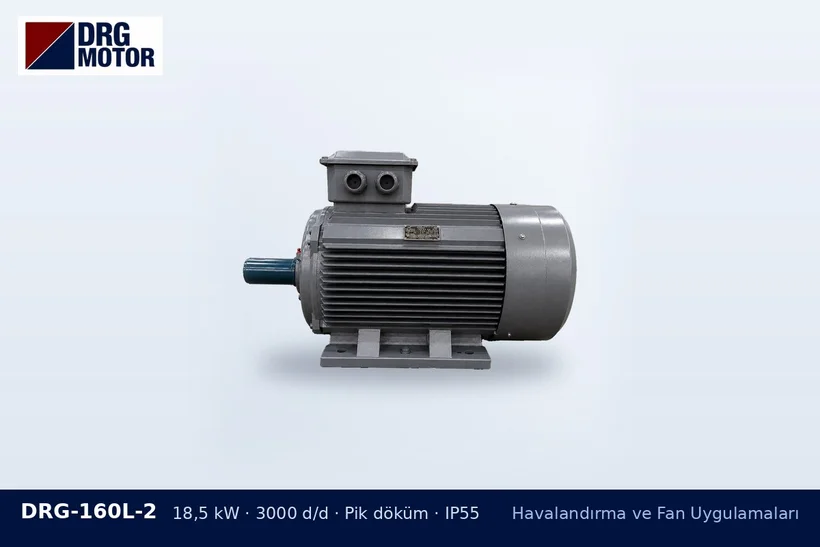
Selection criteria for bag filter and cyclone arrangements are described on the dust collection fan motors page, and straight-bladed impellers for material handling on the radial straight-blade fan page. Based on the power and speed on the fan data sheet, you can browse cast iron motor options in the shop.