 English
 Le français
 Türkçe

If the impeller is mounted directly on the motor shaft, there is no choice: the motor speed must match the fan's design speed. On belt-driven fans, either speed can be used, and the decision rests on pulley ratio, noise, bearing load and motor torque. In most belt-driven fan applications a 1500 rpm motor gives a more balanced result, but this is not a rule.
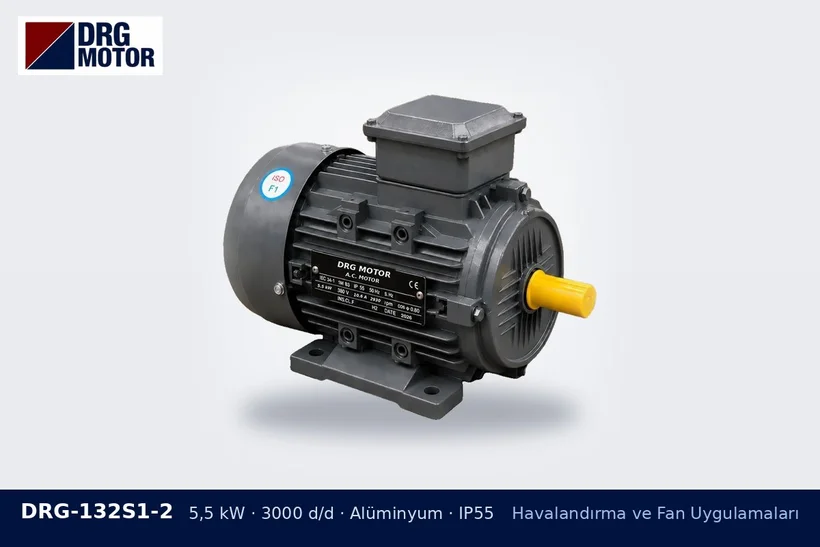
Direct-coupled fan
On a direct-coupled fan, the impeller's airflow, pressure and power values are given for a single speed. Driving an impeller designed for 1500 rpm with a 3000 rpm motor increases the power roughly eightfold and strains the mechanical limits of the impeller; the reverse means the fan will not deliver the required air. The right question here is not "which speed is better" but "which speed was the fan built for".
Comparison for a belt-driven fan
| Criterion | 1500 rpm (4-pole) | 3000 rpm (2-pole) |
|---|---|---|
| Shaft torque (same kW) | About twice as high | Lower |
| Pulley ratio (slow impeller) | Small ratio, large motor pulley | Large ratio, small motor pulley |
| Noise of the motor's own fan | Lower | Higher |
| Frame size | One size larger at some ratings | May be more compact |
For example, if the impeller needs to turn at 1100 rpm, a ratio of about 1.35 is required with a 1500 rpm motor and about 2.7 with a 3000 rpm motor. With a large ratio the motor pulley gets smaller, the belt's arc of contact gets shorter and the tendency to slip increases. The pulley calculation uses the relation n_fan = n_motor × D_motor / D_fan.
Information needed for the decision
- The fan's design speed and the shaft power at that speed
- Existing pulley diameters and belt type
- The noise limit at the installation site and the dimensions of the motor space
The general effects of pole number are described in the comparison of 2-pole and 4-pole motors. Depending on the speed you choose, you can review the centrifugal fan motor criteria and compare the models in the shop.