 English
 Le français
 Türkçe

No, it is not. Airflow is determined not by the motor's kW rating but by impeller speed and system resistance. At the same speed, a lower-power motor tries to drive the fan at the same rate and the fan demands the same power; the result is not less air but an overloaded, overheating motor.
Why does a smaller motor not work?
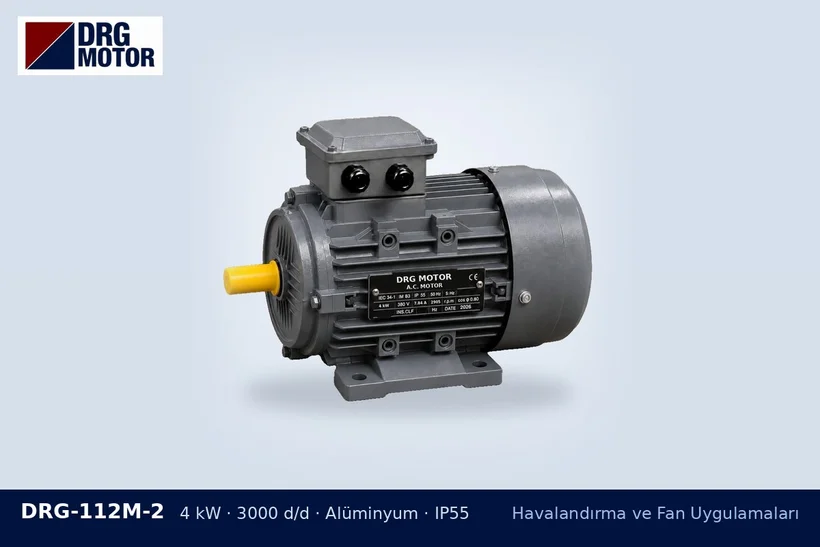
An induction motor runs slightly below the speed set by the supply frequency and the number of poles. If you fit a 2.2 kW, 1500 rpm motor instead of a 4 kW one, the impeller still turns at around 1450 rpm, so the fan still tries to move the same air and draw the same shaft power. Under load the motor's slip increases, its current rises above the rated value, and either the protection trips or the winding suffers long-term damage. Starting becomes harder too.
The right ways to reduce airflow
- Changing pulleys: On a belt-driven fan, the fan pulley is made larger or the motor pulley smaller; the impeller slows down.
- Changing the pole number: On a direct-coupled fan, a lower-speed motor can be used; however, whether the impeller still delivers the required pressure at that speed must be confirmed with the fan manufacturer.
- Speed control: Stepless speed adjustment is possible with an inverter.
- Damper: The simplest but least economical method; the fan still consumes power against the resistance.
When is a smaller motor possible?
Once speed has been reduced, the power demand falls with the cube of speed, so a smaller kW rating may genuinely become sufficient. For example, a fan requiring 7.5 kW at 1450 rpm, when slowed to about 960 rpm, needs a shaft power in the order of 2.2 kW (approximate relation; varies with the impeller and duct curve). In other words, downsizing the motor is not the means of reducing airflow but the consequence of lowering the speed.
To see the speed–power relationship in figures, see the article on the affinity laws. After determining the power needed at the new speed, you can compare 1000 and 1500 rpm models in the shop together with the criteria on the fan motors page.