 English
 Le français
 Türkçe

Several other factors are as important as rain: the roof surface and frame heated by summer sun, wind turning a stopped fan backwards, freezing in winter and condensation caused by day-night temperature swings, build-up of birds' nests and leaves, access for maintenance, and the temperature and contamination of the air the fan draws in. Motor selection is linked to each of these.
Heat and sun
Motor power is rated for a given ambient temperature. The air around a motor sitting inside an enclosed fan housing in direct sun can become noticeably hotter than the open air. In that case it is important for the motor to get cooling air and for the housing to be ventilated; if necessary, a margin is left when choosing the power. Class F insulation provides thermal endurance but is no substitute for cooling.
Wind and reverse rotation
A stationary roof fan can turn freely due to wind or pressure differences inside the building. When the motor is then switched on, it has to start while the impeller is turning the wrong way; the start takes longer and the current stays high for longer. A backdraught damper reduces this risk.
Moisture, frost and condensation
- After long standstills, condensation can form inside the frame; depending on the mounting position, the drain holes must be at the lowest point.
- On vertical-shaft roof fans, water and snow entering at the shaft exit must be considered separately.
- An iced-up impeller in winter causes imbalance and starting difficulty.
Maintenance and access
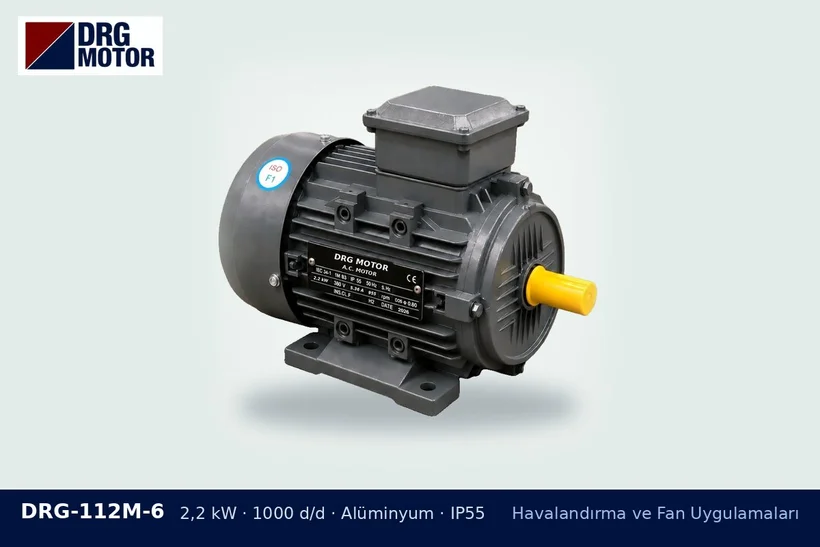
On belt-driven roof fans, the belt should be checked regularly. Safe roof access, removing and lowering the motor, and the need for a light frame all affect motor selection; here an aluminium frame can be an advantage.
Extracted air
If the fan exhausts kitchen, paint shop or process air, check whether the motor sits in the airstream. For application examples you can look at the axial fan motors page and see models by frame and power in the three-phase motor shop.