 English
 Le français
 Türkçe

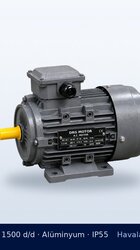
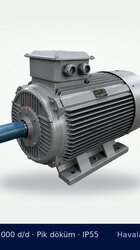
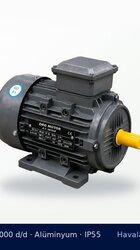
With a heavy-impeller fan, the issue is not the running power but the time the impeller takes to reach full speed. During this time the motor runs with a starting current several times its nameplate current, and heat builds up quickly in the winding; the longer the start, the more likely the protection is to trip or the insulation to age unnecessarily. Selection must therefore take into account the fan's moment of inertia and the starting method to be used.
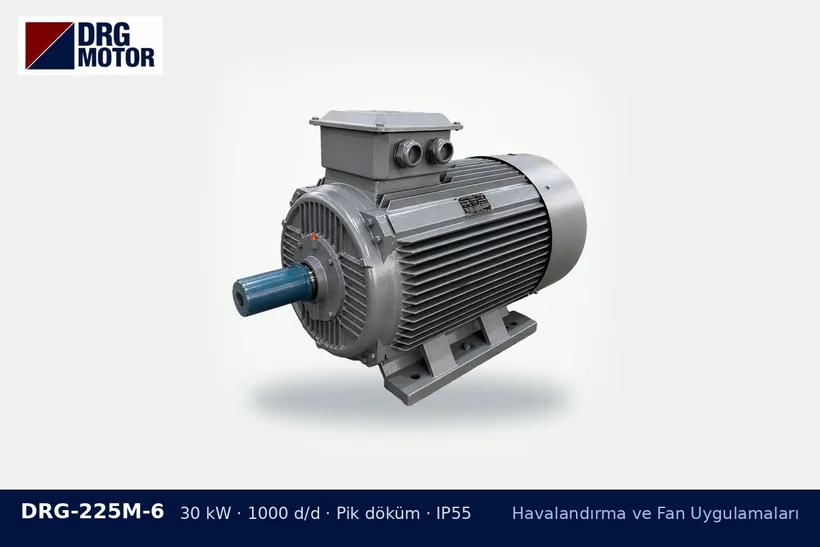
Three factors that determine run-up
Run-up time is directly proportional to the impeller's moment of inertia (J) and inversely proportional to the surplus torque the motor provides above the fan torque during starting. Because fan torque rises with the square of speed, the surplus torque is large at the start of the run-up and narrows as full speed approaches. If motor torque is reduced, this margin shrinks and the time lengthens.
- Total inertia of the impeller and pulleys (requested from the fan manufacturer in kg·m²)
- In a belt drive, the impeller inertia referred to the motor shaft
- Whether the damper is open or closed at start-up
The starting method changes the time
With star–delta starting, the starting torque drops to about one third of direct-on-line starting; with a heavy impeller, this means a markedly longer run-up. A soft starter limits torque as well as current. An inverter provides controlled acceleration at low current, but the ramp time must suit the impeller inertia. Which method and which settings are suitable depends on the motor nameplate, the manufacturer's documentation and the assessment of qualified electrical personnel.
Pole number and frame size
The energy stored in a rotating impeller increases with the square of speed. The same inertia needs four times as much energy at 3000 rpm as at 1500 rpm; a significant share of this energy is turned into heat in the rotor during starting. This is why lower-speed designs and, where necessary, the next frame size up are preferred for heavy impellers. For a final decision, the motor's permissible starting time and locked-rotor withstand capability should be compared against manufacturer data.
The reasoning behind the inertia calculation is explained in the article on inertia and run-up time, and the choice of drive arrangement for radial fans on the centrifugal fan motors page. You can browse high-power cast iron frame models in the shop.