 English
 Le français
 Türkçe

A comparison made only between the rewinding price and the price of a new motor is incomplete. How carefully the rewind was done, the current the motor draws today, the state of mechanical parts like the shaft and the seats of the bearings, and the machine's annual operating hours must all be assessed together.
What may have changed after rewinding
If the laminations are exposed to heat while a burnt winding is being stripped, iron losses may increase. If the wire cross-section, number of turns or connection was applied differently from the original, the motor may draw more current at the same load and run hotter. None of this is visible from outside; it can only be revealed by measurement. This risk is greater on a motor rewound several times.
Assess the motor you have by measuring it
- At an unchanged load, measure each phase current and set it against the rating plate figure; check whether there is a marked difference between phases.
- Compare the frame temperature during normal operation with earlier periods.
- Have the bearing noise, vibration and shaft runout checked.
- Note any cracked or broken parts on the terminal box, fan and end covers.
- Find out the rewinding record, the date it was done and how many times the motor has been rewound.
When replacement comes to the fore
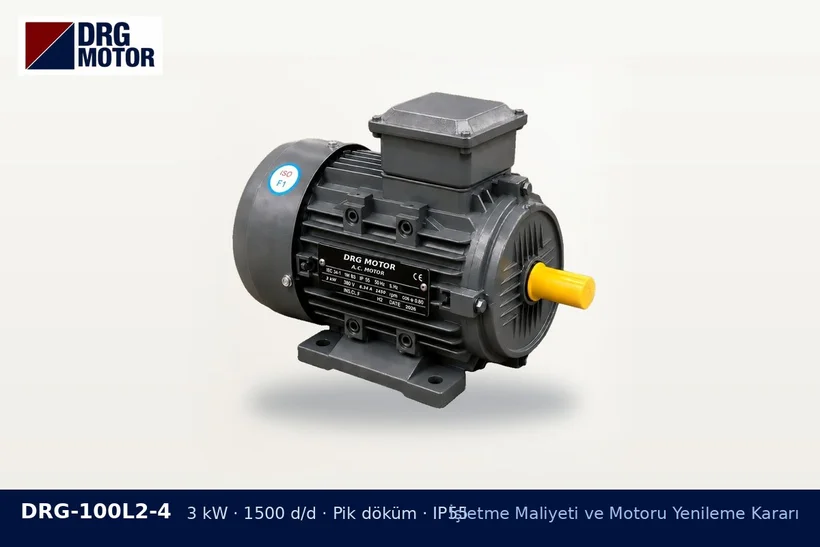
If the motor is on a line running three shifts, fails again at short intervals or the measured current is above the nameplate, a new motor is often the more defensible option. On an auxiliary machine that turns a few hundred hours a year, a well-rewound motor can be used until it reaches the end of its economic life. If a new motor is to be bought, record the frame size, shaft diameter and foot-mounting dimensions of the motor being replaced; the dimensions of the new one can be compared on the technical drawing page.
Building a decision table
On one side, write down the rewinding price, the risk of a second failure and the extra energy consumption; on the other, the price of a new motor, the installation labour and the downtime. Rather than disposing of it entirely, the old motor can also be kept as a spare on a low-priority machine.
If you decide to replace it, you can filter the three-phase motor models in the shop by power, speed and frame to review options that may correspond to the old motor.