 English
 Le français
 Türkçe

As the hourly cost of downtime grows, the weight of the purchase price in the motor decision falls, and preparedness for failure and quick recovery come to the fore. If this cost is small, a simpler approach may be enough; if it is large, a spare motor, a frame suited to heavy duty and planned replacement are considered together.
Working out the hourly cost correctly
Writing down only the sales value of the lost output is misleading; the labour wasted in that hour, a furnace that has to be reheated, even material spoiled inside a mould and the commercial consequence of a late delivery must also be added. In some plants, one hour of downtime turns into several hours of lost productivity until the line is rebalanced.
What changes in the decision when the cost is high
- Frame and protection: in environments with vibration, dust or impacts, a cast iron frame can be considered.
- Power margin: if the load fluctuates, a power rating at which the motor does not run at its limit is needed; an oversized motor, however, causes other losses.
- Spare: keeping a ready motor of the same size reduces downtime to the installation time.
- Monitoring: recording current, temperature and vibration gives early warning of a failure.
If the cost is low
On an auxiliary fan or a rarely used mixer where a breakdown can be absorbed by waiting a few hours, rather than tying up capital in a spare it may be enough to make sure the motor is in a standard IEC frame size that is easy to find.
Information needed for the decision
The machine's position in the line, alternative production options, failure records from recent years and the supply time for the motor should be collected on one page. At DRG the estimated dispatch date is given in the order confirmation; obtaining this information in advance for critical machines makes planning easier.
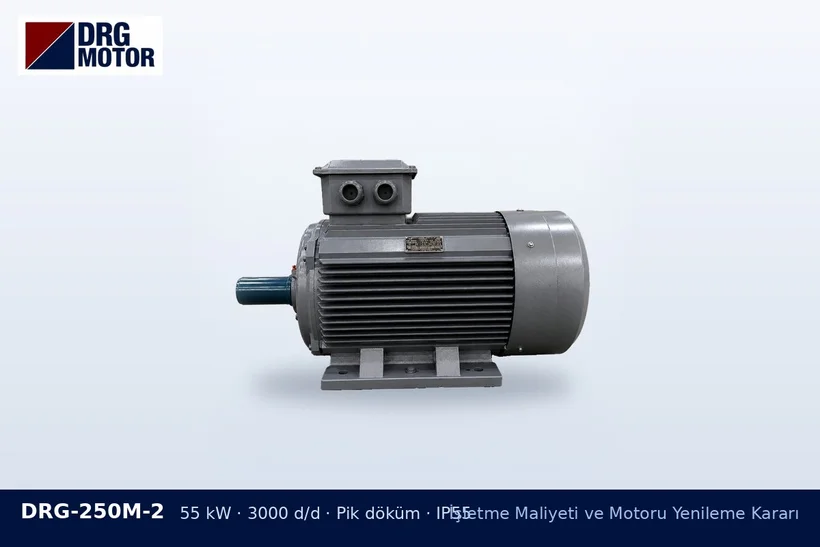
For heavy-duty lines, you can review the dimensions and features of the 55 kW 1500 rpm cast iron motor or the other cast iron options in the shop.