 English
 Le français
 Türkçe

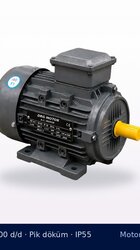
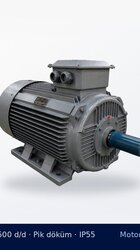
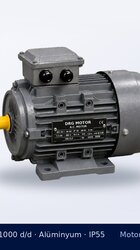
An old pulley or coupling can be reused if its bore diameter, keyway and hub length suit the new motor's shaft and the part shows no wear, cracking or imbalance. Even when the dimensions match, a worn part will quickly strain the new motor's bearings and belts.
Dimensional fit
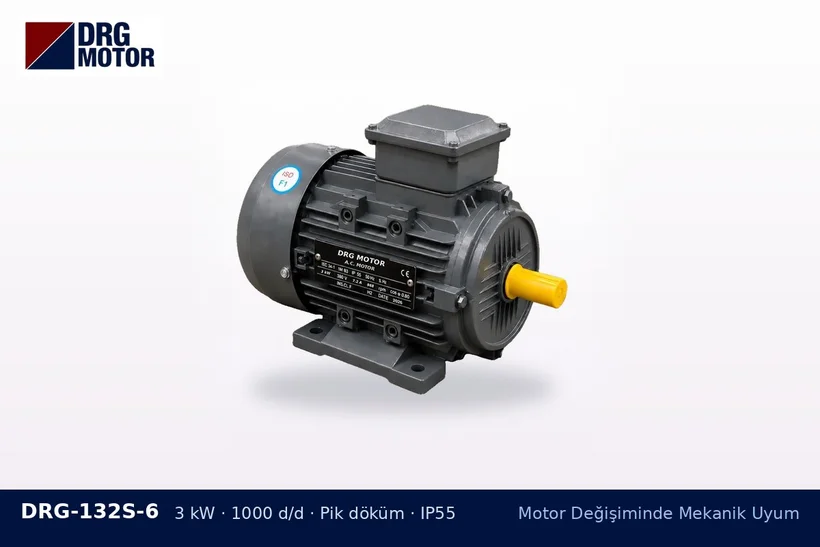
- Bore diameter: Must equal the shaft diameter. In the DRG range, 132-frame models have a 38 mm shaft and 160-frame models a 42 mm shaft.
- Keyway: Its width and depth must seat properly with the key supplied with the new motor.
- Hub length: The protruding shaft length (80 mm on a 132 frame) must support the hub adequately. If most of the hub overhangs the shaft, the load falls on the shaft tip.
If the dimensions differ, work such as boring out or fitting a bush depends on the wall thickness of the part and should be assessed by a machinist.
Checking the pulley's condition
Belt grooves wear over time; if the belt sits deeper in the groove than normal or a shiny step can be seen on the groove flanks, the pulley is worn out. Cracks between hub and rim, a bent rim and hammer marks from earlier fitting also indicate that the pulley should be replaced. If the motor speed is changing, the pulley diameter must be recalculated as well.
Checking the coupling's condition
In flexible couplings, the rubber or polyurethane element in between hardens, cracks or has its teeth crushed. This element is a small consumable part, and a motor change is a good opportunity to renew it. If the coupling hub is loose on the shaft, or there are rust marks or wear on the shaft surface, the hub should be replaced too.
Removal and fitting
The old part should be removed from the shaft with a puller and fitted onto the new shaft without impact. Driving it on with a hammer damages the bearings; damage caused by such fitting is not covered by the warranty.
For shaft and key dimensions, see the article on shaft diameter, keys and couplings, and compare three-phase motor models in the shop by shaft size.