 English
 Le français
 Türkçe

Partly, it can be; what decides is how many millimetres of the coupling hub sit on the shaft and whether the distance the coupling maker requires between the two shaft ends can be maintained. If the hub grips only part of the shaft, the key load is concentrated on a small area, the hub rocks and the key may be crushed.
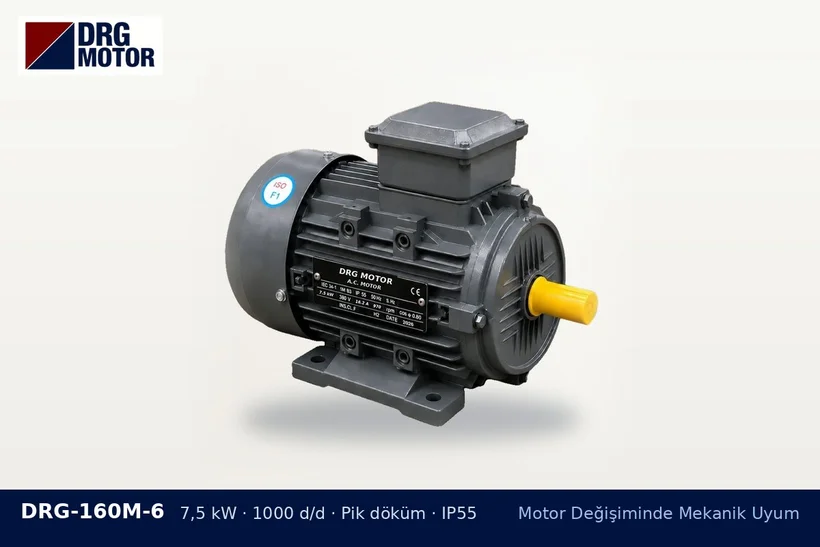
Why is it shorter?
On IEC motors, shaft length (E) is determined by frame size and number of poles. A shaft of the same diameter but shorter may indicate that the two motors belong to different dimension systems or different frame sizes. In that case, compare not only the shaft but also the shaft height and the foot holes.
Three dimensions to check for the coupling
- Engagement length: Where possible, the hub should sit on the shaft over its full length. If the hub face overhangs the end of the shaft, this is acceptable only to a limited extent and only as far as the coupling documentation allows.
- Key length: The key must work along the whole section inside the hub; using a short key is not a solution.
- Gap between ends: For jaw, elastomer-element and disc couplings, the distance between the two hubs is specified. This gap lets the element work freely and absorbs axial expansion.
Possible corrections
- If the base allows, slide the motor towards the machine so that the hub seats fully.
- Use a coupling with a longer hub or a spacer coupling.
- If the base holes are not enough, reposition the motor using slots or an adapter plate.
Whichever route is chosen, the alignment of the two shafts must be measured again afterwards.
Comparison before ordering
To see shaft diameter and length together, you can use the motor comparison page and assess models whose dimensions look suitable in the motor list in the shop.