 English
 Le français
 Türkçe

In most cases, yes; because a belt drive has no rigid axial connection between the motor and the machine shaft, a difference in shaft height is not as critical as in a coupling drive. Even so, being able to adjust the belt length is only one condition; the motor must also be fixable to the base, the pulley must stay in the correct plane and the guard must still close.
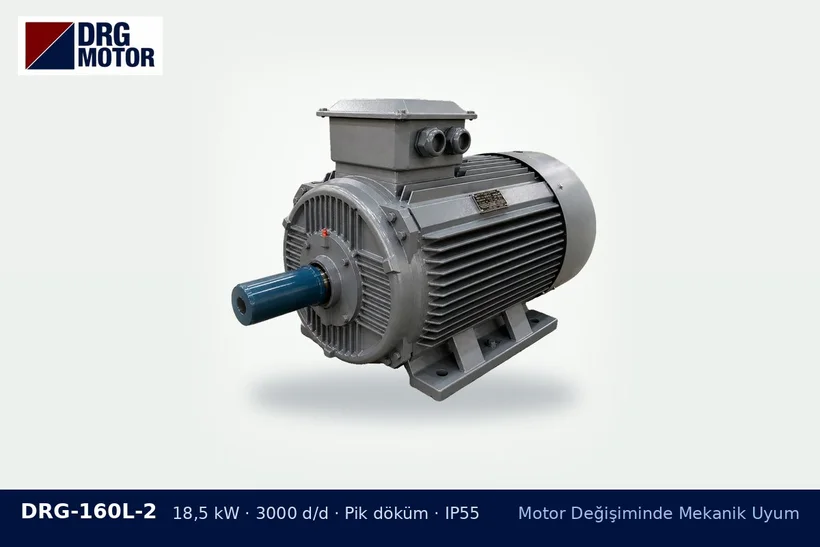
What changes when the frame size changes?
| Dimension | Effect |
|---|---|
| Shaft height (H) | The pulley centre rises or falls; the centre distance and belt angle change. |
| Foot hole spacing | New holes or a plate may be needed in the base or slide rails. |
| Shaft diameter and length | The old pulley may not fit; the hub position shifts. |
| Overall length | The fan cover may come too close to a wall or guard behind it. |
Why a different frame?
A frame size difference usually arises in one of two ways: a different speed has been chosen at the same power (at the same kW, the frame grows as the number of poles increases), or the power has been increased. If the speed changes, the pulley ratio must change too; otherwise the machine runs at an unwanted speed. The machine shaft speed is found by multiplying the motor speed by the ratio of the pulley diameters.
Points to check
- Can the slide rails or base be adapted to the new foot dimensions?
- Are the two pulleys in the same plane? When the frame changes, the pulley position on the shaft must be readjusted.
- Is the belt wrap angle on the small pulley still sufficient?
- Can the belt guard and machine cover still be closed with the new motor?
- Is the base rigid enough for the frame weight and belt pull?
Before choosing
Check the new pulley ratio and belt length with the pulley and belt calculator. Frame size, shaft and length values are given in the model list in the shop; allow for the possibility that the base may need modifying for the new size.