 English
 Le français
 Türkçe

A terminal box on a different side does not prevent installation in most cases; the motor's mechanical connection stays the same. However, cable length, the direction the cable entry will face, whether the box lid can be opened, and whether the box clashes with the belt guard, a wall or another part should be checked before ordering.
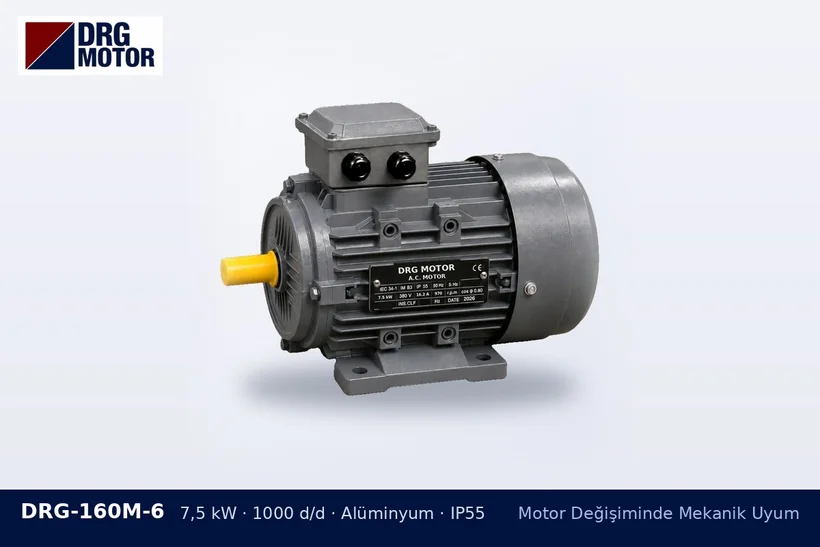
Four points to check on site
- Cable length: The existing cable was cut to suit the old box; when the box moves to the other side, the cable has to run over or under the motor. If it is too short, rather than adding a joint, renewing the cable should be assessed by qualified electrical personnel.
- Clashes: The box may touch the belt guard, the machine body or a motor alongside. Compare the box size on the technical drawing with the space available.
- Lid access: For maintenance, the lid screws must be reachable and the lid must be able to open.
- Water and dust: If the cable gland faces upwards in the box's new position, there is a risk of water getting in.
Can the box orientation be changed?
On some motors the box can be rotated on the frame in set steps, while on other models its position is fixed by the frame casting. This varies by model; confirm it before installation from the product information or by asking DRG. If a non-standard position is required, ask before ordering whether it is possible; if it is, it counts as buyer-specific preparation and affects the return conditions.
Points to watch on the electrical side
Even if the box position changes, the internal connection is made according to the diagram on the motor nameplate. Making the connection and setting up protection depend on the motor nameplate, the manufacturer's documentation and the assessment of qualified electrical personnel.
For more on boxes and cable entries, read the article on terminal boxes and cable entry, check the box position on the technical drawings, and then assess the models in the shop.