 English
 Le français
 Türkçe

The allowance is preserved if the new motor can tension the belt at a point near the middle of the slide rails. If the motor ends up against the far end of the rails at the first installation, there is no room left to take up the belt as it stretches; if it is against the near end, there is no slack available to fit a new belt. What ensures this is choosing the belt length and the motor foot dimensions together.
Why do the rails need travel in both directions?
Belts bed in and stretch slightly during their first hours of running, so travel is needed in the tensioning direction. The motor must also be able to move towards the machine so that the belt can be fitted without forcing it over the pulley or levering it into the grooves. Belt makers specify an allowance for both directions related to the centre distance; the values vary with the belt section.
What to check on the new motor
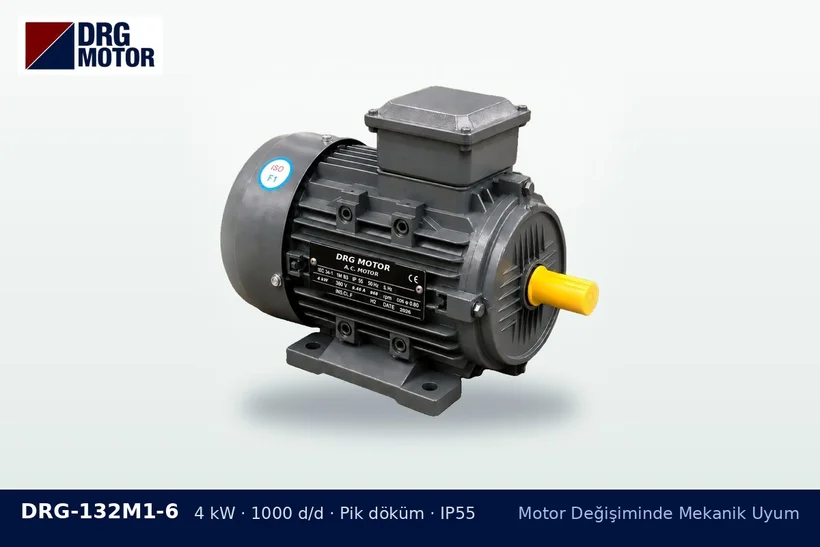
- Foot spacing: Does the longitudinal hole spacing of the new motor fit the rail slots? A long-frame model may use up part of the slot from the outset.
- Shaft end position: If the shaft length and frame length differ, the pulley shifts axially; the pulley is repositioned on the shaft so that the belt does not run at an angle.
- Pulley diameter: If the motor pulley changes, the centre distance and required belt length change too.
- Tensioning bolt: A rusted or bent bolt should be replaced together with the motor.
Choosing the belt length to suit the rails
The right method is to measure the centre distance needed with the motor placed in the middle zone of the rails and to calculate the belt length from that. The pulley and belt calculator gives the machine speed and belt speed for given pulley diameters; determine the belt length from the belt maker's table. If no standard length matches exactly, choosing the shorter one generally increases the forward tensioning travel.
After tensioning
When tensioning is finished, check with a straightedge that the motor feet have stayed parallel on the rails and that the pulleys are in the same plane. To see models used on belt-driven fans, crushers and mills, have a look at the motor list in the shop.