 English
 Le français
 Türkçe

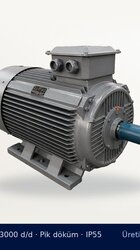
The amount of air a compressor delivers depends far more on the speed of the compressor block and its own mechanical condition than on motor power. If the new motor's speed or pulley differs from the old one, if the belt is slipping, or if the compressor's valves, piston rings or intake filter are already worn, replacing the motor alone will not restore air output.
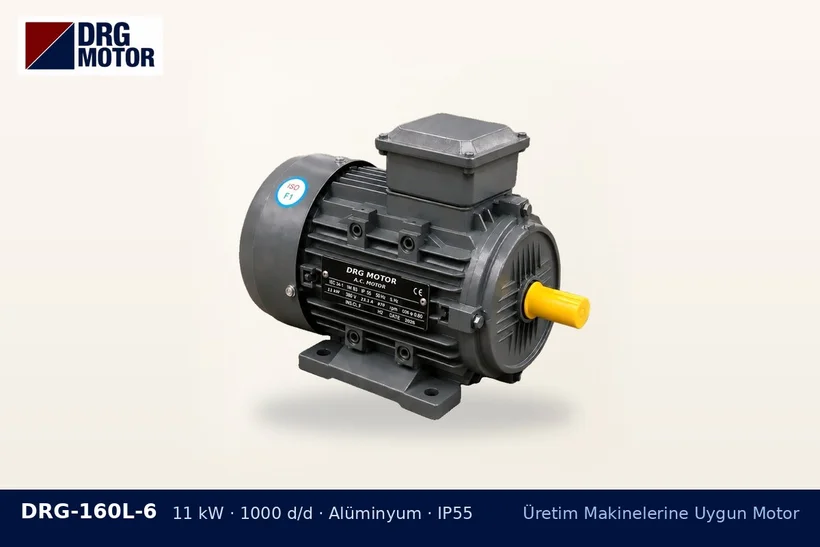
Speed and pulley calculation
On a belt-driven compressor the block speed is found from: ncompressor = nmotor × Dmotor pulley / Dcompressor pulley. Example: a motor running at about 1460 rpm under load, driving a 400 mm pulley from a 150 mm pulley, turns the block at about 548 rpm. If the old motor was in the 3000 rpm class and a 1500 rpm motor has been fitted with the same pulley, the block speed and air output are roughly halved. You can verify the figures with the pulley and belt calculator.
Checks to carry out in order
- Is the speed on the motor nameplate in the same class as that of the old motor?
- Is the motor pulley the same diameter as the old one, or was a new pulley fitted because the shaft diameter is different?
- Are the belt tension and pulley alignment correct, and is there belt squeal under load?
- Does the direction of rotation match the arrow on the compressor? Reverse rotation can cause serious damage on a screw compressor.
- Have the intake filter, unloader valve and line leaks been checked?
Situations that may be caused by the motor
If the motor power is lower than the block requires, speed drops noticeably under load, the protection trips frequently and the compressor is slow to reach the target pressure. In this case current measurements should be taken by qualified personnel. On a piston compressor, worn rings and valves reduce output whatever the motor.
To choose the right motor
The block speed and power requirement on the compressor rating plate are assessed together with the existing pulley diameters. Application notes are on the compressor motors page, and you can review matching models in the online motor list.