 English
 Le français
 Türkçe

First establish how the old motor is attached to the machine (feet, flange or both), the shaft diameter and length, the power and the speed. Then check how the machine reverses and stops, whether the motor is two-speed, and what level of vibration is acceptable. Because surface finish on machine tools is affected by motor vibration, balance and alignment matter as much as mechanical fit.
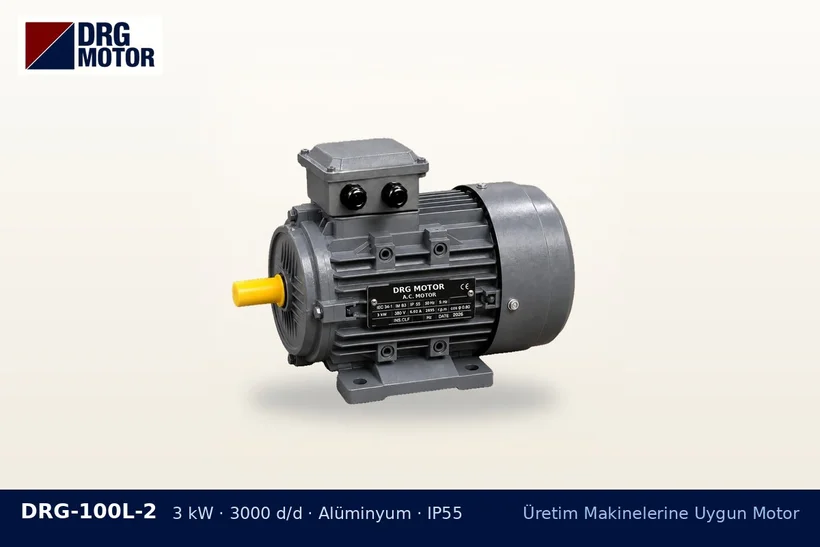
Mechanical connection
- For a foot-mounted motor, the foot hole spacing and shaft height; for a flange-mounted one, the flange type and spigot diameter
- Shaft diameter, length and key size; if the pulley or coupling is to be reused as it is, the dimensions must match
- Whether the motor frame fits in the space inside the machine; overall length and terminal box orientation
You can compare frame dimensions using the technical drawings.
Electrical and functional features
Some older machine tools have a motor with a special two-speed winding; if it is replaced with a standard single-speed motor, the low gears of the gearbox change their function. If the lathe reverses its chuck frequently, the motor re-accelerates and heats up at every change of direction. If a mechanical brake is needed, note that brake motors are not in DRG's standard range; the machine's own braking arrangement or another solution should be considered. Control and protection settings depend on the motor nameplate and the judgement of qualified electrical personnel.
Speed and power
Fitting a motor of the same power but a different speed changes all the gear speeds in the gearbox by the same ratio. A more powerful motor allows a deeper cut, but it is risky if the machine's slideways, spindle and gears were not designed for that load. The same speed class as the old motor should be kept, and any power increase limited by the machine builder's data.
Related pages
Application details are on the metal lathe motors and universal milling machine motors pages; models with equivalent power and speed can be found in the shop list.