 English
 Le français
 Türkçe

It may be, if the belt has been extended only slightly and the motor had a clear margin at its previous load; but this is established by calculation, not by guesswork. As length increases, belt and idler friction, the total material on the belt and the torque needed for a full-load start all grow. If there is an incline, the lifting load also increases with length.
Additional loads from the extension
| Component | Change |
|---|---|
| Empty belt and idler resistance | Rises roughly in proportion to length |
| Friction of the conveyed material | Grows with the amount of material on the belt |
| Lifting power | Rises directly if the height difference increases |
| Starting torque | Rises because there is more mass to set in motion |
Measuring the existing motor's margin
With the conveyor running at full load, the current of all three phases is measured by qualified personnel and compared with the rated current. If the current is already close to the nameplate value, the motor can be expected to run hot after the extension. Strain during starting should also be observed separately; starting from standstill with a loaded belt is the most demanding case.
Points often overlooked
- If belt speed is to stay the same, the gearbox ratio stays the same; if the speed changes, the speed must be recalculated.
- Slip at the drive pulley and the take-up arrangement become more important on a long belt.
- The gearbox's own torque capacity must also be checked against the new load; DRG does not sell gearboxes, and the motor is selected to suit the existing one.
- If a dual-drive arrangement is being considered, the motors should have matching power and speed for load sharing.
When deciding on the new power
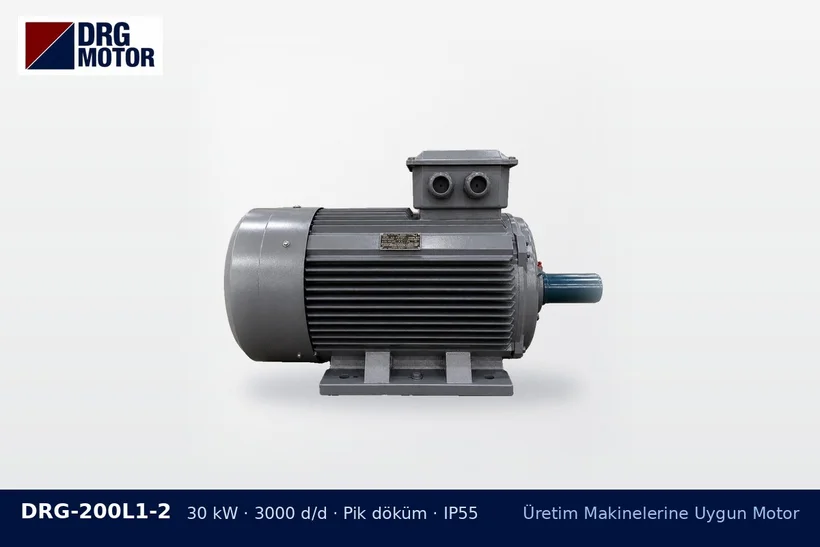
Add the starting condition to the calculated shaft power and see whether the next size up is needed. Heavy-duty examples are described on the belt conveyor motor page; you can compare power ratings in the three-phase motor shop.