 English
 Le français
 Türkçe

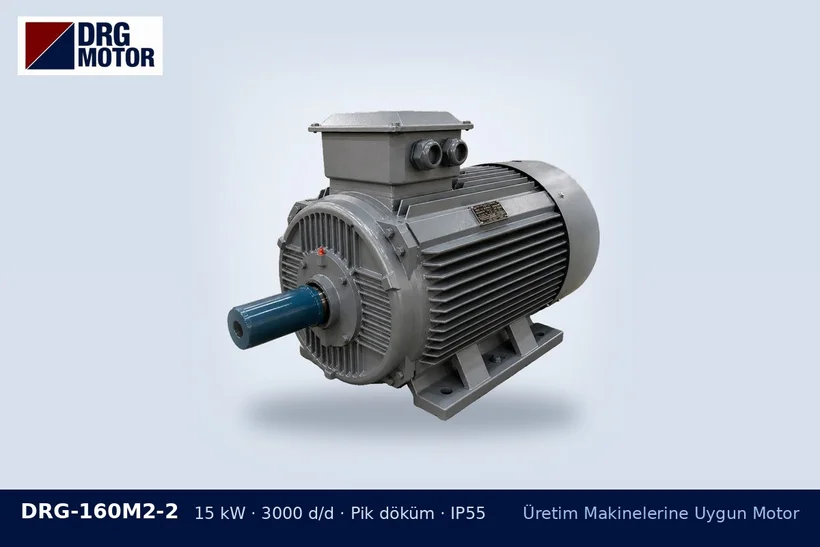
Yes. If the vibration of the screen comes from the eccentric shaft rather than from the motor itself, a general-purpose three-phase induction motor can be used. The condition is that the motor sits on a rigid, fixed base outside the vibrating box and transmits motion to the eccentric shaft through a belt or a flexible coupling. If the motor is to be bolted onto the screen body, this solution is not appropriate.
Eccentric drive and unbalanced-weight drive are two different things
On an eccentric-shaft screen the motor simply turns a shaft; what shakes the box is the eccentric mass mounted on that shaft. In unbalanced-weight vibrator motors, by contrast, the weights sit directly on the motor shaft and the motor shakes together with the box. That second type is a separate product whose bearings and housing are built for this stress; it is not part of DRG's standard IEC range. If your question concerns the first type, a standard motor can be considered among the options.
Load characteristics to watch during selection
- Starting: Setting a loaded or stopped screen in motion requires a long run-up because of the inertia of the rotating masses. The motor must be able to accelerate through this period without overheating.
- Passing through resonance: During starting and stopping, the screen briefly passes through its resonance zone; the base and chassis should not pass this shaking on to the motor.
- Belt tension: An over-tensioned belt puts a high radial force on the shaft end and the drive-end bearing. Keep the distance between the pulley and the shaft shoulder short.
- Dust and moisture: Fine dust is dense in screening areas; IP55 protection is commonly used in such locations, but the fan cover grille must stay clean for proper cooling.
Information to gather before deciding
The drive power and speed on the screen maker's nameplate, the eccentric shaft speed, the pulley diameters and the number of screen decks are the basic data for the decision. If the pulley ratio is known, the machine speed is found by multiplying the motor speed by the ratio of the motor pulley diameter to the machine pulley diameter; the pulley and belt calculator can be used for this. If an existing motor is being replaced, the foot mounting dimensions and the shaft diameter should also be compared.
On heavy-duty screens, a cast iron frame is often preferred for its resistance to a shaking environment. You can see examples close to this application on the vibrating screen motors page, and browse models filtered by power and speed in the three-phase motor shop.