English
 Le français
 Türkçe




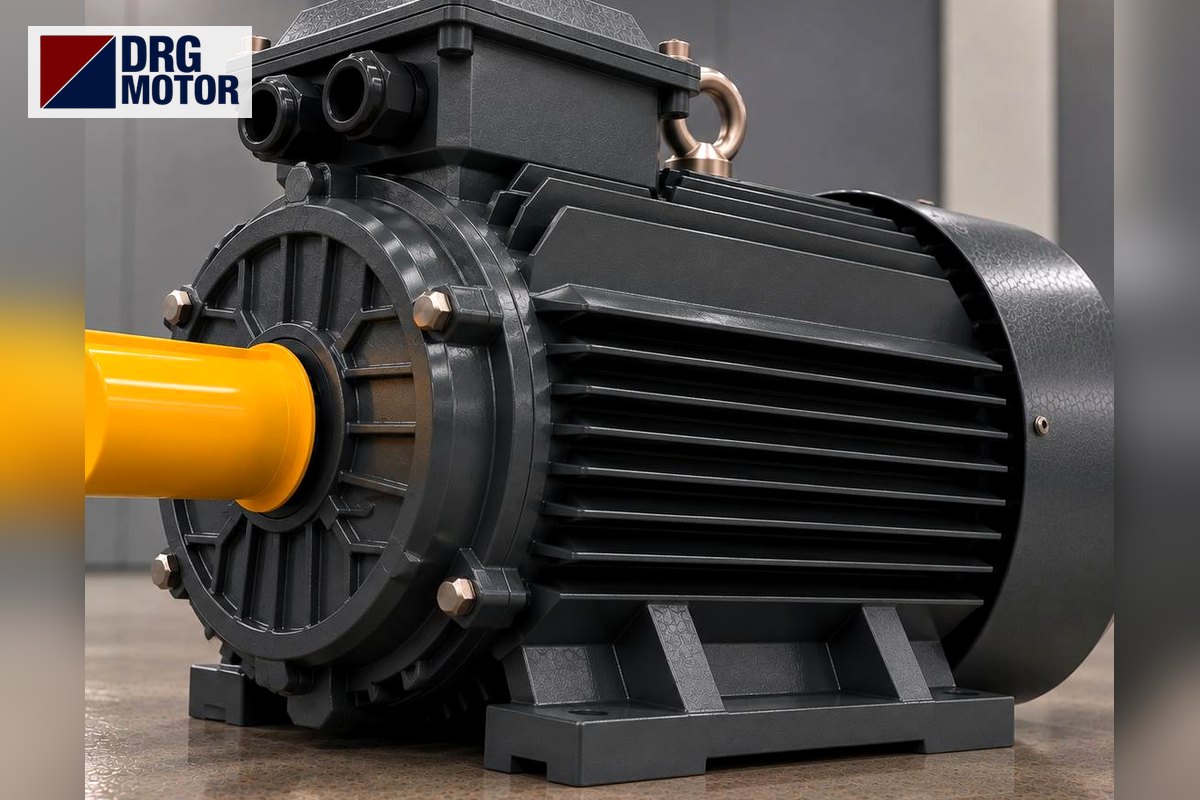

In DRG Motor's 160 frame family, the 160M carries 7.5 kW (6-pole), 11 kW (4-pole), 11 kW (2-pole) and 15 kW (2-pole) motors, and the 160L carries 11 kW (6-pole), 15 kW (4-pole) and 18.5 kW (2-pole) motors. All of them share a shaft height H of 160 mm, a 42×110 mm shaft and the same B5 flange (P 350 / N 250 / M 300 mm); what separates 160M from 160L is the axial foot hole spacing B (210 / 254 mm) and the overall length L (608 / 652 mm). Aluminium housings stop at 11 kW in this family; 15 and 18.5 kW are cast iron only.
The model codes in the tables below link straight to the product pages. To compare every frame size, start from the online motor shop or the three-phase asynchronous electric motors page; the aluminium versions are also listed under aluminium housing electric motors.
Which DRG models are built on the 160M and 160L frames?
Frame 160 is where the IEC range gathers the powers around 11 kW: 2-, 4- and 6-pole motors share the same shaft height, but the frame length (M or L) depends on power and pole count. According to the product records, the line-up is:
160M frame
| Model code | Power / rated speed | Housing material | Current at 400 V / torque |
|---|---|---|---|
| DRG-160M-6-AL | 7.5 kW (10 HP) · 6-pole · 970 rpm | Aluminium | 15.4 A · 73.8 Nm |
| DRG-160M-6-GG | 7.5 kW (10 HP) · 6-pole · 970 rpm | Cast iron | 15.4 A · 73.8 Nm |
| DRG-160M-4-AL | 11 kW (15 HP) · 4-pole · 1465 rpm | Aluminium | 20.4 A · 71.7 Nm |
| DRG-160M-4-GG | 11 kW (15 HP) · 4-pole · 1465 rpm | Cast iron | 20.4 A · 71.7 Nm |
| DRG-160M1-2-AL | 11 kW (15 HP) · 2-pole · 2945 rpm | Aluminium | 19.6 A · 35.7 Nm |
| DRG-160M1-2-GG | 11 kW (15 HP) · 2-pole · 2945 rpm | Cast iron | 19.6 A · 35.7 Nm |
| DRG-160M2-2-GG | 15 kW (20 HP) · 2-pole · 2945 rpm | Cast iron | 26.5 A · 48.6 Nm |
160L frame
| Model code | Power / rated speed | Housing material | Current at 400 V / torque |
|---|---|---|---|
| DRG-160L-6-AL | 11 kW (15 HP) · 6-pole · 970 rpm | Aluminium | 22 A · 108.3 Nm |
| DRG-160L-6-GG | 11 kW (15 HP) · 6-pole · 970 rpm | Cast iron | 22 A · 108.3 Nm |
| DRG-160L-4-GG | 15 kW (20 HP) · 4-pole · 1465 rpm | Cast iron | 27.3 A · 97.8 Nm |
| DRG-160L-2-GG | 18.5 kW (25 HP) · 2-pole · 2940 rpm | Cast iron | 32.5 A · 60.1 Nm |
Torque values come from the product records and can be checked with T = 9550 × P / n. For DRG-160L-6-GG: 9550 × 11 / 970 ≈ 108.3 Nm. "1000 / 1500 / 3000 rpm" is the speed class; the nameplate speed is slightly lower, e.g. 970, 1465 and 2945 rpm. The 2-pole 160L is rated at 2940 rpm.
160M1 and 160M2: two 2-pole ratings in one frame
On the 2-pole side, the 160M comes in two models. DRG-160M1-2-GG delivers 11 kW (15 HP), while DRG-160M2-2-GG delivers 15 kW (20 HP). Their B3 dimensions are identical in the product records (B 210 mm, L 608 mm); the difference is inside the motor, and from the outside only the "1" or "2" after the frame code tells them apart. Current at 400 V rises from 19.6 A to 26.5 A, so if the 15 kW M2 is fitted in place of an M1, re-check fuses, contactor and cable size. You can verify currents with the motor current chart and cable cross-section with the motor cable size calculator.
If an old nameplate only says "160M" and the motor is 2-pole, read the power before deciding between M1 and M2. Shaft, flange and feet are the same, so the wrong rating will not show up mechanically — it only shows up on the current and protection side.
Click to see current electric motor prices and order nowSEE PRICES →
Where aluminium ends: 11 kW and cast iron
DRG aluminium housing motors cover 0.25–11 kW, and frame 160 is the last stop of that range. On the 160M, DRG-160M-6-AL, DRG-160M1-2-AL and DRG-160M-4-AL are available in aluminium; on the 160L only DRG-160L-6-AL is. The 15 and 18.5 kW models (DRG-160M2-2-GG, DRG-160L-4-GG, DRG-160L-2-GG) are cast iron only.
Aluminium and cast iron motors with the same type code share the same B3 dimensions, the same shaft (42×110 mm) and the same bearing (6309-C3) in this frame. The choice usually depends on the environment and the robustness required; the article on aluminium vs cast iron housings covers the difference.
Same kW, different frame: the 11 kW and 15 kW trap
The most common mistake in the 160 family is knowing the power but skipping the pole count. 11 kW appears with three pole counts, yet the 6-pole version sits on the 160L, not the 160M; at 15 kW the 2-pole is a 160M2 and the 4-pole is a 160L:
| Power | Poles / speed class | IEC frame | Torque |
|---|---|---|---|
| 11 kW | 2 / 3000 rpm | 160M | 35.7 Nm |
| 11 kW | 4 / 1500 rpm | 160M | 71.7 Nm |
| 11 kW | 6 / 1000 rpm | 160L | 108.3 Nm |
| 15 kW | 2 / 3000 rpm | 160M | 48.6 Nm |
| 15 kW | 4 / 1500 rpm | 160L | 97.8 Nm |
This is why ordering "an 11 kW motor" is not enough: the 6-pole 11 kW produces about three times the torque of the 2-pole one and is 44 mm longer. If you are looking for these powers outside frame 160, the 11 kW flange motor and 15 kW flange motor articles compare the other frame options.
160M vs 160L dimensions: foot spacing and overall length
Both frames share the same shaft height and the same transverse foot dimension. What changes is the foot hole spacing along the axis (B) and the overall length. B3 dimensions (mm, from the product records):
| Dimension | 160M | 160L | Note |
|---|---|---|---|
| A (mm) | 254 | 254 | Foot hole spacing (across) |
| B (mm) | 210 | 254 | Foot hole spacing (along the axis) — M/L difference |
| C (mm) | 108 | 108 | Shaft shoulder to front foot hole |
| H (mm) | 160 | 160 | Shaft centre height |
| K (mm) | 4–Ø14.5 | 4–Ø14.5 | Foot holes |
| D × E (mm) | 42 × 110 | 42 × 110 | Shaft diameter × shaft length |
| F (mm) | 12 | 12 | Key width |
| AC (mm) | 314 | 314 | Housing diameter |
| AD (mm) | 251 | 251 | Shaft axis to top of terminal box |
| HD (mm) | 426 | 426 | Floor to top of terminal box |
| L (mm) | 608 | 652 | Overall length — M/L difference |
| LB (mm) | 498 | 542 | Flange face to rear cover |
In practice: replacing a 160M with a 160L moves the rear foot holes 44 mm backwards and makes the motor 44 mm longer. The front foot hole to shaft shoulder distance (C = 108 mm) is unchanged, so coupling alignment is kept, but the base needs new holes or slots. For detailed drawings see DRG 2D technical drawings and the DRG technical catalogue.
42×110 mm shaft: the same on every 160 model
In this family the pole count does not change the shaft: every 2-, 4- and 6-pole 160M and 160L model has a 42 mm shaft, 110 mm long, with a key width F of 12 mm, keyway bottom dimension G 37 mm, shaft + key dimension GA 45 mm and a M16×36 centre thread. Larger frames split 2-pole and 4-pole shafts; frame 160 does not. For shaft sizes at other powers see the motor shaft diameter by kW table; for coupling selection see shaft diameter, key and coupling standards.
B5 flange (FF300) dimensions and a note on B14
In the DRG catalogue B5 table, the 160M and 160L flange rows are identical; only the overall length differs (L 608 / 652 mm). Flange dimensions:
| Dimension | Value (160M and 160L) | Meaning |
|---|---|---|
| P | 350 mm | Flange outside diameter |
| N | 250 mm | Spigot (pilot) diameter |
| M | 300 mm | Bolt circle diameter |
| S | 18.5 mm | Flange hole diameter |
| T | 5 mm | Spigot depth |
| LA | 15 mm | Flange thickness |
| G | 37 mm | Keyway bottom dimension |
| GA | 45 mm | Shaft + key top dimension |
| DH | M16×36 | Shaft end centre thread |
Check four values separately when ordering: the outside diameter P 350 mm must fit the machine recess, the spigot N 250 mm must seat in the mating pilot bore, and the bolt circle M 300 mm and hole diameter S 18.5 mm must match the bolt positions. The FF/FT hole difference is explained in FF and FT on B5 and B14 flanges, and the flange table for all frames is in the B5 motor flange dimensions table.
The DRG catalogue has no dimension table for the small B14 flange, so we do not give B14 or B34 foot and small flange dimensions for frame 160. If you need one, send the flange outside diameter, bolt circle, spigot and thread size on WhatsApp and we will confirm.
If the motor goes onto a gearbox input, the size code alone is not enough. From the gearbox input nameplate or drawing, read the input flange P/N/M/S values, the input bore (compare with the 42 mm motor shaft), key width (F 12 mm), ratio and permissible load, and compare them with the values above. DRG supplies the motor only; the selection steps are covered in choosing a flange motor for a gearbox and electric motors for worm gearboxes.
Electrical connection: 400/690 V (Δ/Y), current and cable entry
Every DRG model in the 160 family is wound 400/690 V (Δ/Y); on a 400 V supply it is connected in delta. This differs from the 230/400 V motors up to 3 kW, so when a 160 frame replaces an old 230/400 V motor, review the terminal connection and the starting method. The terminal box has 2 × M40×1,5 cable entries. Currents at 400 V range from 15.4 A to 32.5 A; the highest is for DRG-160L-2-GG (18.5 kW). For torque and power calculations use the electric motor calculator.
Dimensions to confirm before ordering
- Nameplate power (kW) and speed: on a 2-pole 160M, is it 11 kW or 15 kW?
- Frame length: foot spacing B 210 mm means 160M, 254 mm means 160L.
- Shaft 42×110 mm, key 12 mm — check the mating bore and keyway.
- Mounting: B3 foot, B5 flange or both (B35). See motor mounting types.
- B5 flange P 350, N 250, M 300, S 18.5 mm; if you need B14, send us the dimensions.
- Housing material: aluminium or cast iron up to 11 kW, cast iron only at 15 and 18.5 kW.
Send a photo of your current motor's nameplate together with the shaft and flange dimensions, and we will confirm together whether it is a 160M or a 160L, which pole count and which housing material.
Send a photo of your current motor nameplate and we will find the suitable DRG model together.Send on WhatsApp
Browse the 160M and 160L frame motors and their current pricesSEE PRICES
Frequently asked questions
What is the difference between 160M1 and 160M2?
Both are 2-pole motors with 160M dimensions. The M1 delivers 11 kW and the M2 15 kW; the M1 comes in aluminium and cast iron, the M2 in cast iron only. Current at 400 V is 19.6 A versus 26.5 A.
Why is the 11 kW 6-pole motor not a 160M?
According to the product records, the 6-pole 160M goes up to 7.5 kW; the 11 kW 6-pole is DRG-160L-6-AL / DRG-160L-6-GG on the 160L frame. Its 108.3 Nm torque needs a longer frame.
Can a 160L motor replace a 160M?
Shaft height, shaft, dimension C and B5 flange dimensions are the same. On foot mounting the rear foot holes move by 44 mm and the motor is 44 mm longer; measure the base and the space behind the motor first.
Is there a B14 flange motor in frame 160?
The DRG catalogue has no B14 small-flange dimension table, so we do not quote B14 dimensions. Send the dimensions of the flange you need and we will confirm case by case.
Electric Motors Related to This Topic — Models and Current Prices
Suitability is not decided by power alone: compare the speed, voltage, mounting, shaft and fixing dimensions of your machine with the product data; if unsure, send us the nameplate of your current motor.
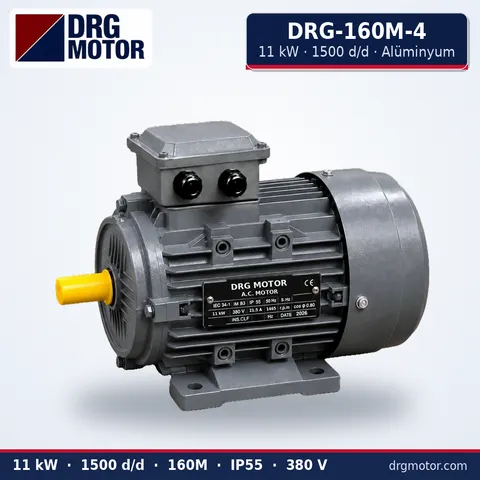
11 kW Three-Phase Motor 1500 rpm – DRG-160M-4 Aluminium
- 11 kW · 1500 rpm (4 poles)
- Aluminium frame · IEC 160M
- Shaft: 42 × 110 mm
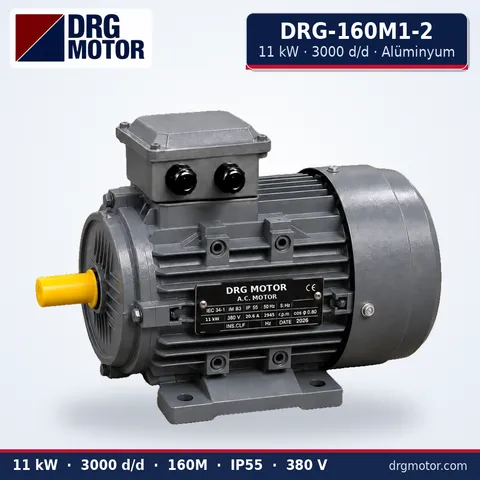
11 kW Three-Phase Motor 3000 rpm – DRG-160M1-2 Aluminium
- 11 kW · 3000 rpm (2 poles)
- Aluminium frame · IEC 160M
- Shaft: 42 × 110 mm
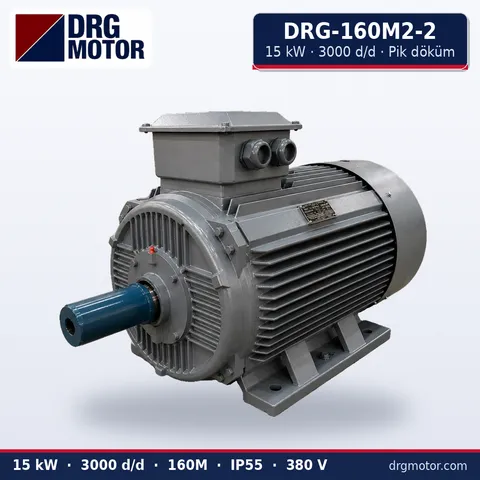
15 kW Three-Phase Motor 3000 rpm – DRG-160M2-2 Cast Iron
- 15 kW · 3000 rpm (2 poles)
- Cast iron frame · IEC 160M
- Shaft: 42 × 110 mm
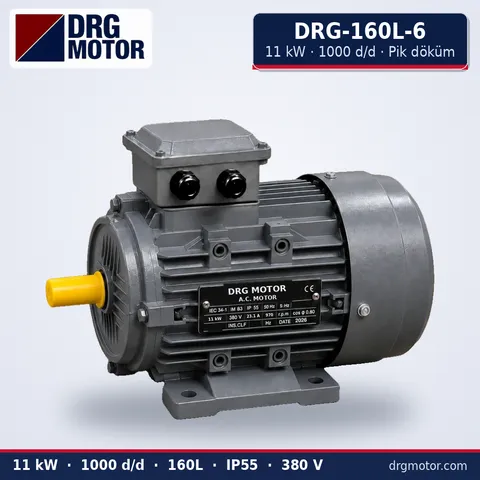
11 kW Three-Phase Motor 1000 rpm – DRG-160L-6 Cast Iron
- 11 kW · 1000 rpm (6 poles)
- Cast iron frame · IEC 160L
- Shaft: 42 × 110 mm
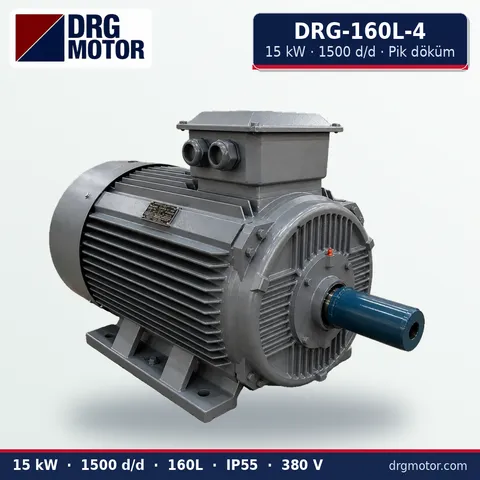
15 kW Three-Phase Motor 1500 rpm – DRG-160L-4 Cast Iron
- 15 kW · 1500 rpm (4 poles)
- Cast iron frame · IEC 160L
- Shaft: 42 × 110 mm
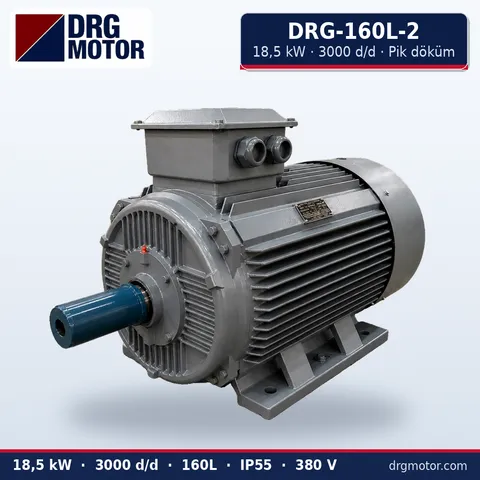
18.5 kW Three-Phase Motor 3000 rpm – DRG-160L-2 Cast Iron
- 18.5 kW · 3000 rpm (2 poles)
- Cast iron frame · IEC 160L
- Shaft: 42 × 110 mm