English
 Le français
 Türkçe




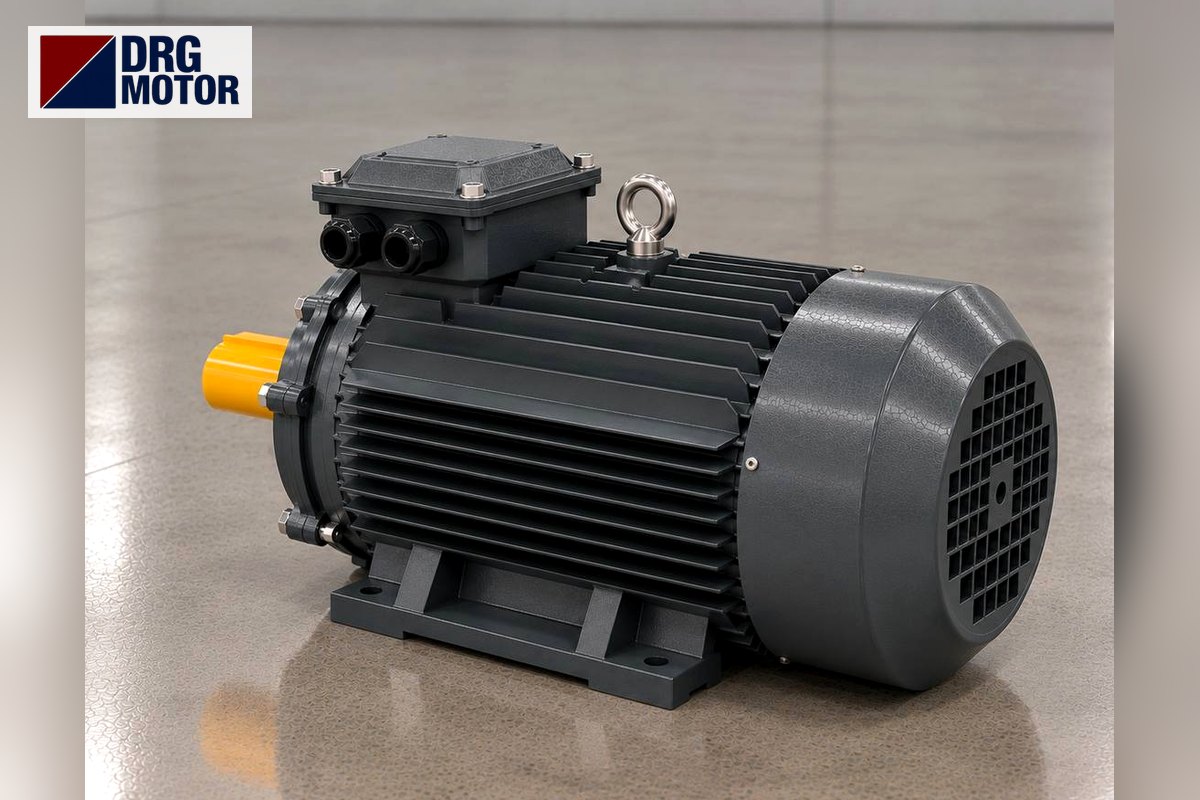

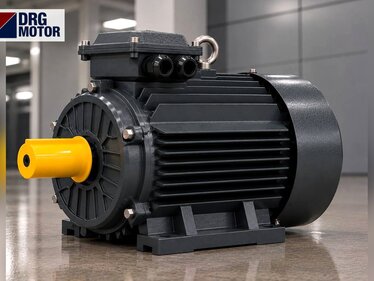
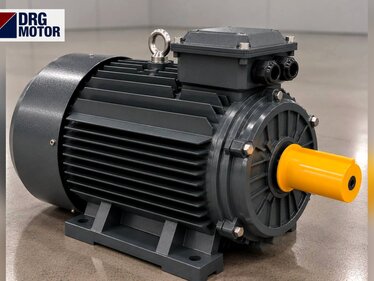
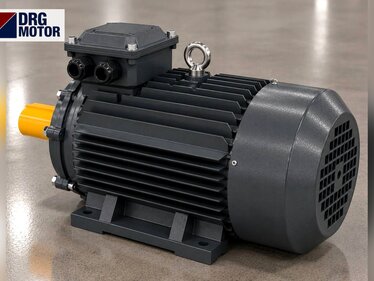
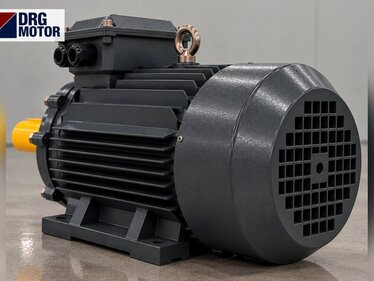
DRG Motor's cast iron housing with a 280 mm shaft height covers six models: 280S carries 45 kW (6-pole) and 75 kW (2- and 4-pole), 280M carries 55 kW (6-pole) and 90 kW (2- and 4-pole). The shaft is set by the pole count, not the frame letter: 65×140 mm on 2-pole models and 75×140 mm on 4- and 6-pole models. What separates the two frames is the lengthwise foot spacing: B 368 mm (280S) versus 419 mm (280M).
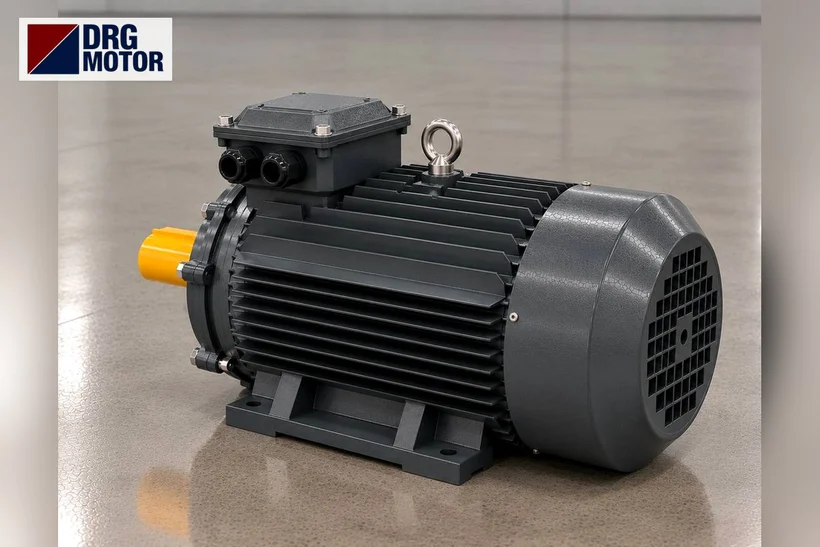
All six product pages sit in the three-phase asynchronous electric motors range, and you can filter them by power, speed and frame in the online motor shop. This frame is typically found on large centrifugal fans, process pumps, screw compressors, mills and crushers. Replacing a motor on such a machine usually involves a crane, base work and coupling work, so settling the few-millimetre differences before ordering saves a lot of time on site.
Six models on the 280 frame: power and pole map
280S and 280M each have one DRG model per pole count, and the M frame is one power step above the S frame for every pole count. Reading the table across: 2- and 4-pole ratings match (75 kW / 90 kW), while the 6-pole models are 45 kW and 55 kW.
| Poles / speed class | 280S frame | 280M frame | Shaft D×E (mm) |
|---|---|---|---|
| 2-pole – 3,000 rpm | DRG-280S-2: 75 kW / 100 HP | DRG-280M-2: 90 kW / 125 HP | 65×140 |
| 4-pole – 1,500 rpm | DRG-280S-4: 75 kW / 100 HP | DRG-280M-4: 90 kW / 125 HP | 75×140 |
| 6-pole – 1,000 rpm | DRG-280S-6: 45 kW / 60 HP | DRG-280M-6: 55 kW / 75 HP | 75×140 |
The 1000/1500/3000 values are speed classes (synchronous speed). Nameplate speed under load is slightly lower: 2,975 rpm on 2-pole, 1,486 rpm on 4-pole and 985 rpm on 6-pole models. All six are wound for 400/690 V (Δ/Y); on a 400 V supply the motor runs in delta (Δ). Every model has a 2 × M63×1,5 cable entry.
Shaft choice: 65×140 or 75×140?
On the 280 frame the pole count determines the shaft regardless of the S/M letter. The 2-pole DRG-280S-2 and DRG-280M-2 share one shaft, and the four 4- and 6-pole models share another:
- 2-pole: shaft diameter 65 mm, key width 18 mm, G 58 mm, GA 69 mm, bearing listed as 6314-C3.
- 4- and 6-pole: shaft diameter 75 mm, key width 20 mm, G 67.5 mm, GA 79.5 mm, bearing listed as 6317-C3.
A feature of this frame: the shaft length E is 140 mm in both cases, so moving from 2-pole to 4-pole does not change the overall length and axial clearance on the machine is not an issue. The coupling is: a 65 mm hub will not go onto a 75 mm shaft, the opposite leaves 10 mm of play, and since the key grows from 18 mm to 20 mm the keyway will not match either. Plan for a new or re-machined hub. General rules on shaft, key and coupling are in motor shaft diameter, key and coupling standards, and shaft values for every rating are in the motor shaft diameter by kW table.
The bearing record also matters: when buying spare bearings, 2-pole 280 motors list 6314-C3 and 4/6-pole 280 motors list 6317-C3. Ordering one bearing type by frame number alone would be a mistake.
Click to see current electric motor prices and order nowSEE PRICES →
Dimensional difference between 280S and 280M
The S and M letters in the IEC frame code indicate housing length. In DRG records, 280S and 280M share shaft height, transverse foot spacing, C, foot holes, housing diameter and terminal box height. They differ in two dimensions by the same amount: B 368 → 419 mm and L 982 → 1033 mm, i.e. 51 mm. The M frame grows equally between the foot holes and in overall length.
| Dimension (mm) | 280S | 280M | S → M difference |
|---|---|---|---|
| H – shaft height | 280 | 280 | same |
| A – foot holes, across | 457 | 457 | same |
| B – foot holes, lengthwise | 368 | 419 | +51 |
| C – shaft shoulder to front foot hole | 190 | 190 | same |
| K – foot holes | 4–Ø24 | 4–Ø24 | same |
| D – shaft diameter | 65 (2-p) / 75 (4/6-p) | 65 (2-p) / 75 (4/6-p) | depends on poles, not frame |
| E – shaft length | 140 | 140 | same |
| F – key width | 18 (2-p) / 20 (4/6-p) | 18 (2-p) / 20 (4/6-p) | depends on poles, not frame |
| AC – housing diameter | 547 | 547 | same |
| AD – axis to terminal box top | 387 | 387 | same |
| L – overall length | 982 | 1033 | +51 |
In practice, moving from 280S to 280M (for instance from 75 kW to 90 kW) means moving the rear pair of base holes back by 51 mm; at the same pole count the shaft does not change, so the coupling side stays as it is. You can see these dimensions on the 2D technical drawings and 3D technical drawings pages.
B5 flanged 280: four catalogue rows, one flange
DRG's B5 large-flange catalogue table has four rows for the 280 frame: a 2-pole row and a 4/6/8-pole row for each of 280S and 280M. The flange dimensions themselves are the same in all four rows:
| B5 flange dimension | Value (mm) | What it is for |
|---|---|---|
| P – flange outer diameter | 550 | Fits the recess on the machine |
| N – spigot (pilot) diameter | 450 | Centres the motor on the axis |
| M – bolt circle diameter | 500 | Position of the bolt holes |
| S – flange hole diameter | 18.5 | Bolt size |
| T – spigot depth | 5 | How far the pilot enters the recess |
| LA – flange thickness | 22 | Bolt length selection |
| DH – shaft end thread | M20×42 | Pulling and securing a hub or pulley |
What separates the rows is the shaft and the length. "280M B5" is not a complete order; the pole count must be stated too, because the flange is shared but the shaft is not:
| Catalogue row | Shaft D×E / key F (mm) | G / GA (mm) | L / LB (mm) |
|---|---|---|---|
| 280S – 2-pole | 65×140 / 18 | 58 / 69 | 982 / 842 |
| 280S – 4, 6, 8-pole | 75×140 / 20 | 67.5 / 79.5 | 982 / 842 |
| 280M – 2-pole | 65×140 / 18 | 58 / 69 | 1033 / 893 |
| 280M – 4, 6, 8-pole | 75×140 / 20 | 67.5 / 79.5 | 1033 / 893 |
For the B35 arrangement (feet plus flange) and B3/B5 ordering differences see the B3, B5 and B35 mounting order guide; flange dimensions of other frames are in the B5 motor flange dimensions table.
The B14 small-flange table is not in the DRG catalogue, so we do not give B14 or B34 dimensions for the 280 frame. If you need such a connection, send the existing flange's outer diameter, bolt circle, spigot diameter and thread size on WhatsApp and we will check it.
2-pole or 4-pole at 75 kW and 90 kW?
At the same power the 2- and 4-pole models draw similar currents, but their torque differs by roughly a factor of two. Torque values are from DRG records; the last column is our check with M = 9550·P/n (P in kW, n = nameplate speed in rpm).
| Model | Current at 400 V (A) | Rated torque (Nm) | 9550·P/n check |
|---|---|---|---|
| DRG-280S-2 (75 kW, 2-pole) | 127 | 240.8 | 9550·75/2,975 = 240.8 |
| DRG-280S-4 (75 kW, 4-pole) | 129 | 482 | 9550·75/1,486 = 482 |
| DRG-280M-2 (90 kW, 2-pole) | 152 | 288.9 | 9550·90/2,975 = 288.9 |
| DRG-280M-4 (90 kW, 4-pole) | 155 | 578.4 | 9550·90/1,486 = 578.4 |
| DRG-280S-6 (45 kW, 6-pole) | 81.6 | 436.3 | 9550·45/985 = 436.3 |
| DRG-280M-6 (55 kW, 6-pole) | 98.1 | 533.2 | 9550·55/985 = 533.2 |
At 75 kW the 2-pole model delivers 240.8 Nm and the 4-pole model 482 Nm. Changing the speed of a fan or pump impeller also changes flow and pressure, so staying with the old motor's pole count is the rule. If a pole change is being considered, that decision belongs on the machine side, not to the motor rating alone. Size cables and protection from the 400 V current with the motor current chart and the motor cable size calculator; torque and power can be checked with the electric motor calculator.
Checking order for a replacement
- Nameplate speed: ~2,975 rpm means 2-pole (65×140 mm shaft); ~1,486 rpm 4-pole, ~985 rpm 6-pole (75×140 mm shaft).
- Shaft diameter: if the nameplate is unreadable, use a caliper; on the 280 frame 65 mm appears only on 2-pole, 75 mm on 4/6-pole.
- Lengthwise foot spacing B: 368 mm means 280S, 419 mm means 280M.
- Common dimensions: H 280 mm, A 457 mm, C 190 mm, foot holes 4–Ø24 mm.
- If B5 flanged: measure P 550, N 450, M 500 and S 18.5 mm separately.
- Connection: confirm the nameplate reads 400/690 V (Δ/Y) and the supply is 400 V.
The general ordering steps by shaft and frame are in the motor frame size order guide, and models are listed frame by frame in the price list by frame number.
Frequently asked questions
Do I need a new coupling when moving from 280S to 280M?
Not if you keep the same pole count: 280S and 280M both use 65×140 mm on 2-pole and 75×140 mm on 4/6-pole. The base holes change (B 368 → 419 mm) and the motor is 51 mm longer.
Do the 90 kW 2-pole and 90 kW 4-pole motors have different shaft lengths?
No, both have E 140 mm and the same overall length L 1033 mm. What differs is shaft diameter (65 / 75 mm), key width (18 / 20 mm) and the bearing record (6314-C3 / 6317-C3).
Is there a motor smaller than 45 kW on the 280 frame?
In DRG data the smallest 280 model is the 45 kW 6-pole DRG-280S-6. On 2- and 4-pole, the 280S rating is 75 kW.
Is the 280M B5 flange different from the 280S flange?
No. All four catalogue rows show P 550, N 450, M 500, S 18.5, T 5 and LA 22 mm. Only the shaft and the lengths (L, LB) change.
Technical confirmation and ordering
DRG Motor is an electric motor manufacturer, supplier and seller. With a heavy motor such as a 280 frame, a wrong order costs both freight and installation time, so send us the old motor's nameplate photo, its shaft diameter and B dimension (plus P, N, M and S if it is flanged) and we will confirm the model together. For the general features of large cast iron frames see cast iron frame and high kW motors and the DRG technical and product catalogue.
Send a photo of your current motor nameplate and we will find the suitable DRG model together.Send on WhatsApp
Review the six 280S and 280M frame models and their current pricesSEE PRICES
Electric Motors Related to This Topic — Models and Current Prices
Suitability is not decided by power alone: compare the speed, voltage, mounting, shaft and fixing dimensions of your machine with the product data; if unsure, send us the nameplate of your current motor.
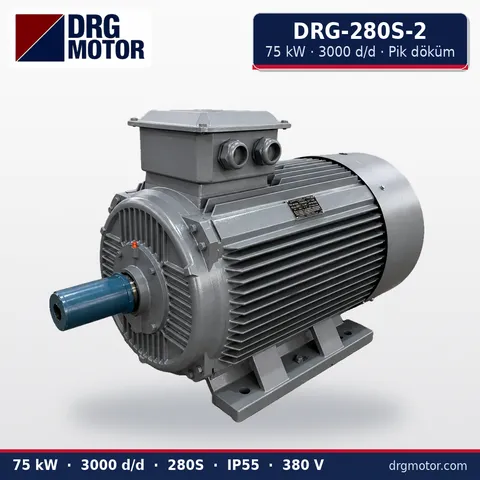
75 kW Three-Phase Motor 3000 rpm – DRG-280S-2 Cast Iron
- 75 kW · 3000 rpm (2 poles)
- Cast iron frame · IEC 280S
- Shaft: 65 × 140 mm
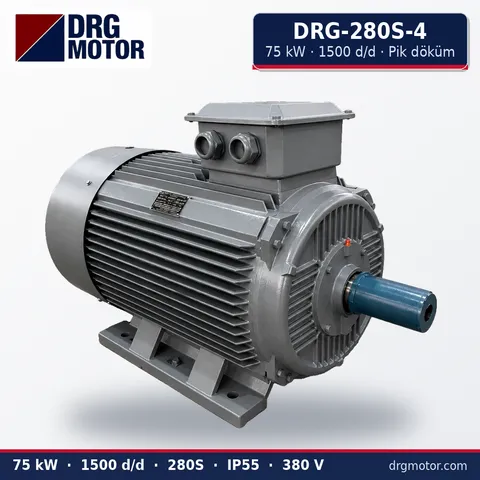
75 kW Three-Phase Motor 1500 rpm – DRG-280S-4 Cast Iron
- 75 kW · 1500 rpm (4 poles)
- Cast iron frame · IEC 280S
- Shaft: 75 × 140 mm
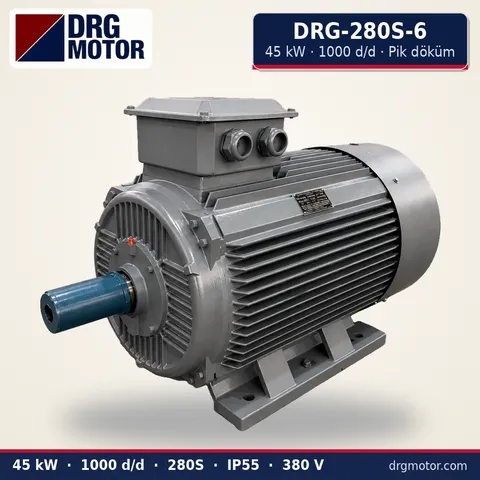
45 kW Three-Phase Motor 1000 rpm – DRG-280S-6 Cast Iron
- 45 kW · 1000 rpm (6 poles)
- Cast iron frame · IEC 280S
- Shaft: 75 × 140 mm
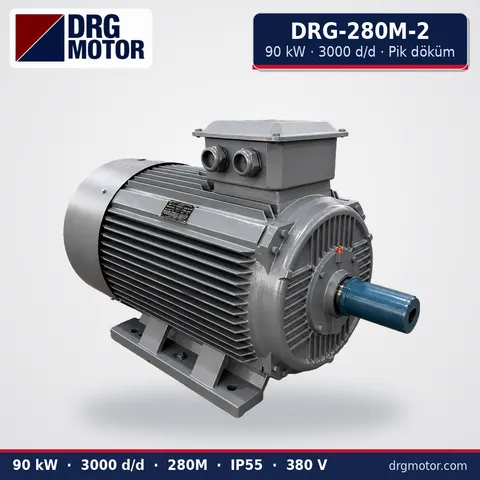
90 kW Three-Phase Motor 3000 rpm – DRG-280M-2 Cast Iron
- 90 kW · 3000 rpm (2 poles)
- Cast iron frame · IEC 280M
- Shaft: 65 × 140 mm
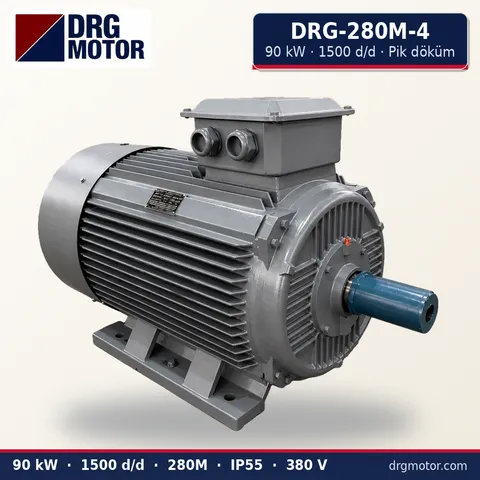
90 kW Three-Phase Motor 1500 rpm – DRG-280M-4 Cast Iron
- 90 kW · 1500 rpm (4 poles)
- Cast iron frame · IEC 280M
- Shaft: 75 × 140 mm
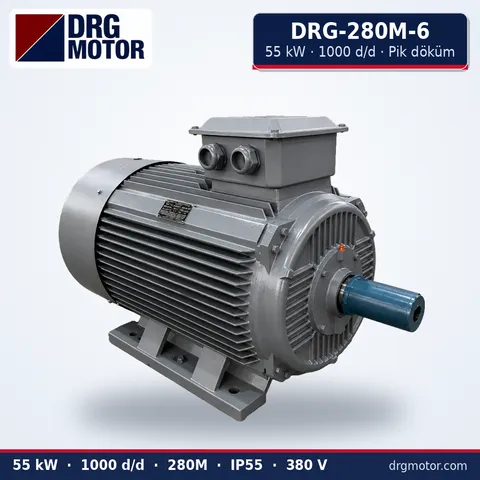
55 kW Three-Phase Motor 1000 rpm – DRG-280M-6 Cast Iron
- 55 kW · 1000 rpm (6 poles)
- Cast iron frame · IEC 280M
- Shaft: 75 × 140 mm