English
 Le français
 Türkçe




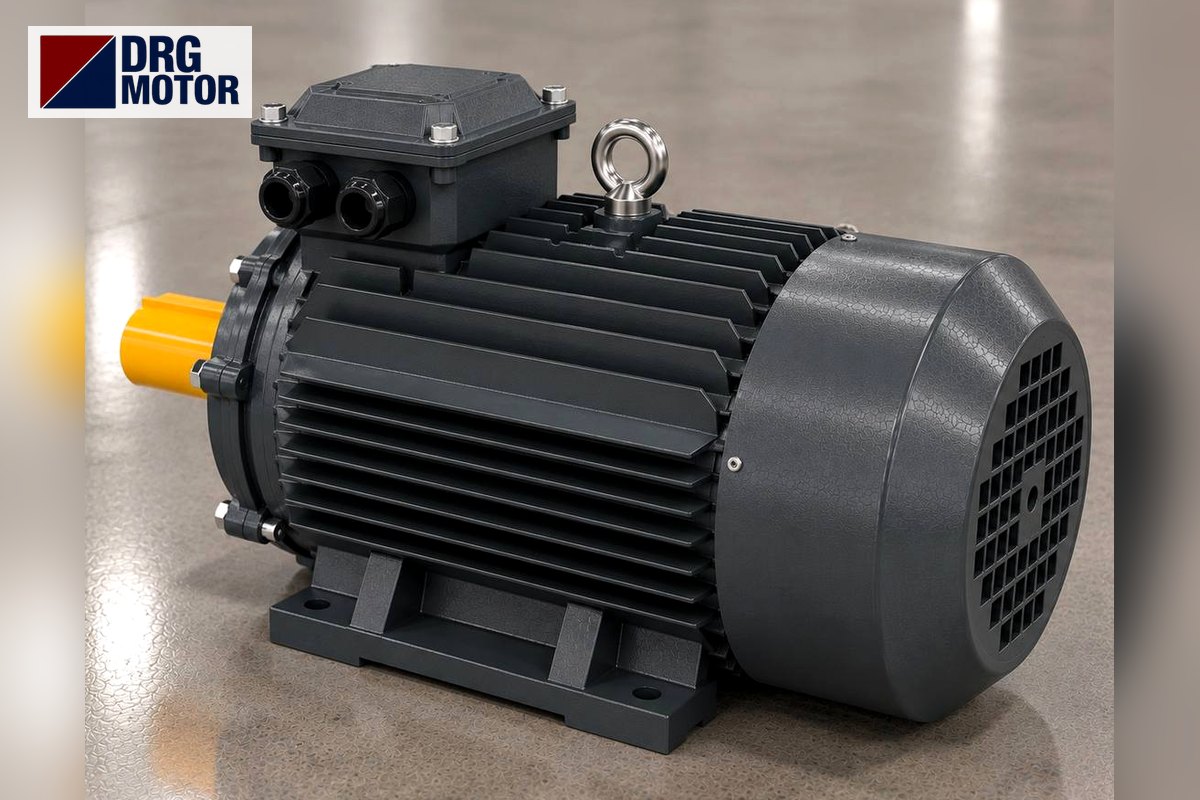

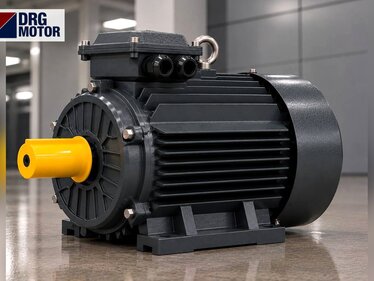
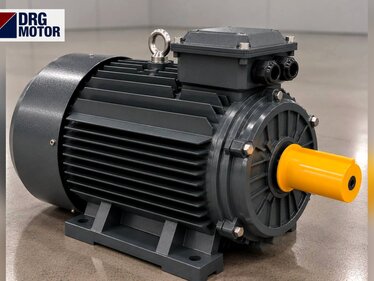
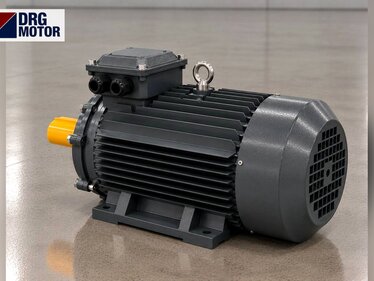
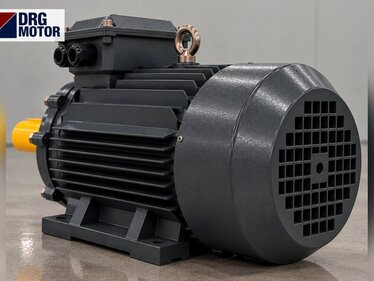
The 250M frame holds three DRG Motor cast iron models: the DRG-250M-2 (55 kW, 2-pole), the DRG-250M-4 (55 kW, 4-pole) and the DRG-250M-6 (37 kW, 6-pole). All three share the same outline — shaft height H 250 mm, foot holes A 406 × B 349 mm and overall length L 910 mm; the only mounting dimension that separates them is the shaft diameter: 60×140 mm on 2-pole, 65×140 mm on 4- and 6-pole.
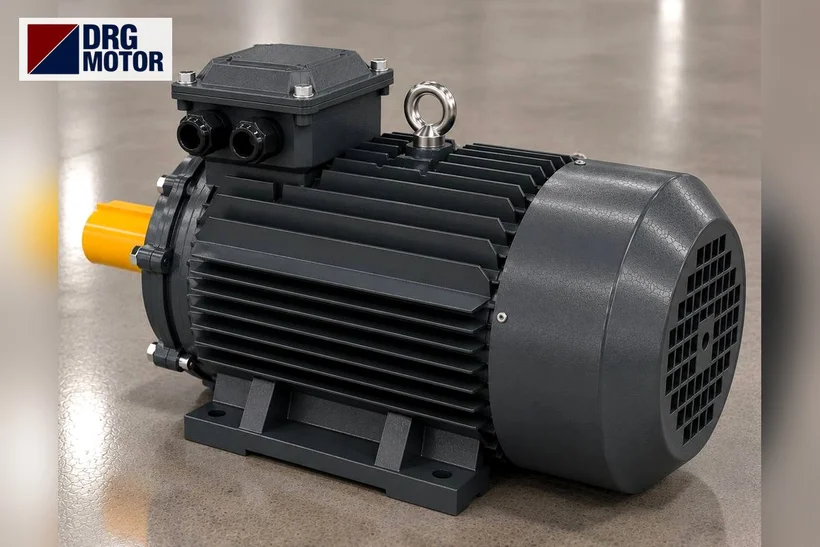
The three product pages sit in the three-phase asynchronous electric motors range, and you can compare them with other frames in the online motor shop. 250M is a frame often found on large centrifugal fans, circulation pumps, screw compressors and crusher or screen lines in the 55 kW class. This article is written for maintenance teams replacing a motor on such machines and for engineers specifying a new one.
Three models, two ratings in the 250M frame
In 250M, the DRG range offers 55 kW at two speeds and 37 kW at low speed. The first speed in the table is the class (synchronous speed); the second is the rated speed printed on the nameplate. The DRG-250M-4, for example, belongs to the 1500 rpm class and reads 1485 rpm on its nameplate; the 15 rpm gap is the slip of an induction motor under load.
| Model (poles) | Power | Class / nameplate speed | Current at 400 V |
|---|---|---|---|
| DRG-250M-2 (2-pole) | 55 kW / 75 HP | 3000 / 2970 rpm | 93.5 A |
| DRG-250M-4 (4-pole) | 55 kW / 75 HP | 1500 / 1485 rpm | 97.6 A |
| DRG-250M-6 (6-pole) | 37 kW / 50 HP | 1000 / 985 rpm | 68.1 A |
All three models are wired 400/690 V (Δ/Y): delta on a 400 V supply, which also makes them suitable for star-delta starting. At 55 kW the current difference between 2-pole and 4-pole is 4.1 A at 400 V, so size cables and breakers for each model separately.
One frame, two shafts: 60 mm or 65 mm?
What sets 250M apart from other large frames is that the pole difference shows up only in the shaft diameter. In DRG records, the only B3 dimension that differs between the 2-pole and the 4/6-pole 250M is D; shaft length E, key width F, thread and overall length remain the same.
| Shaft dimension (mm) | 2-pole – 55 kW | 4-pole – 55 kW | 6-pole – 37 kW |
|---|---|---|---|
| D – shaft diameter | 60 | 65 | 65 |
| E – shaft length | 140 | 140 | 140 |
| F – key width | 18 | 18 | 18 |
| G – key-seat bottom dimension | 53 | 58 | 58 |
| DH – shaft end thread | M20×42 | M20×42 | M20×42 |
That similarity is a trap. With identical shaft length and key, a 60 mm and a 65 mm shaft are hard to tell apart by eye — the difference is only 5 mm. A coupling hub or pulley bore will not tolerate those 5 mm: a 65 mm bore sits loose on a 60 mm shaft, and a 60 mm bore will not go onto a 65 mm shaft at all. The key-seat dimension G carries the same difference (53 / 58 mm). Ordering "a 55 kW 250M motor" is therefore incomplete; the pole count must be stated. Shaft and hub relationships are detailed in motor shaft diameter, key and coupling standards, and the shafts of other ratings are listed in the motor shaft diameter by kW table.
Click to see current electric motor prices and order nowSEE PRICES →
250M B3 foot dimensions and housing size
There is no difference in the foot mounting between the three models; the values below are common to the 2-, 4- and 6-pole 250M. Check base holes against this table when replacing a motor.
| B3 dimension | Value (mm) | Where to measure on site |
|---|---|---|
| H – shaft height | 250 | From foot base to shaft axis |
| A – foot hole spacing, across | 406 | Centres of two opposite foot holes |
| B – foot hole spacing, lengthwise | 349 | Front and rear hole centres on one side |
| C – shaft shoulder to front foot hole | 168 | From shaft shoulder to front hole centre |
| K – foot holes | 4–Ø24 | Number and diameter of holes |
| AC – housing diameter | 485 | Outer diameter including fins |
| AD – axis to terminal box top | 358 | From shaft axis to box cover |
| L – overall length | 910 | From shaft end to rear of fan cowl |
The shared foot pattern has a practical benefit: on the same base, a 37 kW 6-pole motor can take the place of a 55 kW 4-pole motor (or the reverse) with the foot holes and shaft axis unchanged, and with the same shaft (65×140 mm). What changes is the speed and torque seen by the machine. Drawing files are available on the 2D technical drawings and 3D technical drawings pages.
B5 flanged 250M: two catalogue rows
In DRG's B5 large-flange catalogue table, 250M appears as two rows: one for 2-pole and one for 4, 6 and 8 poles. The flange itself is the same in both rows: outer diameter P 550 mm, spigot diameter N 450 mm, bolt circle M 500 mm, hole diameter S 18.5 mm, spigot depth T 5 mm, flange thickness LA 22 mm.
| B5 dimension | 250M – 2-pole (mm) | 250M – 4/6-pole (mm) |
|---|---|---|
| P – flange outer diameter | 550 | 550 |
| N – spigot (pilot) diameter | 450 | 450 |
| M – bolt circle diameter | 500 | 500 |
| S – flange hole diameter | 18.5 | 18.5 |
| T – spigot depth | 5 | 5 |
| LA – flange thickness | 22 | 22 |
| D×E – shaft | 60×140 | 65×140 |
| G – key-seat bottom dimension | 53 | 58 |
| LB – flange face to rear end | 770 | 770 |
| L – overall length | 910 | 910 |
On a flange-mounted machine (a vertical pump stand, for instance), even when the old motor's flange matches these values, the shaft row still has to be chosen separately. Flange values for every frame are in the B5 motor flange dimensions table, and mounting arrangements are compared in motor mounting types B3, B5, B14 and B35.
The B14 small-flange table is not part of the DRG catalogue, so we do not give B14 or B34 dimensions for 250M. If you need such a connection, send the existing flange's outer diameter, bolt circle, spigot diameter and thread size on WhatsApp and we will check it.
Why does the 37 kW 6-pole give more torque than the 55 kW 4-pole?
250M holds a surprise at first glance: the lower-powered 6-pole model has a rated torque 5 Nm higher than the 55 kW 4-pole model. Torque is M = 9550·P/n (P in kW, n = nameplate speed in rpm); as speed drops, the same power turns into more torque.
| Model | Power / nameplate speed | Rated torque (Nm) | Check: 9550·P/n |
|---|---|---|---|
| DRG-250M-2 | 55 kW / 2970 rpm | 176.9 | 9550·55/2970 = 176.9 |
| DRG-250M-4 | 55 kW / 1485 rpm | 353.7 | 9550·55/1485 = 353.7 |
| DRG-250M-6 | 37 kW / 985 rpm | 358.7 | 9550·37/985 = 358.7 |
So on a machine that starts heavy at low speed (a large-diameter fan, a mixer, a belt conveyor), a 37 kW 6-pole delivers shaft torque similar to a 55 kW 4-pole with less power — but the machine speed changes, so the pulley ratio or reduction must be recalculated. At the same 55 kW, the 4-pole model's torque is about 2 times that of the 2-pole, which is why the 2-pole motor manages with a thinner shaft. The electric motor calculator helps with these figures.
Bearings, cable entry and electrical connection
DRG records list 6314-C3 bearings and a 2 × M63×1,5 cable entry for all three models. In the 55 kW class the 400 V current is 93.5–97.6 A, and 68.1 A for the 37 kW 6-pole. At these currents, cross-section and gland size go together: the outer diameter of the chosen cable must suit the 2 × M63×1,5 entries. Use the motor cable size calculator for the cross-section and the motor current chart for protection settings. The general design of large cast iron frames is covered in cast iron frame and high kW motors.
Matching the motor on site to 250M data
When replacing a motor whose nameplate is worn or painted over, following this order reduces the risk of picking the wrong shaft row. Shaft height and foot spacing identify the frame; shaft diameter identifies the pole row.
| Information | Where to get it | Compare with 250M data |
|---|---|---|
| Nameplate speed | Old motor nameplate | ~2970 rpm → 2-pole; ~1485 rpm → 4-pole; ~985 rpm → 6-pole |
| Shaft diameter | Caliper on the shaft, away from the keyway | 60 mm → 2-pole row; 65 mm → 4/6-pole row |
| Key-seat bottom dimension (G) | From keyway floor to the opposite shaft surface | 53 mm (2-pole) / 58 mm (4/6-pole) |
| Foot holes | Hole centre distances, across and lengthwise | A 406 mm, B 349 mm, C 168 mm, K 4–Ø24 mm |
| Shaft height | From foot base to shaft axis | H 250 mm |
| B5 flange | Outer diameter, spigot, bolt circle, hole size | P 550 / N 450 / M 500 / S 18.5 mm |
Ordering steps by shaft and frame are in the motor frame size order guide, and the model list by frame is in the price list by frame number.
Frequently asked questions
Can a 55 kW 2-pole and a 4-pole 250M motor replace each other?
Foot holes, shaft height and overall length are the same, but the shaft is 60 mm versus 65 mm, so the coupling hub or pulley changes. The speed also roughly halves or doubles; whether the pump or fan can run at that speed must be confirmed with the machine maker.
How long is the shaft of a 250M motor?
In DRG data, E is 140 mm on all three models; key width F 18 mm and shaft end thread M20×42 are also shared. Only the shaft diameter and the related G dimension differ.
Is there a 45 kW or 75 kW DRG motor in the 250M frame?
DRG data lists the 250M frame only for 55 kW (2- and 4-pole) and 37 kW (6-pole). Other ratings use other frames; see the shop or the price list article for the frame list.
Does the 250M flange change with pole count?
No; P 550, N 450, M 500 and S 18.5 mm are identical in both catalogue rows. The rows differ in shaft diameter (60 / 65 mm) and the G value.
Confirm with a nameplate photo and measurements
DRG Motor is an electric motor manufacturer, supplier and seller. To pick the right 250M model, send us a photo of the existing nameplate, the shaft diameter measured with a caliper and, if flanged, the flange dimensions; we will compare them with the DRG technical and product catalogue and agree the correct row with you.
Send a photo of your current motor nameplate and we will find the suitable DRG model together.Send on WhatsApp
Browse the 55 kW and 37 kW motors in the 250M frame with current pricesSEE PRICES
Electric Motors Related to This Topic — Models and Current Prices
Suitability is not decided by power alone: compare the speed, voltage, mounting, shaft and fixing dimensions of your machine with the product data; if unsure, send us the nameplate of your current motor.
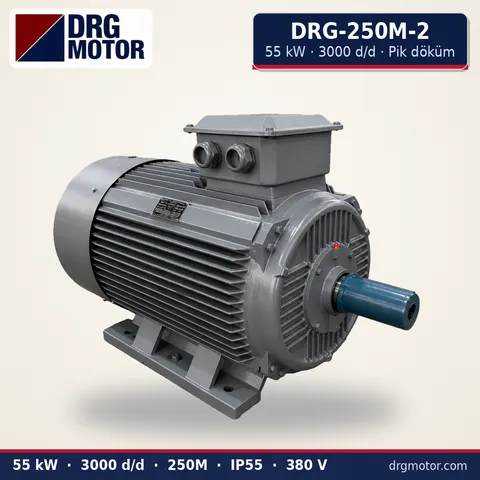
55 kW Three-Phase Motor 3000 rpm – DRG-250M-2 Cast Iron
- 55 kW · 3000 rpm (2 poles)
- Cast iron frame · IEC 250M
- Shaft: 60 × 140 mm
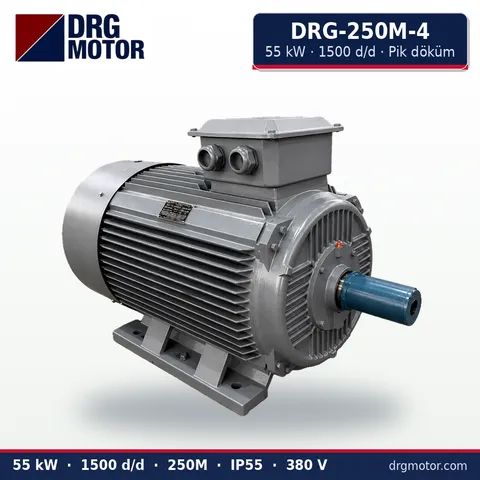
55 kW Three-Phase Motor 1500 rpm – DRG-250M-4 Cast Iron
- 55 kW · 1500 rpm (4 poles)
- Cast iron frame · IEC 250M
- Shaft: 65 × 140 mm
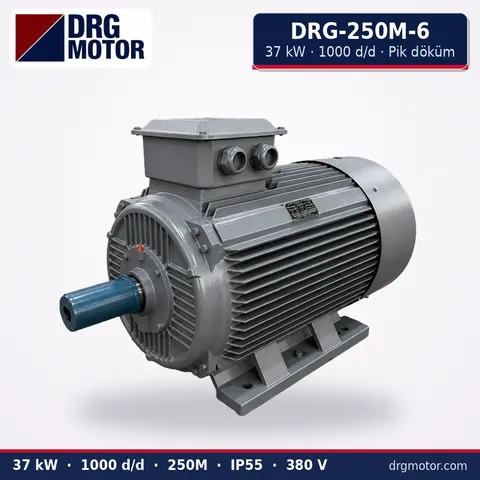
37 kW Three-Phase Motor 1000 rpm – DRG-250M-6 Cast Iron
- 37 kW · 1000 rpm (6 poles)
- Cast iron frame · IEC 250M
- Shaft: 65 × 140 mm