English
 Le français
 Türkçe




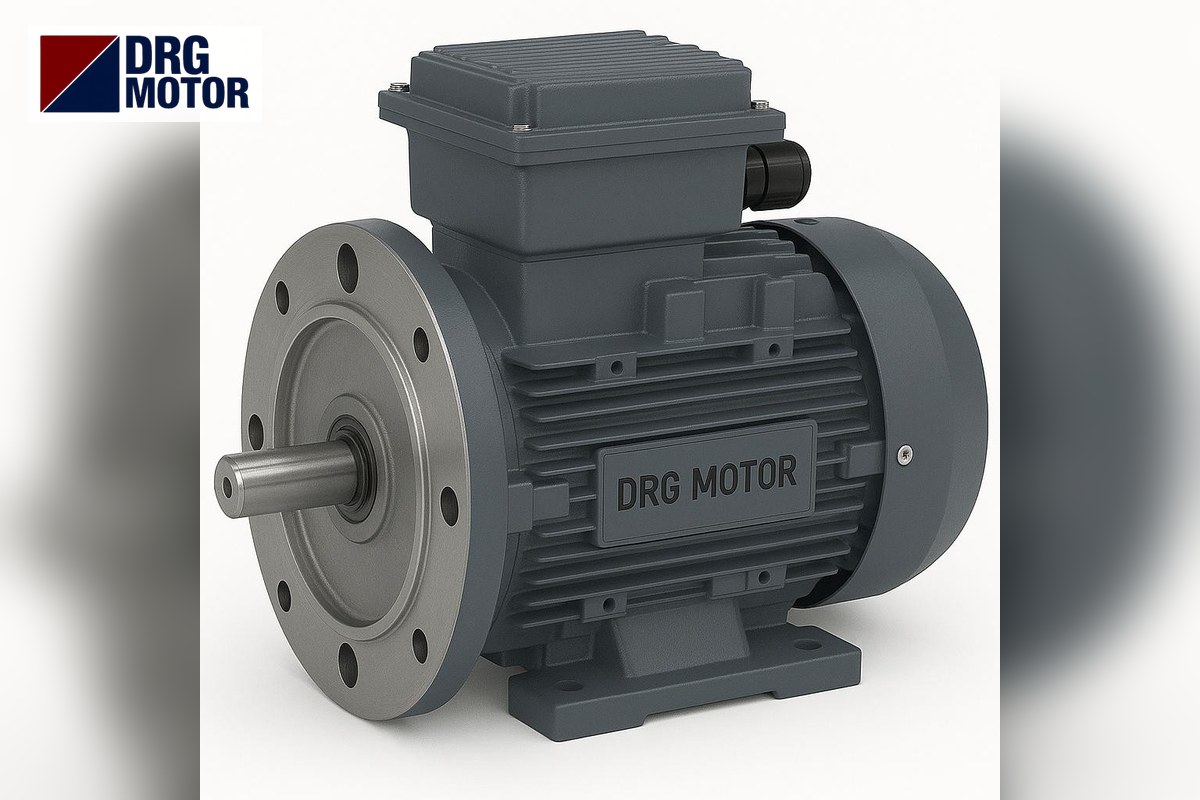

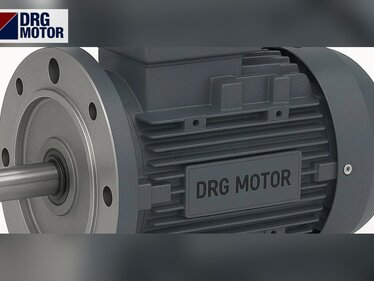
All three 15 kW (20 HP) flanged motors have cast iron housings and all share the same B5 flange: outer diameter P 350 mm, bolt circle M 300 mm, spigot diameter N 250 mm, spigot length T 5 mm, hole diameter S 18.5 mm. The 3000 rpm DRG-160M2-2 is a 160M frame, the 1500 rpm DRG-160L-4 a 160L and the 1000 rpm DRG-180L-6 a 180L. The flange is common, but the shaft changes: 42 × 110 mm on the 160 frame, 48 × 110 mm on the 180L.
At this power the real task is less about knowing the flange size and more about centring the flange correctly. A motor that sits crooked in a 250 mm spigot recess creates misalignment at the shaft end that loads the coupling, and the bearing and coupling element pay for it. Below, alongside the dimensions, we explain step by step how to check centring during installation.
The pages of the three models and other power ratings are in the Buy Electric Motors Online category; every code in this article links straight to its product page.
Flange and shaft data for the 15 kW frames
| Poles / model | Rated speed | Frame | Spigot N × T | Bolt circle M / S | Outer dia. P / LA | Housing dia. AC | Shaft D × E, key F | Buy |
|---|---|---|---|---|---|---|---|---|
| 2 – DRG-160M2-2 | 2945 rpm | 160M | 250 × 5 | 300 / 18.5 | 350 / 15 | 314 | 42 × 110, 12 | See Prices |
| 4 – DRG-160L-4 | 1465 rpm | 160L | 250 × 5 | 300 / 18.5 | 350 / 15 | 314 | 42 × 110, 12 | See Prices |
| 6 – DRG-180L-6 | 978 rpm | 180L | 250 × 5 | 300 / 18.5 | 350 / 15 | 355 | 48 × 110, 14 | See Prices |
Two points stand out. First, the B5 flange of the 160 and 180 frames is identical in the catalogue; you do not need to change the flange recess on the machine to take the 6-pole motor, but the coupling hub and the 14 mm key change for the 48 mm shaft. Second, the 180L housing diameter AC is 355 mm, larger than the 350 mm flange outer diameter. If the part of the motor behind the flange has to pass through an opening in a plate or bracket, allow for this 5 mm overhang.
What do the spigot diameter and spigot length do?
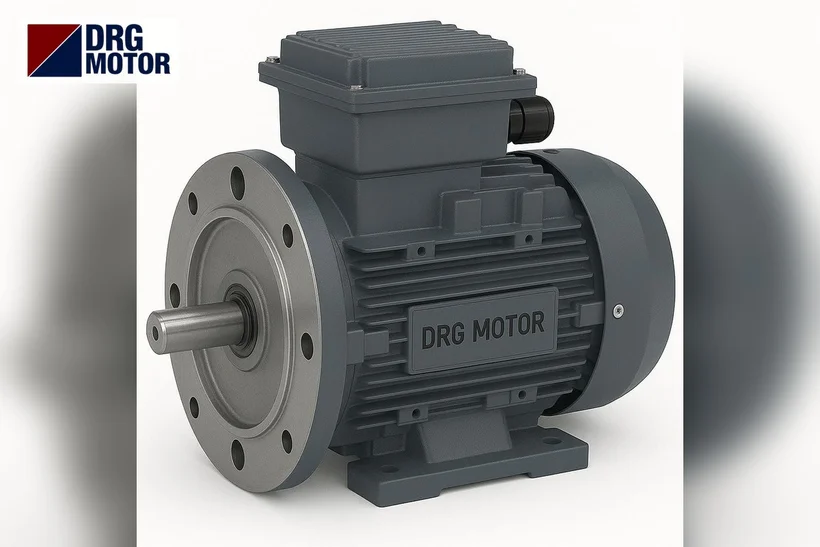
The raised ring in the middle of the B5 flange (diameter N, height T) enters the recess in the mating part and brings the motor shaft onto the machine axis. The bolts only provide clamping force; the axis is set by this spigot. With 18.5 mm holes there is natural clearance between bolt and hole; if the bolts are tightened before the spigot is fully home, the motor can shift by that clearance.
On the 15 kW frames T is 5 mm. The spigot engages the recess by only 5 mm, so a slight tilt lets it ride on the edge of the recess. Believing the motor is "seated" before the flange face lies fully against the mating face is the most common installation error at this power.
Confirming the frame by measuring the existing flange
When replacing an old motor with an unreadable nameplate, measuring the flange is the quickest way to identify the frame. Take the outer diameter of the spigot with a calliper: if it reads 250 mm, you are dealing with a 160 or 180 frame flange. The bolt circle is hard to measure directly; adding one hole diameter (S) to the distance between the inner edges of two opposite holes gives the hole centre distance, i.e. M. On a flange with 18.5 mm holes, an inner-edge distance of about 281.5 mm means M is 300 mm. If the flange outer diameter P is 350 mm and the flange thickness LA 15 mm, the measurements agree with the table.
The flange size does not tell 160 from 180, because both frames carry the same flange. To separate them, look at the shaft: 42 mm means a 160 frame, 48 mm a 180 frame. Then measure the body length from flange to rear end (LB): 498 mm on 160M, 542 mm on 160L, 616 mm on 180L. Together these three measurements make clear which code to order.
Centring a large flange: step by step
- Clean the mating recess and the motor flange; paint drops, burrs and old gasket residue stop the 5 mm spigot from entering fully.
- Measure the recess diameter with a calliper; it should be a fit the 250 mm spigot can enter but not rock in by hand.
- Hold the motor level on the hoist and push the spigot straight into the recess; do not tighten the bolts until the gap between flange face and mating face is zero all round.
- Tighten the bolts first by hand, then gradually in a cross pattern. Fully tightening one bolt before moving to the next tilts the flange.
- Check the gap between coupling halves and the axial misalignment with a dial gauge or straightedge; if there is misalignment, do not try to "force" it right without removing the flange.
- Turn the shaft by hand; any rubbing or binding means centring is not complete.
On flange-carried machines such as pumps, coupling alignment, smooth rotation by hand and vibration at first start together show that centring was done right. For a general comparison of mounting types, see our article on B3, B5, B14 and B35 mounting types.
Torque and shaft: three different loads on one flange
Even with the same flange, the torque passing through it changes with speed. Rated torque is 48.6 Nm at 2945 rpm, 97.8 Nm at 1465 rpm and 146.5 Nm at 978 rpm. This threefold torque is why the 6-pole model's shaft goes up to 48 mm. At start, torque rises to 2.0–2.2 times rated; on the 1500 rpm model about 97.8 × 2.2 ≈ 215 Nm of starting torque passes through the coupling and the flange bolts.
With directly coupled loads such as pumps or gearboxes the torque goes through the coupling; with belt drives it lands on the shaft end as radial force. Since in flange mounting the belt force is carried through the flange, belt-driven applications in the 15 kW class are mostly built with foot-mounted or B35 motors. To see output speed and torque for your own ratio, use the gearbox output speed calculator.
Electrical data
All three models are wound for 400/690 V (Δ/Y) and are connected in delta at 380 V. Rated current at 400 V is 26.5 A (2-pole), 27.3 A (4-pole) and 29.3 A (6-pole); cos φ is 0.89, 0.86 and 0.81. With starting current ratios of 8.1, 7.8 and 7.3, star-delta starting is common at this power. Use the motor cable size calculator for the cable cross-section; the connection must be made by a qualified electrician.
Technical elements that set the price
At 15 kW the housing material is fixed (cast iron). The variables are the number of poles, the resulting frame length (160M, 160L, 180L) and the mounting: flange-only B5 or feet + flange B35. The 6-pole model moving up one frame enlarges the construction. To see the current status, open the relevant code among the 120 models in our online shop.
Checklist before installation
- Is the mating recess 250 mm in diameter and at least 5 mm deep?
- Is the bolt circle 300 mm and do the bolts suit 18.5 mm holes?
- Is the coupling hub 42 mm (160) or 48 mm (180L)?
- For the 180L, is there an opening the 355 mm housing can pass through?
- Is there axial room for 608, 652 or 726 mm length?
- If there is a belt drive, has B35 been chosen?
- Will the bolts be tightened in a cross pattern after the flange face is fully seated?
15 kW flanged cast iron motors
- DRG-160M2-2 — 15 kW · 2945 rpm · 160M · cast iron
- DRG-160L-4 — 15 kW · 1465 rpm · 160L · cast iron
- DRG-180L-6 — 15 kW · 978 rpm · 180L · cast iron
Click to see current prices and order these motors nowSEE PRICES →
Frequently Asked Questions
What are the flange dimensions of a 15 kW motor?
The B5 flange of the DRG 15 kW models (160M, 160L and 180L frames) is P 350 mm, M 300 mm, N 250 mm, T 5 mm, S 18.5 mm.
What is the shaft diameter of a 20 HP motor?
The shaft is 42 × 110 mm on the 3000 and 1500 rpm 15 kW models and 48 × 110 mm on the 1000 rpm model.
Are the 160 and 180 frame flanges the same?
In the catalogue B5 dimensions, yes: both are P 350 / M 300 / N 250 mm. What differs is the shaft diameter (42 and 48 mm), the key and the housing diameter.
What should be checked if a flanged motor vibrates?
First check that the spigot is fully seated in the recess, the flange face lies flat without a gap and the coupling is aligned. Bolts not tightened in a cross pattern can also tilt the flange and cause vibration.
Share the dimensions of your mounting recess and we will settle the right 15 kW frame together: +90 (542) 666 11 11, [email protected] or the contact page. For other powers and speeds, browse the Buy Electric Motors Online page.