English
 Le français
 Türkçe




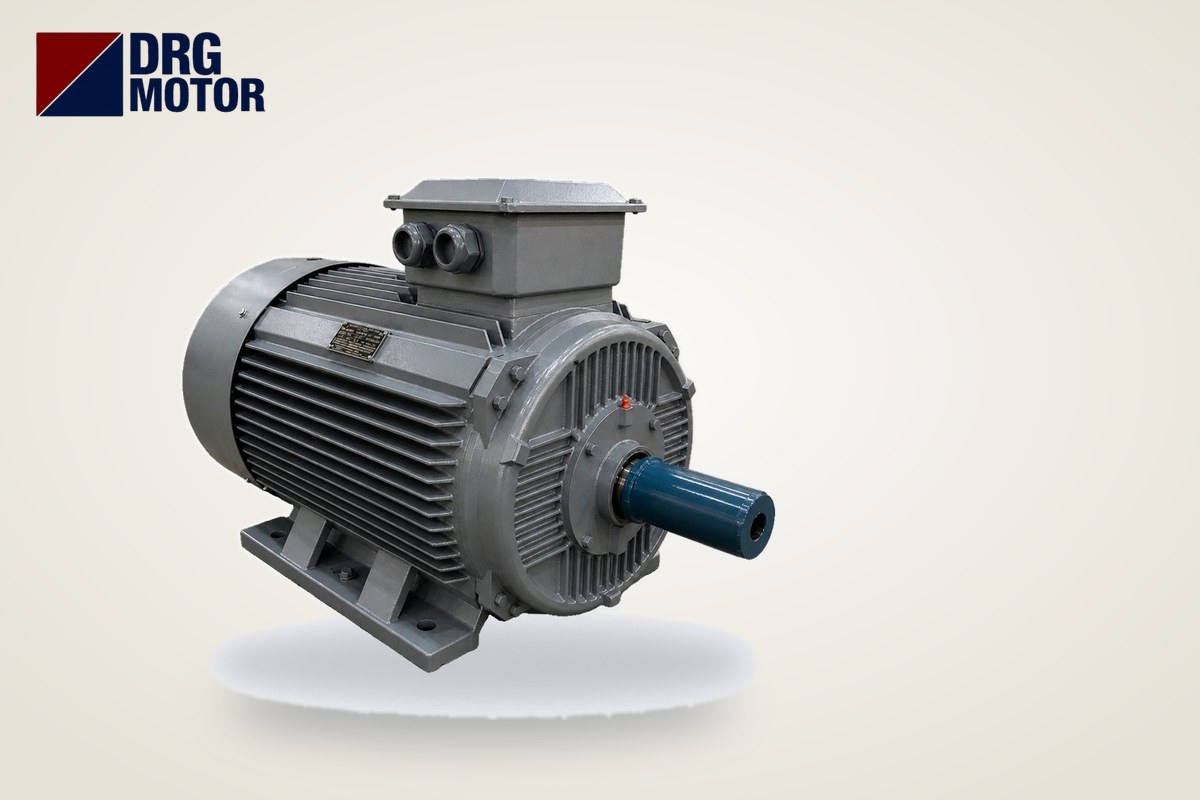

A motor's shaft diameter depends not on kW but on its IEC frame: for example, a 15 kW 1500 rpm motor has a 160L frame and a shaft 42 mm in diameter and 110 mm long (key width 12 mm); the same 15 kW at 3000 rpm has a 160M frame and again a 42×110 shaft, while the 1000 rpm version moves up to a 180L frame with a 48×110 shaft. Among the standard motors in the DRG store, shaft diameters range from 11 mm at 0.25 kW to 100 mm on the 315 kW 4-pole motor. The table below gives the frame, shaft diameter × shaft length and key width for each power and pole count in a single cell.
There are two reasons why the shaft diameter changes at the same power. The first is the number of poles: as speed falls, the torque needed for the same kW rises, the motor moves to a larger frame and the shaft gets thicker. The second is the frame design: compact series motors deliver the same power in a frame one size smaller, so their shaft is also one step thinner. That is why writing only the kW is not enough when ordering a coupling or pulley. You can see the motors in the table with their frame and shaft dimensions on our Buy Electric Motors Online page.
For a general explanation of shaft ends, key standards and coupling types, see our article on shaft diameter, key and coupling standards in electric motors; this article focuses directly on the dimension table by power.
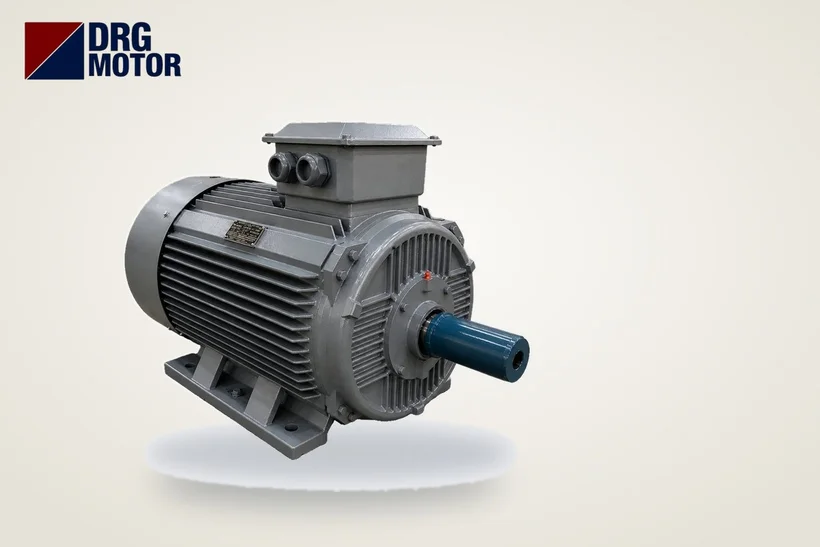
Motor Shaft Diameter by kW Table (0.25–315 kW)
Each cell shows, in order, IEC frame · shaft diameter D × shaft length E · key width F; all dimensions are in mm. The values are the catalogue dimensions of the standard (non-compact) models in the DRG store. The 315 kW 6-pole motor has a 400M frame and, since the catalogue gives no shaft dimension for it, no dimension is shown in that cell.
| Power (kW) | 2-pole – 3000 rpm | 4-pole – 1500 rpm | 6-pole – 1000 rpm |
|---|---|---|---|
| 0.25 | 63 · 11×23 · 4 | 71 · 14×30 · 5 | 71 · 14×30 · 5 |
| 0.37 | 71 · 14×30 · 5 | 71 · 14×30 · 5 | 80 · 19×40 · 6 |
| 0.55 | 71 · 14×30 · 5 | 80 · 19×40 · 6 | 80 · 19×40 · 6 |
| 0.75 | 80 · 19×40 · 6 | 80 · 19×40 · 6 | 90S · 24×50 · 8 |
| 1.1 | 80 · 19×40 · 6 | 90S · 24×50 · 8 | 90L · 24×50 · 8 |
| 1.5 | 90S · 24×50 · 8 | 90L · 24×50 · 8 | 100L · 28×60 · 8 |
| 2.2 | 90L · 24×50 · 8 | 100L · 28×60 · 8 | 112M · 28×60 · 8 |
| 3 | 100L · 28×60 · 8 | 100L · 28×60 · 8 | 132S · 38×80 · 10 |
| 4 | 112M · 28×60 · 8 | 112M · 28×60 · 8 | 132M · 38×80 · 10 |
| 5.5 | 132S · 38×80 · 10 | 132S · 38×80 · 10 | 132M · 38×80 · 10 |
| 7.5 | 132S · 38×80 · 10 | 132M · 38×80 · 10 | 160M · 42×110 · 12 |
| 11 | 160M · 42×110 · 12 | 160M · 42×110 · 12 | 160L · 42×110 · 12 |
| 15 | 160M · 42×110 · 12 | 160L · 42×110 · 12 | 180L · 48×110 · 14 |
| 18.5 | 160L · 42×110 · 12 | 180M · 48×110 · 14 | 200L · 55×110 · 16 |
| 22 | 180M · 48×110 · 14 | 180L · 48×110 · 14 | 200L · 55×110 · 16 |
| 30 | 200L · 55×110 · 16 | 200L · 55×110 · 16 | 225M · 60×140 · 18 |
| 37 | 200L · 55×110 · 16 | 225S · 60×140 · 18 | 250M · 65×140 · 18 |
| 45 | 225M · 55×110 · 16 | 225M · 60×140 · 18 | 280S · 75×140 · 20 |
| 55 | 250M · 60×140 · 18 | 250M · 65×140 · 18 | 280M · 75×140 · 20 |
| 75 | 280S · 65×140 · 18 | 280S · 75×140 · 20 | 315S · 85×170 · 22 |
| 90 | 280M · 65×140 · 18 | 280M · 75×140 · 20 | 315M · 85×170 · 22 |
| 110 | 315S · 65×140 · 18 | 315S · 85×170 · 22 | 315L · 85×170 · 22 |
| 132 | 315M · 65×140 · 18 | 315M · 85×170 · 22 | 315L · 85×170 · 22 |
| 160 | 315L · 65×140 · 18 | 315L · 85×170 · 22 | 355M · 100×170 · 25 |
| 185 | 315L · 65×140 · 18 | 315L · 85×170 · 22 | 355M · 100×170 · 25 |
| 200 | 315L · 65×140 · 18 | 315L · 85×170 · 22 | 355M · 100×170 · 25 |
| 250 | 355M · 75×140 · 20 | 355M · 100×170 · 25 | 355L · 100×170 · 25 |
| 315 | 355L · 75×140 · 20 | 355L · 100×170 · 25 | 400M (ask for dimensions) |
The Frame, Not the Power, Sets the Shaft Diameter
Read the table column by column rather than row by row and the rule becomes visible: the shaft size does not change unless the frame number changes. In 4-pole versions, the 11 kW (DRG-160M-4) and 15 kW (DRG-160L-4) motors have different power ratings, but because of their 160M and 160L frames they carry the same 42×110 shaft. Likewise, in 2-pole versions both the 5.5 kW and 7.5 kW motors have a 132S frame and a 38×80 shaft.
Conversely, when the same kW falls into a different frame, the shaft changes too. In the 3 kW example, the 2-pole and 4-pole motors use a 28×60 shaft on a 100L frame, while the 6-pole 3 kW motor moves up to a 132S frame with a 38×80 shaft. The compact series is the clearest example:
- 5.5 kW 4-pole: standard DRG-132S-4 132S frame, shaft 38×80; compact DRG-112M-4K 112M frame, shaft 28×60.
- 11 kW 4-pole: standard DRG-160M-4 160M frame, shaft 42×110; compact DRG-132M-4K 132M frame, shaft 38×80.
- 3 kW 2-pole: standard DRG-100L-2 100L frame, shaft 28×60; compact DRG-90L-2K 90L frame, shaft 24×50.
So when replacing an old motor with a new one of the same power, you tell whether the coupling or pulley will fit by looking not at the power but at the old motor's frame and the shaft you measured.
2-Pole vs 4-Pole Shaft Difference on the Same Frame
On frames 225M and larger, the same frame number carries two different shafts. 2-pole motors run at high speed with lower torque, so their shaft is thinner; from 4 poles upwards the torque roughly doubles and the shaft gets thicker. For example, at 45 kW the 2-pole DRG-225M-2 has a rated torque of 144.9 Nm and the 4-pole DRG-225M-4 289.4 Nm; accordingly the shafts are 55×110 and 60×140. The table below lists the frames with this difference, together with the catalogue key width F and the shaft-plus-key height GA.
| Frame | 2-pole D×E | 2-pole F / GA | 4-pole and above D×E | 4-pole and above F / GA |
|---|---|---|---|---|
| 225M | 55×110 | 16 / 59 | 60×140 | 18 / 64 |
| 250M | 60×140 | 18 / 64 | 65×140 | 18 / 69 |
| 280S | 65×140 | 18 / 69 | 75×140 | 20 / 79.5 |
| 280M | 65×140 | 18 / 69 | 75×140 | 20 / 79.5 |
| 315S | 65×140 | 18 / 69 | 85×170 | 22 / 85 |
| 315M | 65×140 | 18 / 69 | 85×170 | 22 / 85 |
| 315L | 65×140 | 18 / 69 | 85×170 | 22 / 85 |
| 355M | 75×140 | 20 / 79.5 | 100×170 | 25 / 100 |
| 355L | 75×140 | 20 / 79.5 | 100×170 | 25 / 100 |
The difference is largest on frames 315 and 355: 65 mm versus 85 mm on the 315 frame and 75 mm versus 100 mm on the 355 frame. On these frames, ordering a coupling for a "315 frame motor" without stating the number of poles leads to the wrong hub. On frames 200L and smaller, the catalogue shaft size does not change with the number of poles.
Verifying the Shaft Dimensions on Site
On a motor whose nameplate is unreadable or whose frame number is unknown, measuring the shaft is the quickest way to find the row in the table. Before measuring, clean the shaft, remove the key and hold the caliper perpendicular to the shaft.
D and E: diameter and length
Measure the shaft diameter at two points away from the keyway, in two directions at right angles. The shaft length E is the distance from the shaft shoulder (where the shaft leaves the end shield) to the shaft end. The diameter you measure should match one of the standard values in the table (e.g. 24, 28, 38, 42, 48); a value in between indicates that the shaft is worn or was machined to a non-standard size.
F and GA: key width and key height
Take the keyway width F by inserting the inside jaws of the caliper into the keyway. With the key in place, the distance from the bottom of the shaft to the top of the key is GA; the keyway depth in the coupling or pulley hub is machined to this dimension. For example, GA is 45 mm on the 160L frame and 64 mm on the 225M 4-pole version.
Shaft end thread
The centre hole thread at the shaft end (DH in the catalogue) is for pulley pullers and hub retaining bolts. It is given as M16×36 on the 160L frame and M20×42 on the 225M frame; if you will secure the hub axially, choose the bolt according to this thread.
Checklist for Ordering a Coupling or Pulley
- State the motor's frame and number of poles, not its power (e.g. "160L, 4-pole").
- Give the shaft diameter × length (D×E) and key width (F) as dimensions: "42×110, key 12".
- Also give the GA dimension for the hub keyway.
- On frames 225M and above, always add whether the motor is 2-pole or 4-pole.
- If you use a compact series motor, remember that its shaft is one step smaller than a standard motor of the same power.
- Make sure the pulley hub length does not exceed the shaft length E; the hub should seat against the shaft shoulder.
- If you have not yet settled the motor power and speed, first determine the kW with our electric motor calculators.
Example Motors by Shaft Size
The models below represent the key cases in the table: the three pole versions of 15 kW, the compact 11 kW and the 45 kW pair with different shafts on the same frame. For other ratings, the 120 models in our online store are listed with their frame and shaft dimensions.
- DRG-160L-4 – 15 kW – 1500 rpm – 160L cast iron frame
- DRG-160M2-2 – 15 kW – 3000 rpm – 160M cast iron frame
- DRG-180L-6 – 15 kW – 1000 rpm – 180L cast iron frame
- DRG-132M-4K – 11 kW – 1500 rpm – 132M aluminium frame
- DRG-225M-2 – 45 kW – 3000 rpm – 225M cast iron frame
- DRG-225M-4 – 45 kW – 1500 rpm – 225M cast iron frame
Click to see current prices and order these motors nowSEE PRICES →
Frequently Asked Questions
What is the shaft diameter of a 15 kW motor?
On 15 kW 1500 rpm (160L) and 15 kW 3000 rpm (160M) motors the shaft is 42×110 mm with a 12 mm key. The 15 kW 1000 rpm motor has a 180L frame with a 48×110 mm shaft and a 14 mm key.
What is the shaft diameter of an 11 kW motor?
Standard 11 kW motors have a 160M frame in 2-pole and 4-pole versions and a 160L frame in the 6-pole version, and all three have a 42×110 mm shaft. The compact 11 kW 4-pole motor, however, has a 38×80 mm shaft on a 132M frame.
What is the shaft size of a 7.5 kW motor?
On 7.5 kW 2-pole (132S) and 4-pole (132M) motors the shaft is 38×80 mm with a 10 mm key. The 7.5 kW 6-pole motor has a 160M frame and a 42×110 mm shaft.
Why are there two different shaft diameters on the same frame?
On frames 225M and above, motors with 4 or more poles transmit roughly twice the torque at the same power, so they use a thicker shaft. For example, on the 315 frame the shaft is 65×140 on the 2-pole motor and 85×170 mm on the 4-pole motor.
To determine together the motor that fits your existing coupling or pulley, call +90 (542) 666 11 11, send the shaft dimensions to [email protected] or use our contact page. A motor whose dimensions are already known can be ordered directly from the Buy Electric Motors Online page.