English
 Le français
 Türkçe




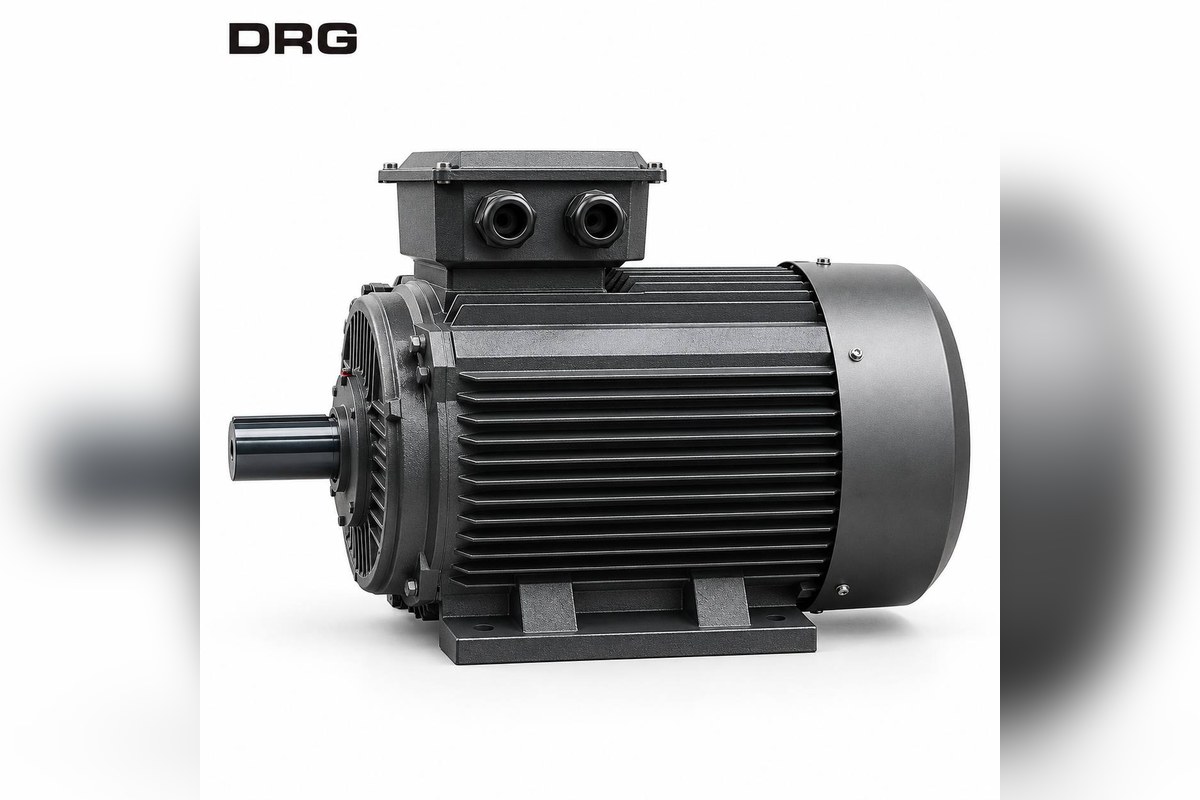

When replacing the hydraulic pump motor of a press brake, the new motor must match the old motor's nameplate power and speed and, just as importantly, the bell-housing flange and coupling dimensions that connect it to the pump; even with the right power, the motor will not fit if the flange or shaft is different. For example, the direct replacement for a motor whose nameplate shows 11 kW, about 1460 rpm and frame 160M is the DRG-160M-4 (20.4 A at 400 V, shaft 42 × 110 mm); the compact DRG-132M-4K of the same power has a different flange and shaft, so it cannot be fitted to the old bell housing.
On a press brake there is no need to re-size the motor by calculation: the machine builder has already set the power for the pump. The real work is matching correctly, checking the direction of rotation and measuring the current after commissioning. Removal, wiring and panel work must be done by a qualified electrician, and the hydraulic circuit must not be opened until the ram (upper beam) is mechanically secured. You can find suitable models and current prices on the Buy Electric Motors Online page.
The 3 most common mistakes when replacing a press brake motor
- Ordering by kW only: an 11 kW motor exists in both a 160M frame and a compact 132M frame; if the bell housing is machined for 160M, the compact motor's flange and shaft will not fit.
- Applying pressure without checking rotation: a gear or vane pump running backwards does not draw oil; even a few seconds of dry running can damage the pump.
- Raising the pressure setting because "the new motor is stronger": the new motor is not stronger, it has the same power; if the setting is raised, the current exceeds the nameplate value at the end of the bend.
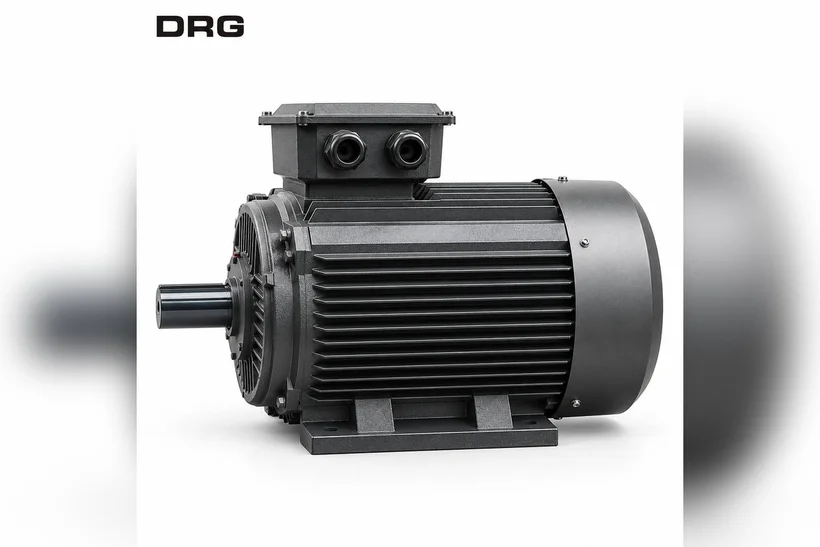
What information should be taken from the old motor's nameplate?
Photograph the nameplate before removing the motor; if it is painted over or worn, identify the motor by its frame and flange dimensions. For a general guide to reading nameplates see our how to read a motor nameplate article; the critical lines for a press brake replacement are:
| Nameplate data | What to check | Match on new motor |
|---|---|---|
| kW | Rated power | Same kW |
| rpm (min⁻¹) | Around 1450 = 4-pole | 4-pole (1500 rpm) |
| V and Δ/Y | 400 V Δ or 400 V Y? | 400/690 V or 230/400 V |
| A | Rated current | Overload setting |
| IM / mounting | B5, B35, V1 | Same mounting |
| Frame (e.g. 160M) | Shaft height | Flange and shaft fit |
If the nameplate says 400 V Δ, the motor has a 400/690 V winding and probably starts in star-delta; the new motor must also be 400/690 V. In the DRG range, motors from 4 kW upwards are 400/690 V, so no panel change is needed in the 5.5–22 kW range common on press brakes.
Click to see current electric motor prices and order nowSEE PRICES →
Bell housing and coupling: how does the motor sit on the pump?
On most press brake units the motor is mounted vertically (V1) on the tank lid; between motor and pump there is an aluminium or cast bell housing and a flexible coupling with two half hubs. The motor side of the bell housing is machined to the motor's B5 flange. The B5 flange dimensions of frame 160M are:
- Flange outer diameter P: 350 mm
- Pitch circle M: 300 mm
- Spigot diameter N: 250 mm
- Hole diameter S: 18.5 mm
- Flange thickness LA: 15 mm
- Shaft D × E: 42 × 110 mm
The compact DRG-132M-4K, however, is in frame 132M: flange P 300 mm, M 265 mm, N 230 mm, shaft 38 × 80 mm. So for the same 11 kW both the bell housing and the coupling hub are different. Frames 160M and 160L share the same flange and shaft and differ only in body length; that is why moving from 11 kW to 15 kW usually leaves the bell housing and coupling unchanged, and only the motor's length and weight need checking.
Shaft and key dimensions
| Model | Frame / shaft height | Shaft D × E | Key F |
|---|---|---|---|
| DRG-132S-4 | 132S / H 132 mm | 38 × 80 mm | 10 mm |
| DRG-132M-4 | 132M / H 132 mm | 38 × 80 mm | 10 mm |
| DRG-160M-4 | 160M / H 160 mm | 42 × 110 mm | 12 mm |
| DRG-132M-4K | 132M / H 132 mm | 38 × 80 mm | 10 mm |
| DRG-160L-4 | 160L / H 160 mm | 42 × 110 mm | 12 mm |
| DRG-180L-4 | 180L / H 180 mm | 48 × 110 mm | 14 mm |
The coupling hub bore must match the shaft diameter (D) and its keyway the key width (F). The hub must sit along the full shaft length (E), leaving the gap specified by the coupling between the two hubs. In vertical mounting the motor runs with vibration on top of the tank, so alignment and bolt tightening torque matter; for details see our shaft and coupling alignment article.
How is the direction of rotation checked?
The pump body carries an arrow showing the direction of rotation, as seen from the shaft end of the pump. On a vertical motor it is easier to check this by looking at the motor's fan cover: the fan appears to turn opposite to the pump arrow, because you are looking at the motor from the other end.
- Before fitting the coupling, bump the motor on and off and watch the fan's direction.
- If it is reversed, swap any two supply phases at the terminal box (qualified electrician, with power off).
- With the coupling fitted, listen at first start, without pressure, to whether the pump is drawing oil; tank level and flow in the return line should be normal.
- On a star-delta panel the direction must be the same on the star and delta contactors; if it changes at changeover, the delta bridge is wired wrongly.
Why measure current after setting the pressure?
After a motor replacement, the relief valve and bending pressure are usually re-set. The only way to show the setting does not overload the motor is to measure the current in all three phases with a clamp meter during the heaviest bend. For the DRG-160M-4 the nameplate current is 20.4 A at 400 V and 21.5 A at 380 V. Example readings:
| Measured after pressure setting | Ratio I / In | Meaning |
|---|---|---|
| 18 A | 0.88 | Normal, margin left |
| 20.4 A | 1.00 | At limit, check setting |
| 22.5 A | 1.10 | Overload, lower pressure |
If the current exceeds the nameplate value, compare the pressure setting and bending tonnage with the machine's capacity chart before thinking of a bigger motor. If there is a clear difference between phase currents, check the supply voltage and terminal connections. The overload relay must be set to the nameplate current; for selection use the overload-fuse-contactor selection tool.
Commissioning checklist
- Nameplate photo, old motor frame/flange dimensions and shaft diameter recorded.
- New motor flange (P, M, N) and shaft (D × E, F) identical to the old motor.
- Bell-housing bolts tightened crosswise, coupling hubs seated along the shaft.
- Direction checked without the coupling; pump draws oil without pressure.
- Voltage connection matches the nameplate: a 400/690 V motor in delta at 400 V.
- Overload relay set to nameplate current.
- Three-phase current measured on the heaviest bend and below nameplate value.
Which DRG model? Power ratings common on press brakes
Press brake hydraulic units use 4-pole (1500 rpm) motors. The models below are a starting point for finding a direct match by the old motor's power and frame; drawings are on the technical drawings page.
| Model | Power / speed | Frame | Current 400 V |
|---|---|---|---|
| DRG-132S-4 | 5.5 kW / 1460 rpm | 132S · cast iron | 10.7 A |
| DRG-132M-4 | 7.5 kW / 1460 rpm | 132M · cast iron | 14.3 A |
| DRG-160M-4 | 11 kW / 1465 rpm | 160M · cast iron | 20.4 A |
| DRG-132M-4K | 11 kW / 1465 rpm | 132M · aluminium | 20.4 A |
| DRG-160L-4 | 15 kW / 1465 rpm | 160L · cast iron | 27.3 A |
| DRG-180L-4 | 22 kW / 1470 rpm | 180L · cast iron | 39.7 A |
Direct replacement for an old 11 kW motor in frame 160M:
- Power: 11 kW
- Rated speed: 1465 rpm
- Frame: 160M · cast iron
- Current 400 V: 20.4 A
- cos φ: 0.85
- Rated torque: 71.7 Nm
- Starting torque: 2.2 × Tn
- Breakdown torque: 2.3 × Tn
- Shaft D × E: 42 × 110 mm
- Bearing: 6309-C3
- Voltage: 400/690 V (Δ/Y)
DRG Motor is a manufacturer, supplier and seller of electric motors; DRG MOTOR motors are guaranteed against material and manufacturing defects for 2 years from the delivery date (warranty certificate).
Motors in this power range
- DRG-132S-4 – 5.5 kW – 1460 rpm – 132S cast iron
- DRG-132M-4 – 7.5 kW – 1460 rpm – 132M cast iron
- DRG-160M-4 – 11 kW – 1465 rpm – 160M cast iron
- DRG-132M-4K – 11 kW – 1465 rpm – 132M aluminium
- DRG-160L-4 – 15 kW – 1465 rpm – 160L cast iron
- DRG-180L-4 – 22 kW – 1470 rpm – 180L cast iron
Click to see current prices and order these motors nowSEE PRICES →
Frequently Asked Questions
How many kW should a press brake motor be?
When replacing, the new motor's power should equal the power on the old nameplate; it was set by the machine builder for the pump and bending tonnage. If the nameplate is unreadable, identify the motor by frame (shaft height H) and flange dimensions.
Can a compact motor replace an 11 kW press brake motor?
Not if the bell housing and coupling are made for frame 160M: the compact DRG-132M-4K has a 132M flange and a 38 mm shaft, while 160M has a 42 mm shaft. It can be used if the bell housing and coupling hub are changed together.
What happens if a press brake pump runs backwards?
The pump does not draw oil, no pressure builds and dry running can damage it. Check direction by bumping the motor before fitting the coupling; if reversed, swap two phases.
How many amps does an 11 kW press brake motor draw?
The DRG-160M-4 draws a rated current of 20.4 A at 400 V and 21.5 A at 380 V. The current measured on the heaviest bend should stay below this value.
Send us a photo of your old motor's nameplate and its flange dimensions, and we will identify the directly matching DRG model together: phone +90 (542) 666 11 11, e-mail info@drgmotor.com, contact page. For all models and current prices, see Buy Electric Motors Online.