English
 Le français
 Türkçe




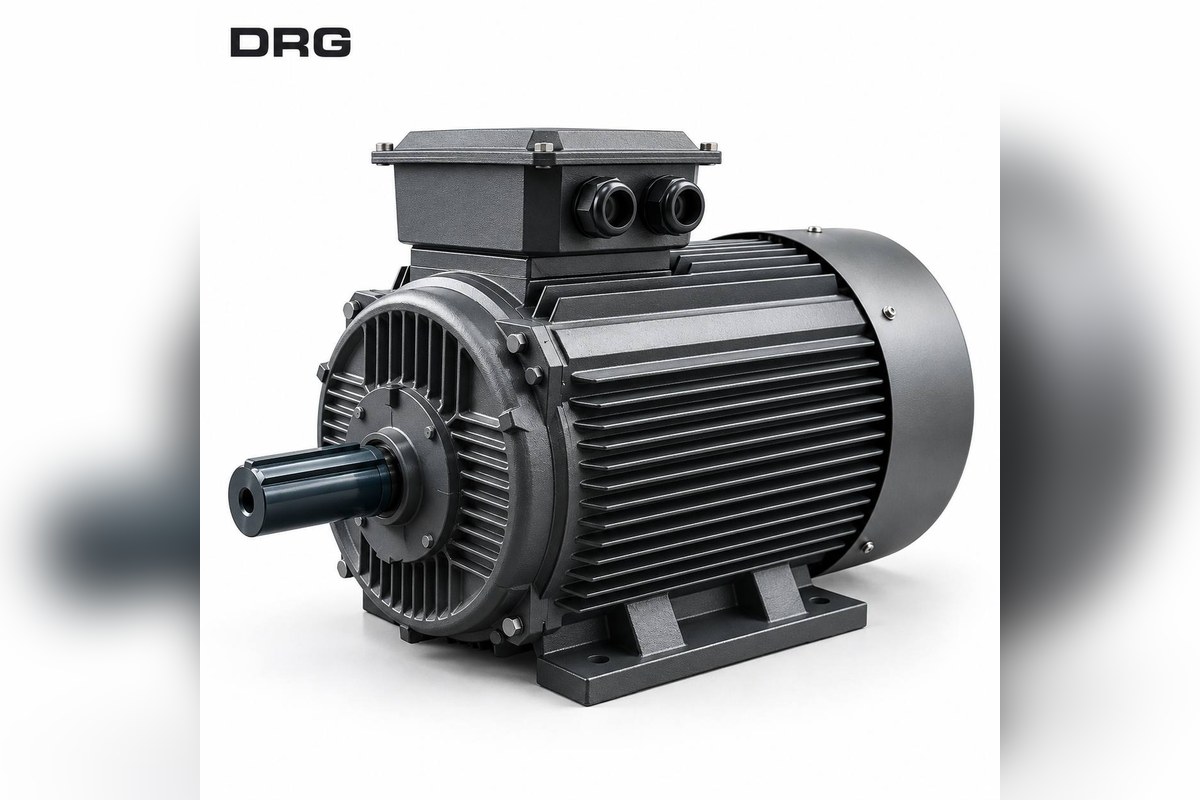

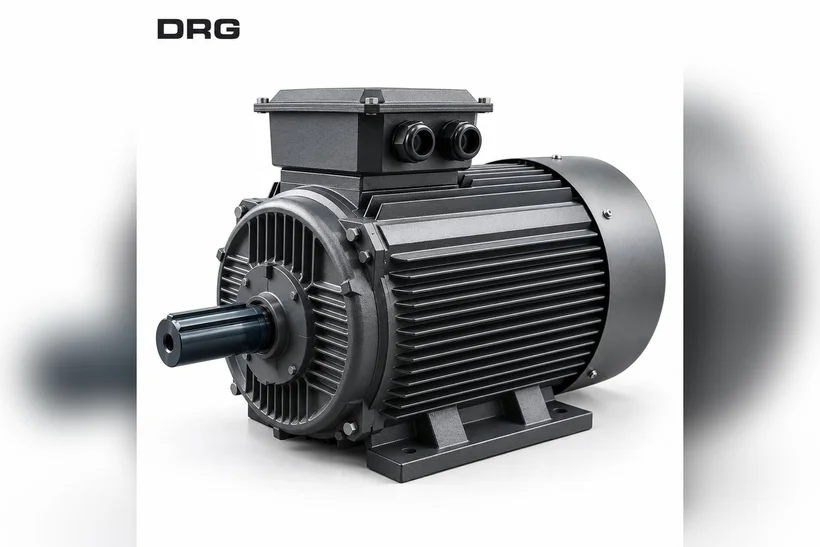
The motor of a plastic agglomerator (densifier) is chosen so it can bring the bladed drum up to speed when empty and keep current below the nameplate value while filling; the real limit, however, is the torque spike at the moment water is added. Agglomerators in the 30–75 kW range use 4-pole (1500 rpm) cast iron motors; for example, the 45 kW DRG-225M-4 draws 80.2 A at 400 V and has 289.4 Nm rated and 665.6 Nm breakdown torque. The drum starts empty in star, and loading begins only after the switch to delta.
In an agglomerator the load does not arrive piece by piece as in a crusher, but as a mass: film and fibre heat up by friction in the drum, soften, then are suddenly shocked with cold water and turn into granules. In this cycle the motor first carries a rising friction load, then a short, hard torque at the water moment. Panel, star-delta and overload settings must be done by a qualified electrician; never reach into the blade area without locking out power. You can see suitable models and current prices on the Buy Electric Motors Online page.
The 3 most common mistakes with agglomerator motors
- Starting with the drum full: in star the motor gives one third of the delta starting torque; a full drum will not start on that torque, the motor hangs in star and the winding heats up.
- Adding water too early and all at once: if the material has not softened enough or too much water is added, the mass lumps together and torque jumps; the motor approaches its breakdown limit.
- Raising the overload setting to fill more: more material means more friction heat; setting the overload above nameplate current just moves the problem into the motor.
How does an agglomerator cycle load the motor?
The cycle has four stages. First the empty drum runs up to rated speed; then film or fibre is fed gradually and friction heat rises as the blades tear the material. As the material softens and approaches a dough-like state, the load reaches its highest level. At this point a small amount of cold water is added: the material suddenly shrinks, hardens and turns into granules, after which the door is opened and the batch discharged.
For the motor there are two critical moments: the long high load before the dough stage (heating) and the short torque spike when water is added (stall risk). You manage the first by monitoring current and the second by the motor's breakdown torque margin. Piece-crushing load in a granulator or shredder is a different subject; for that see our plastic granulator motor article.
How hard is the motor hit at the water shock?
The torque needed when water is added depends on the amount of material in the drum and how the water is added; it is not known as data. To show the calculation, assume the instantaneous load rises to 1.8 times rated torque. For the 45 kW DRG-225M-4:
- Rated torque Tn = 289.4 Nm; assumed torque at the water moment = 1.8 × 289.4 = 520.9 Nm.
- Breakdown torque Tmax = 2.3 × Tn = 665.6 Nm; ratio 520.9 / 665.6 = 0.78.
- If supply voltage drops by 10%, torque falls with the square of voltage: Tmax ≈ 665.6 × 0.81 = 539.2 Nm; the ratio rises to 0.97.
Result: at full voltage there is margin, but in a plant with low voltage the same water shock pushes the motor to its breakdown limit; speed collapses and current approaches starting current. That is why water should be added gradually, the cable size chosen for voltage drop (cable size calculator) and, if necessary, the next power rating selected.
Click to see current electric motor prices and order nowSEE PRICES →
Star-delta starting and starting current
At these ratings direct-on-line starting strains the supply; star-delta is common on agglomerators. In the DRG range, motors from 4 kW upwards have 400/690 V windings and run in delta on a 400 V supply, so they suit star-delta. Since starting torque in star drops to about 0.67 × Tn, the drum must always start empty.
| Model | Tn / Tmax | Y starting torque | Starting current D → Y |
|---|---|---|---|
| DRG-200L-4 | 194.2 / 446.7 Nm | 129.5 Nm | 392.7 → 130.9 A |
| DRG-225S-4 | 237.9 / 547.2 Nm | 158.6 Nm | 489.1 → 163.0 A |
| DRG-225M-4 | 289.4 / 665.6 Nm | 192.9 Nm | 593.5 → 197.8 A |
| DRG-250M-4 | 353.7 / 813.5 Nm | 259.4 Nm | 722.2 → 240.7 A |
| DRG-280S-4 | 482 / 1108.6 Nm | 321.3 Nm | 890.1 → 296.7 A |
The starting currents in the table are calculated from the catalogue Is/In ratio. The switch from star to delta should happen once the motor is close to rated speed; switching early creates a current surge close to direct-on-line starting. The feed door or conveyor should not open before the delta contactor has closed. For settings use the star-delta starting tool.
Heating under steady load: adjusting the fill by current
The most practical way to measure an agglomerator's heating load is to watch current while filling. Fitting an ammeter in the panel and marking the target zone for the operator protects both motor and blades. An approximate reading guide for a 45 kW motor:
| Phase | Current (45 kW) | What it means |
|---|---|---|
| Idle, drum empty | Well below nameplate | Bearings and belt normal |
| Filling / densifying | Around 72.2 A | Target zone (≈ 0.9 × In) |
| Moment water is added | Short spike | Should drop in seconds |
| Long time above nameplate | Above 80.2 A | Overfilled, overload trips |
The aim is to hold current at about 0.9 times nameplate current in the densifying phase. If current stays above nameplate for a long time, reduce the fill; if it stays well below, the machine is running under capacity. As the blades dull, friction and current rise; current creeping up week by week is a sign that the blades need sharpening. For overload selection see the overload-fuse-contactor selection page.
Belt drive or direct coupling?
On a directly coupled agglomerator the drum turns at motor speed (1485 rpm). A belt drive lets you set the drum speed and damps the water shock somewhat: the belt slips briefly during a sudden torque spike, protecting the motor and bearings. For example, if a drum speed of 900 rpm is required, with a 200 mm motor pulley the drum pulley is 200 × 1485 / 900 ≈ 330 mm (ratio 1.65). For your own values use the pulley-belt calculator.
With a belt drive the motor shaft carries radial load; the pulley must sit along the full shaft length (E) and belt tension must be kept at the manufacturer's value. The 45 kW motor has a 60 × 140 mm shaft and 6313-C3 bearing.
Mounting and environment checklist
- Motor feet fixed to a rigid base; anti-vibration mounts not loose.
- Terminal box gasket intact against dust and steam, cable glands tight.
- Water line and steam outlet not directed onto the motor.
- Fan cover and cooling fins clean of plastic dust.
- Star-delta changeover time set to the motor approaching rated speed.
- Ammeter in the panel with a target current mark for the operator.
Which DRG motor? Models by agglomerator power
The 4-pole cast iron models below cover 30–75 kW agglomerators. Selection is based on the old motor's power and the drum diameter; in plants with low voltage the next power rating should be considered. Drawings are on the technical drawings page.
| Model | Power / speed | Frame | Current 400 V |
|---|---|---|---|
| DRG-200L-4 | 30 kW / 1475 rpm | 200L · cast iron | 53.8 A |
| DRG-225S-4 | 37 kW / 1485 rpm | 225S · cast iron | 66.1 A |
| DRG-225M-4 | 45 kW / 1485 rpm | 225M · cast iron | 80.2 A |
| DRG-250M-4 | 55 kW / 1485 rpm | 250M · cast iron | 97.6 A |
| DRG-280S-4 | 75 kW / 1486 rpm | 280S · cast iron | 129 A |
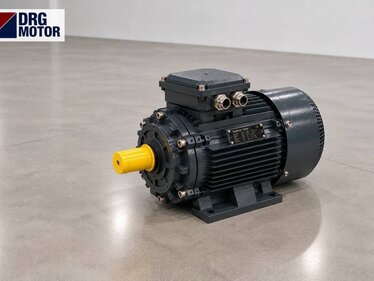
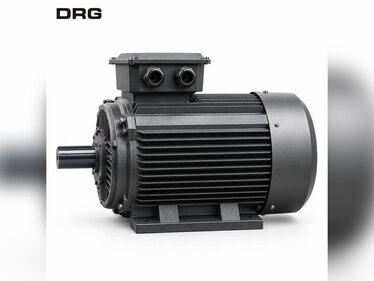
The 45 kW model commonly used on mid-size agglomerators:
- Power: 45 kW
- Rated speed: 1485 rpm
- Frame: 225M · cast iron
- Current 400 V: 80.2 A
- cos φ: 0.86
- Rated torque: 289.4 Nm
- Starting torque: 2 × Tn
- Breakdown torque: 2.3 × Tn
- Shaft D × E: 60 × 140 mm
- Bearing: 6313-C3
- Voltage: 400/690 V (Δ/Y)
DRG Motor is a manufacturer, supplier and seller of electric motors; DRG MOTOR motors are guaranteed against material and manufacturing defects for 2 years from the delivery date (warranty certificate).
Motors in this power range
- DRG-200L-4 – 30 kW – 1475 rpm – 200L cast iron
- DRG-225S-4 – 37 kW – 1485 rpm – 225S cast iron
- DRG-225M-4 – 45 kW – 1485 rpm – 225M cast iron
- DRG-250M-4 – 55 kW – 1485 rpm – 250M cast iron
- DRG-280S-4 – 75 kW – 1486 rpm – 280S cast iron
Click to see current prices and order these motors nowSEE PRICES →
Frequently Asked Questions
How many kW should an agglomerator motor be?
It depends on drum diameter and fill; agglomerators on the market are mostly in the 30–75 kW range. For a replacement the old motor's power is the reference; in plants with voltage drop, the next rating can be considered as margin for the water shock.
Why does the agglomerator motor struggle when water is added?
Water suddenly shrinks and hardens the material and torque spikes briefly. In the example assumption this spike is 0.78 of breakdown torque on a 45 kW motor; with voltage 10% low the ratio rises to 0.97 and the motor slows down.
How many amps does a 45 kW agglomerator motor draw?
The DRG-225M-4 draws a rated current of 80.2 A at 400 V and 84.4 A at 380 V. With star-delta starting the starting current is about 197.8 A.
Can an agglomerator start full on star-delta?
No. In star the starting torque is about 0.67 times rated torque and will not move a full drum. Empty the drum and start it empty; feed only after switching to delta.
Send us your agglomerator's old motor nameplate, drum diameter and drive type, and we will narrow down the right DRG model together: phone +90 (542) 666 11 11, e-mail info@drgmotor.com, contact page. For all models and current prices, see Buy Electric Motors Online.