English
 Le français
 Türkçe




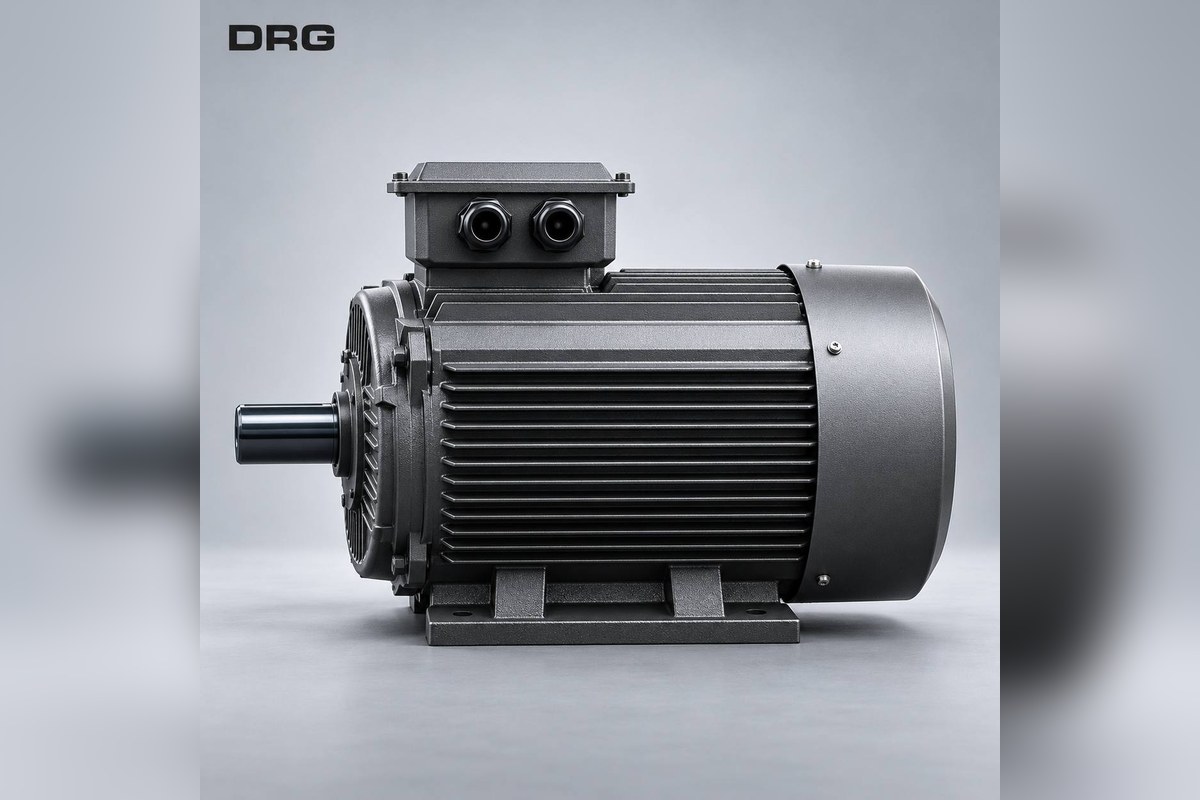

The hydraulic power unit motor of a pipe bending machine is sized not for the peak power at the moment of bending but for the equivalent (RMS) power of the whole cycle; the peak load is only checked against the motor's breakdown torque. For example, a 16 l/min pump at 200 bar bending pressure needs 6.27 kW of shaft power, but if this load lasts only 6 seconds of a 30-second cycle the equivalent power is 2.88 kW, and a 4 kW, 1500 rpm motor (for example DRG-112M-4, 7.95 A at 400 V) carries this unit comfortably.
Why does the calculation matter? Because pipe bending is an intermittent load: a short, hard pressure peak followed by a long light load for approach, return and part change. As the bending time gets longer (thick wall, large diameter, stainless pipe) or the operator shortens the idle time, the equivalent power rises and the same motor starts to overheat. The panel, overload relay and star-delta wiring must always be done by a qualified electrician. You can find suitable models and current prices among the 120 models on the Buy Electric Motors Online page.
The 3 most common motor mistakes on pipe bending units
- Buying a large motor based on peak power: a motor sized for the 6-second bend runs close to no-load for most of the cycle; starting current grows, the panel and cable grow unnecessarily, and cos φ drops at light load.
- Buying a small motor based on average power: average power understates winding heating. Since heating rises with the square of current, the correct measure is the root mean square (RMS), not the average.
- Raising the pressure setting and keeping the same motor: tightening the relief valve to bend thicker pipe directly raises peak power; the motor approaches its breakdown limit, speed drops mid-bend and the overload trips.
How does a bending cycle load the motor?
On a typical unit with a fixed-displacement gear pump, the shaft power drawn by the pump is proportional to pressure: P (kW) = Q (l/min) × p (bar) / (600 × η). Here η is the pump efficiency; if it is unknown, 0.85 can be taken as a cautious assumption. The cycle below was calculated with a 16 l/min pump and η = 0.85; on your machine, read the times with a stopwatch and the pressures from the gauge. The details of the kW calculation from flow and pressure are in our hydraulic pump motor power calculation article; here we add the time dimension on top of it.
| Phase | Pressure | Time | Shaft power |
|---|---|---|---|
| Approach / clamping | 30 bar | 4 s | 0.94 kW |
| Bending | 200 bar | 6 s | 6.27 kW |
| Return | 40 bar | 5 s | 1.25 kW |
| Idle / part change | 5 bar | 15 s | 0.16 kW |
The cycle totals 30 seconds. While the peak power is 6.27 kW, the time-weighted average is only 1.67 kW. This wide gap between the two values is what misleads motor selection on pipe bending units.
How is the equivalent (RMS) power calculated?
Since winding heating rises with the square of current, and current is roughly proportional to load, the power the motor "feels" under intermittent load is the root mean square:
Peq = √( Σ Pi² × ti / Σ ti )
For the cycle above: √((0.94² × 4 + 6.27² × 6 + 1.25² × 5 + 0.16² × 15) / 30) = 2.88 kW. Although the average power is 1.67 kW, the equivalent power is almost double, because the short but high bending load carries weight once squared. Repeating the calculation for different scenarios gives this table:
| Scenario | Equivalent power | Peak power | Suitable motor |
|---|---|---|---|
| Example cycle (30 s) | 2.88 kW | 6.27 kW | DRG-112M-4 · 4 kW |
| Bending 12 s (cycle 36 s) | 3.67 kW | 6.27 kW | DRG-132S-4 · 5.5 kW |
| Idle 45 s (cycle 60 s) | 2.04 kW | 6.27 kW | DRG-112M-4 · 4 kW |
| Pump 25 l/min (30 s) | 4.49 kW | 9.80 kW | DRG-132M-4 · 7.5 kW |
Two cases in the table stand out. When bending time rises from 6 to 12 seconds, the equivalent power climbs to 3.67 kW; a 4 kW motor would still be enough on paper but without margin, so moving to 5.5 kW makes sense. When idle time gets longer, the equivalent power falls to 2.04 kW, yet the motor still cannot be downsized: this time the choice is set by the peak load, not by heating. The breakdown torque check in the next section shows why.
Click to see current electric motor prices and order nowSEE PRICES →
Can the motor handle the peak? Breakdown torque check
An induction motor can carry a short overload up to its breakdown torque (Tmax); beyond that limit speed collapses and the motor stalls. Practical check: the ratio peak power / rated motor power must stay clearly below the catalogue Tmax/Tn ratio. Since torque falls with the square of voltage, when the supply drops by 10% (0.9 × U) the usable ratio becomes 2.3 × 0.81 = 1.86; basing the calculation on this value is safe.
| Model | Power | Peak / rated | Tmax / Tn |
|---|---|---|---|
| DRG-100L2-4 | 3 kW | 2.09 | 2.3 |
| DRG-112M-4 | 4 kW | 1.57 | 2.3 |
| DRG-132S-4 | 5.5 kW | 1.14 | 2.3 |
With the 3 kW motor the ratio is 2.09: below 2.3 at full voltage, but above the 1.86 limit when voltage drops, so the motor slows down mid-bend. With the 4 kW motor the ratio is 1.57, leaving a wide margin. That is why 4 kW is the lower limit for a 16 l/min – 200 bar unit even in cycles where the equivalent power is 2–3 kW. With a 25 l/min pump the peak power becomes 9.80 kW; on a 5.5 kW motor the ratio of 1.78 hits the limit, on 7.5 kW it drops to 1.31.
How many starts per hour? Stop the motor or let it idle?
A 30-second cycle means 120 bends per hour. If the motor is stopped and restarted for every bend, that is 120 starts per hour; at each start the motor draws about 7.8 times its rated current (7.95 A × 7.8 ≈ 62.0 A for the DRG-112M-4) and starting heat accumulates in the winding. The right arrangement is to leave the motor running for the shift and put the pump into pressureless circulation through the unloading (by-pass) valve in the idle phase; the 5 bar idle load in the table represents this.
For long pauses, the panel can be fitted with a timer relay that stops the motor after a set idle time. If starting current needs to be reduced, DRG motors from 4 kW upwards have 400/690 V windings and run in delta on a 400 V supply, so they are suitable for star-delta starting; 230/400 V motors of 3 kW and below are connected in star at 400 V and cannot use star-delta starting. For panel settings you can use the star-delta starting tool and the overload-fuse-contactor selection pages.
Checklist before replacing the motor
- Pump displacement (cm³/rev or l/min) and pump speed from the nameplate: a 1500 rpm pump needs a 4-pole motor.
- The maximum pressure set on the relief valve (from the gauge, at the moment of bending).
- Bending, approach, return and idle times (with the thickest pipe, with a stopwatch).
- Mounting: vertical bell-housing flange on the tank (B5/V1) or foot-and-flange (B35)? On frame 112M the B5 flange is P 250 mm, M 215 mm, N 180 mm; shaft 28 × 60 mm.
- Pump coupling and bell housing match the shaft diameter; key width.
- Overload relay set to the new motor's nameplate current; are the contactor and cable size suitable?
- Direction of rotation: check against the arrow on the pump at first start.
Which DRG motor? Models for 16–25 l/min units
The models below cover the power range commonly found on pipe bending units with 1500 rpm gear pumps. For dimensions and flange details see the technical drawings page.
| Model | Power / speed | Frame | Current 400 V |
|---|---|---|---|
| DRG-100L2-4 | 3 kW / 1450 rpm | 100L · cast iron | 6.02 A |
| DRG-112M-4 | 4 kW / 1450 rpm | 112M · cast iron | 7.95 A |
| DRG-132S-4 | 5.5 kW / 1460 rpm | 132S · cast iron | 10.7 A |
| DRG-132M-4 | 7.5 kW / 1460 rpm | 132M · cast iron | 14.3 A |
| DRG-160M-4 | 11 kW / 1465 rpm | 160M · cast iron | 20.4 A |
The model that stands out in the example cycle for a 16 l/min – 200 bar unit:
- Power: 4 kW
- Rated speed: 1450 rpm
- Frame: 112M · cast iron
- Current 400 V: 7.95 A
- cos φ: 0.82
- Rated torque: 26.3 Nm
- Starting torque: 2.2 × Tn
- Breakdown torque: 2.3 × Tn
- Shaft D × E: 28 × 60 mm
- Bearing: 6206-ZZ-C3
- Voltage: 400/690 V (Δ/Y)
DRG Motor is a manufacturer, supplier and seller of electric motors; DRG MOTOR motors are guaranteed against material and manufacturing defects for 2 years from the delivery date (warranty certificate).
Motors in this power range
- DRG-100L2-4 – 3 kW – 1450 rpm – 100L cast iron
- DRG-112M-4 – 4 kW – 1450 rpm – 112M cast iron
- DRG-132S-4 – 5.5 kW – 1460 rpm – 132S cast iron
- DRG-132M-4 – 7.5 kW – 1460 rpm – 132M cast iron
- DRG-160M-4 – 11 kW – 1465 rpm – 160M cast iron
Click to see current prices and order these motors nowSEE PRICES →
Frequently Asked Questions
How many kW motor does a pipe bending machine need?
It depends on pump flow, bending pressure and cycle times. For 16 l/min – 200 bar and the 30-second example cycle, the equivalent power is 2.88 kW and the peak power 6.27 kW; the choice that covers both is a 4 kW, 1500 rpm motor.
What is the difference between equivalent (RMS) power and average power?
Average power is the simple time average of the load; equivalent power is the square root of the mean of the squares and represents motor heating. In the example cycle the average is 1.67 kW and the equivalent power 2.88 kW.
How many amps does a 4 kW hydraulic unit motor draw?
The DRG-112M-4 draws a rated current of 7.95 A at 400 V and 8.37 A at 380 V; on direct-on-line starting the current rises to about 7.8 times rated.
Does a pipe bending unit need star-delta starting?
It is not mandatory, but it reduces starting current if the motor is started often or the supply is weak. The motor must have a 400/690 V winding for this; in the DRG range, 4 kW and above meet this requirement.
Send us your unit's pump nameplate, bending pressure and cycle times, and we will calculate the equivalent power together and narrow down the right DRG model: phone +90 (542) 666 11 11, e-mail info@drgmotor.com, contact page. For all models and current prices, see Buy Electric Motors Online.