English
 Le français
 Türkçe




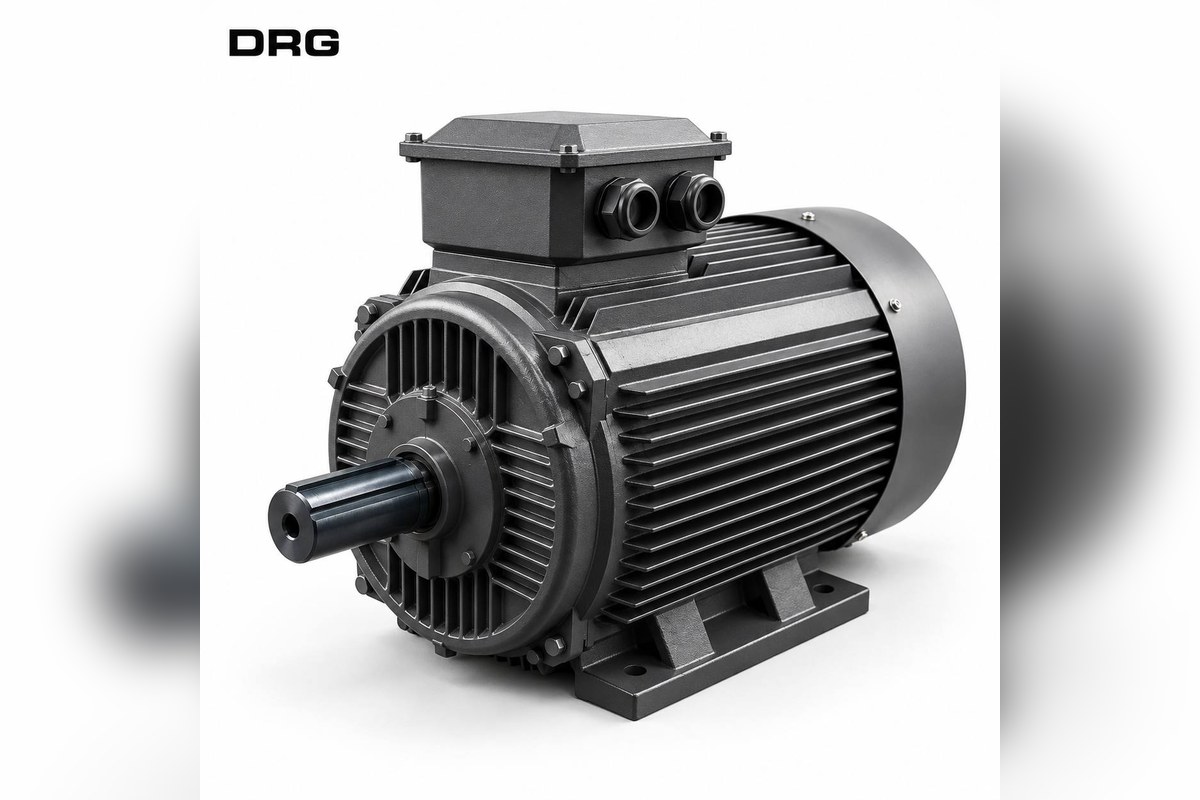

The hydraulic pump motor of a guillotine shear is sized not for the rapid-approach flow but for the power drawn by the small (high-pressure) pump during the cutting phase. On a double-pump (high–low) unit, rapid approach at 40 l/min – 30 bar needs 2.35 kW and cutting at 10 l/min – 200 bar needs 3.92 kW; this unit runs with a 5.5 kW, 1500 rpm motor (for example DRG-132S-4, 10.7 A at 400 V). Asking for the same speed from a single pump at 200 bar would require 15.69 kW.
That is why, when replacing a guillotine motor, you first need to know whether the unit has one pump or two, where the cutting pressure is set and whether the motor starts in star-delta. Panel and wiring work must be done by a qualified electrician, and power must be locked out before working near the blade. You can find suitable models and current prices among the 120 models in our online store.
The 3 most common mistakes when choosing a guillotine motor
- Calculating with flow × maximum pressure: on a double-pump unit the large pump returns to tank through the unloading valve during cutting; counting it at 200 bar as well makes the motor three to four times larger than needed.
- Fitting a 230/400 V motor to a star-delta panel: on a 400 V supply, star-delta starting requires a 400/690 V winding; in the DRG range this is the case from 4 kW upwards.
- Ordering without measuring the bell housing and coupling: on a vertical motor on top of the tank, the pump is attached to the bell housing; if the flange spigot diameter (N) or shaft diameter (D) does not match, the motor cannot be mounted.
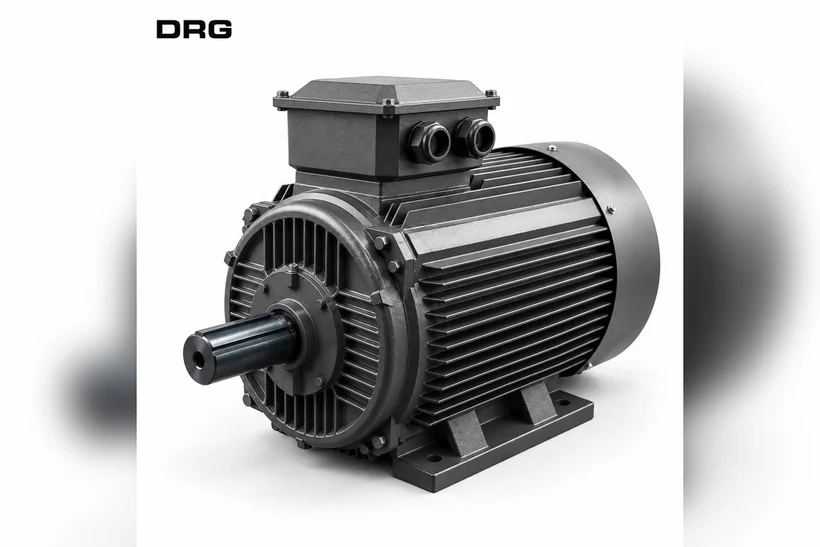
What does a cutting stroke look like?
A cutting stroke has four phases: the hold-downs clamp the sheet, the upper blade comes down quickly to the sheet surface (rapid approach), the blade cuts the sheet (cutting), then returns upwards. Rapid approach and return need high flow at low pressure, cutting needs low flow at high pressure. A double-pump unit solves this by mounting two pumps on the same motor shaft: when pressure rises, the large pump's flow returns to tank through the unloading valve and only the small pump does the cutting.
The highest load the motor sees is therefore the cutting phase, and its duration depends on sheet length and thickness. It is normal for motor speed to dip and recover during a cut; but if the overload warms up on every cut, either the pressure setting has been raised or the unloading valve is not releasing the large pump to tank.
How many kW? Calculation for a double-pump unit
For each phase, pump shaft power is found with P (kW) = Q (l/min) × p (bar) / (600 × η); η is the pump efficiency and, if unknown, 0.85 can be taken as a cautious assumption. The motor is chosen as the first standard rating at which the cutting power does not exceed about 85% of rated power; this margin covers drift in the pressure setting and supply voltage drop. The four examples below are assumed pump pairs; real values must be taken from the pump nameplate and the pressure gauge.
| Rapid approach | Cutting | Cutting power | Motor |
|---|---|---|---|
| 30 l/min · 25 bar | 8 l/min · 180 bar | 2.82 kW | DRG-112M-4 · 4 kW |
| 40 l/min · 30 bar | 10 l/min · 200 bar | 3.92 kW | DRG-132S-4 · 5.5 kW |
| 60 l/min · 30 bar | 16 l/min · 220 bar | 6.90 kW | DRG-160M-4 · 11 kW |
| 80 l/min · 30 bar | 22 l/min · 250 bar | 10.78 kW | DRG-160L-4 · 15 kW |
In the second row the cutting power is 3.92 kW, a ratio of 0.71 to rated power. If the same unit tried to deliver 40 l/min at 200 bar with a single pump it would need 15.69 kW, about 4 times the power. For the general calculation of power from flow and pressure you can use the pump motor power calculator.
Click to see current electric motor prices and order nowSEE PRICES →
How do thicker sheets affect pressure and the motor?
Cutting force varies roughly with the square of sheet thickness and inversely with the rake angle: with a constant rake angle, doubling the thickness multiplies the force by about 4. Since the cylinder bore is fixed, this increase goes straight into pressure, and pressure goes straight into the power drawn by the small pump. Stainless or high-strength sheet needs a higher cutting pressure than mild steel of the same thickness.
Practical result: if the relief valve is tightened to cut sheet above the capacity on the machine nameplate, the motor goes above its rated power in the cutting phase. The right answer then is not a bigger motor but staying within the machine's capacity, because the blade, frame and cylinder were also built for that capacity.
Why is star-delta starting trouble-free on a guillotine motor?
In star connection the motor takes one third of the delta starting current and starting torque. The torque drop is a problem for machines that start under load, but on a guillotine unit the pump outlet is open to tank during start: the motor only turns the pumps' idle friction and the coupling inertia. So the star starting torque (about 0.67 × Tn) is sufficient.
| Model | Rated current | Starting current D → Y | Y starting torque |
|---|---|---|---|
| DRG-112M-4 | 7.95 A | 62 A → 20.7 A | 19.3 Nm |
| DRG-132S-4 | 10.7 A | 84.5 A → 28.2 A | 24 Nm |
| DRG-160M-4 | 20.4 A | 157.1 A → 52.4 A | 52.6 Nm |
| DRG-160L-4 | 27.3 A | 212.9 A → 71 A | 71.7 Nm |
The starting currents in the table are calculated from the catalogue Is/In ratio. Going from delta to star cuts the current to one third; for the 11 kW DRG-160M-4, 52.4 A instead of 157.1 A. Switching from star to delta should happen once the motor is close to rated speed and while the pump is still unloaded; the cutting valve should open only after the switch to delta. For settings see the star-delta starting tool and overload-fuse-contactor selection pages.
B35 or bell-housing B5? Mounting dimensions
On most guillotine units the motor sits vertically on the tank lid, connected through a bell housing (lantern) and a flexible coupling; this layout uses a B5 (large flange) motor. If the unit is horizontal and the motor is fixed both by its feet to a base and by its flange to the bell housing, B35 is needed. For B35 mounting details see our B35 foot and flange motor dimensions article. The decisive dimensions for the bell housing are:
| Frame | Flange P / M / N | Shaft D × E | Holes |
|---|---|---|---|
| 112M | 250 / 215 / 180 mm | 28 × 60 mm | 4 × Ø14.5 mm |
| 132S | 300 / 265 / 230 mm | 38 × 80 mm | 4 × Ø14.5 mm |
| 160M | 350 / 300 / 250 mm | 42 × 110 mm | 4 × Ø18.5 mm |
| 160L | 350 / 300 / 250 mm | 42 × 110 mm | 4 × Ø18.5 mm |
The table shows B5 flange dimensions from the DRG catalogue (P: flange outer diameter, M: pitch circle, N: spigot diameter). Measure these three values and the shaft diameter on your old motor's flange and compare; all drawings are on the technical drawings page.
Replacement checklist
- Pump nameplate: displacement (cm³/rev) of the large and small pump and pump speed.
- Cutting pressure (relief valve setting) and opening pressure of the unloading valve.
- Panel: star-delta or direct-on-line? If star-delta, the motor must be 400/690 V.
- Mounting: vertical bell-housing flange (B5/V1) or B35; flange P, M, N and shaft D × E.
- Coupling hub matches the shaft diameter and key width.
- Direction of rotation checked against the pump arrow at first start.
- Current during cutting measured with a clamp meter and not above nameplate current.
Which DRG motor? Models for guillotine units
The 4-pole (1500 rpm) models below correspond to the pump pairs in the example table. Cast iron frames from 5.5 kW upwards give a rigid flange for vibrating mounting on top of the tank.
| Model | Power / speed | Frame | Current 400 V |
|---|---|---|---|
| DRG-112M-4 | 4 kW / 1450 rpm | 112M · cast iron | 7.95 A |
| DRG-132S-4 | 5.5 kW / 1460 rpm | 132S · cast iron | 10.7 A |
| DRG-132M-4 | 7.5 kW / 1460 rpm | 132M · cast iron | 14.3 A |
| DRG-160M-4 | 11 kW / 1465 rpm | 160M · cast iron | 20.4 A |
| DRG-160L-4 | 15 kW / 1465 rpm | 160L · cast iron | 27.3 A |
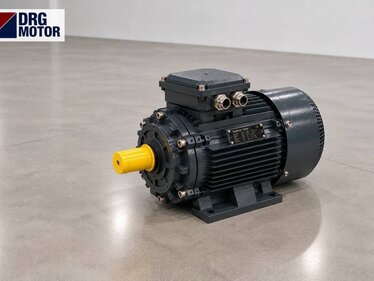
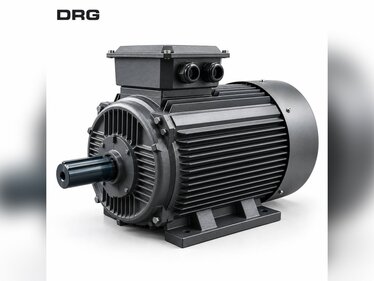
Example model for a mid-size unit with a 40 l/min – 10 l/min double pump:
- Power: 5.5 kW
- Rated speed: 1460 rpm
- Frame: 132S · cast iron
- Current 400 V: 10.7 A
- cos φ: 0.83
- Rated torque: 36 Nm
- Starting torque: 2 × Tn
- Breakdown torque: 2.3 × Tn
- Shaft D × E: 38 × 80 mm
- Bearing: 6208-ZZ-C3
- Voltage: 400/690 V (Δ/Y)
DRG Motor is a manufacturer, supplier and seller of electric motors; DRG MOTOR motors are guaranteed against material and manufacturing defects for 2 years from the delivery date (warranty certificate).
Motors in this power range
- DRG-112M-4 – 4 kW – 1450 rpm – 112M cast iron
- DRG-132S-4 – 5.5 kW – 1460 rpm – 132S cast iron
- DRG-132M-4 – 7.5 kW – 1460 rpm – 132M cast iron
- DRG-160M-4 – 11 kW – 1465 rpm – 160M cast iron
- DRG-160L-4 – 15 kW – 1465 rpm – 160L cast iron
Click to see current prices and order these motors nowSEE PRICES →
Frequently Asked Questions
How many kW motor does a guillotine shear need?
It depends on the flow of the cutting pump and the cutting pressure. With η = 0.85 assumed, cutting at 10 l/min – 200 bar takes 3.92 kW and is covered by a 5.5 kW motor; cutting at 16 l/min – 220 bar takes 6.90 kW and needs an 11 kW motor.
Is a guillotine motor connected in star-delta?
On most units, yes; because the pump is unloaded at start, the lower star torque is enough. The motor must have a 400/690 V winding that runs in delta on a 400 V supply.
How many amps does a 5.5 kW guillotine motor draw?
The DRG-132S-4 draws a rated current of 10.7 A at 400 V and 11.2 A at 380 V. Starting current is about 84.5 A direct-on-line and about 28.2 A in star.
Why does a guillotine hydraulic motor overheat?
The most common causes: the relief valve tightened to cut above capacity, the unloading valve not releasing the large pump to tank, and the pump staying under pressure while idle. Measuring current during cutting and while idle separates the causes.
Send us your unit's pump nameplate, cutting pressure and flange dimensions, and we will narrow down the right DRG model together: phone +90 (542) 666 11 11, e-mail info@drgmotor.com, contact page. For all models and current prices, see Buy Electric Motors Online.