English
 Le français
 Türkçe




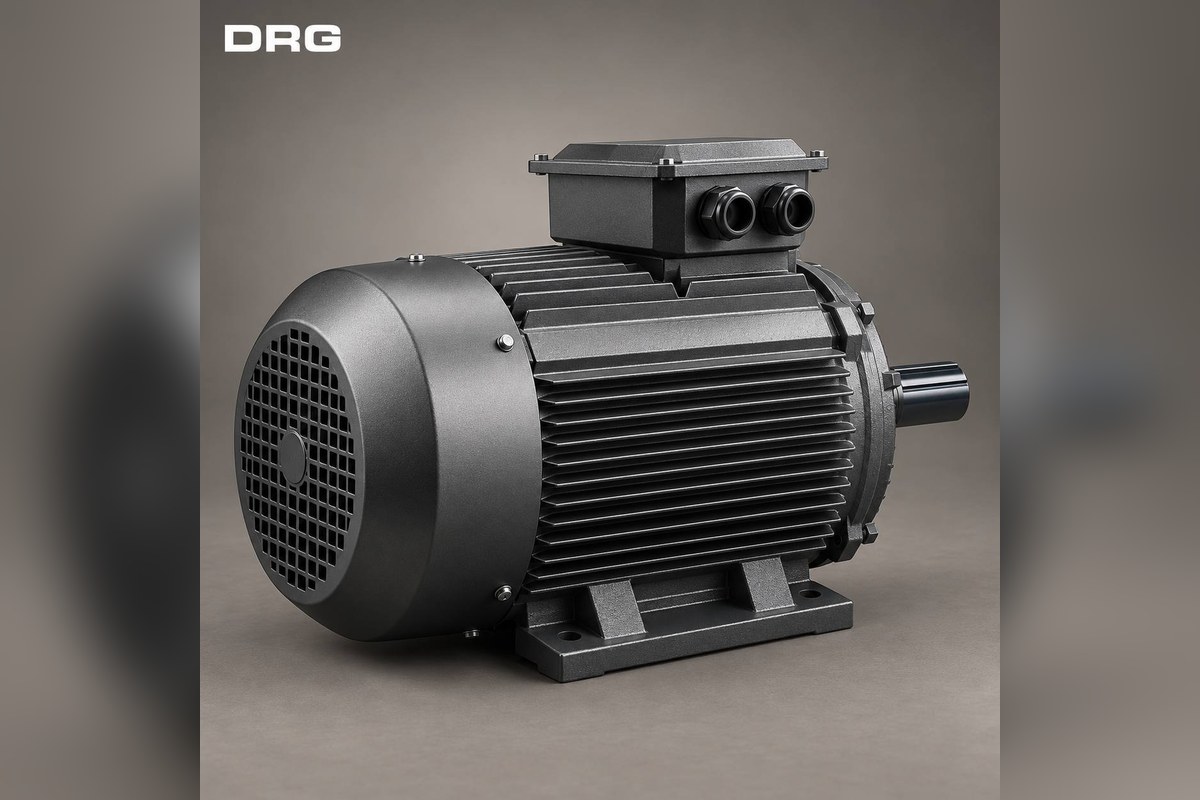

On a metal-cutting band saw, the motor does not drive the blade directly but through a gearbox (usually a worm gearbox): the blade must run at only 20–80 metres per minute, and on a machine with 300 mm wheels, 40 m/min requires the wheel to turn at about 42.4 rpm, roughly one thirty-fourth of a 4-pole motor's speed. Most workshop machines with a 250–300 mm cutting capacity work with a 1.1–2.2 kW 4-pole motor; for example the 1.5 kW DRG-90L-4 draws 3.3 A at 400 V. The real task in a motor replacement is making the new motor fit the gearbox input flange and shaft bore exactly; power and speed are taken from the old motor's nameplate.
Our article on sawmill and band saw motors covers woodworking machines, where the blade runs fast and the motor is belt-coupled. Metal cutting is the opposite: the blade is slow and needs high torque, the motor is flanged to a gearbox, coolant flows during the cut and the arm usually descends on a hydraulic cylinder. So a motor choice that suits a wood saw cannot be applied directly to a metal band saw. Wiring and panel work must be done by a qualified electrician; on a machine wetted by coolant, an earthing fault is a direct electric-shock risk. You can see suitable models among the 120 models in our online store.
The 3 most common mistakes with a metal band saw motor
- Changing the number of poles: fitting a 2-pole motor instead of a 4-pole one doubles blade speed because the gearbox stays the same. On stainless and solid material this quickly dulls the blade teeth.
- Ordering without measuring the gearbox input flange: for a motor that mounts on a gearbox, the flange type (large B5 or small B14), spigot diameter and shaft diameter must match exactly. Two motors of the same power can have different flanges.
- Directing coolant onto the motor: if soluble-oil coolant finds its way through the fan cowl to the frame and cable entry, moisture and leakage current start in the terminal box. Point the gland downwards and keep the coolant hose away from the motor.
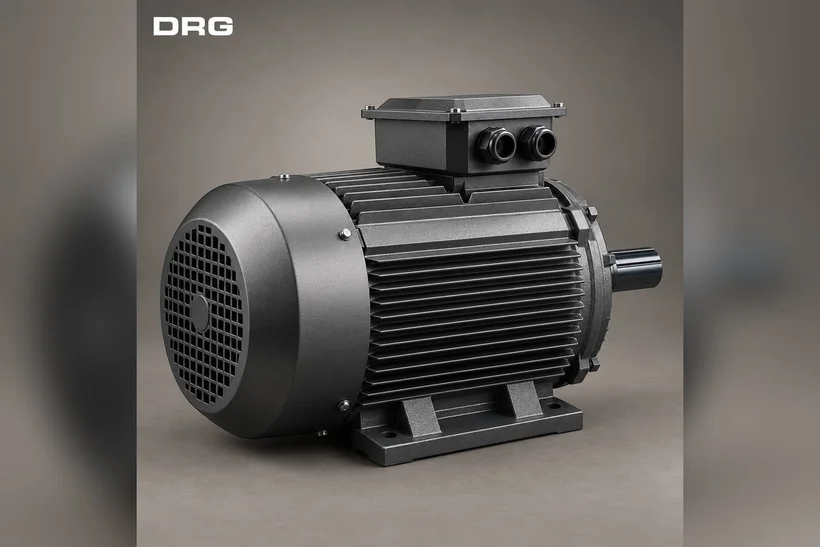
Blade speed and gear ratio: how is motor speed reduced?
Blade speed is the peripheral speed of the drive wheel: v (m/min) = π × D (m) × n (rpm). For a 300 mm wheel, the wheel speed for the desired blade speed and the total gear ratio needed with a 1445 rpm motor were calculated in Python:
| Blade speed | Wheel speed (300 mm) | Required ratio (1445 rpm) |
|---|---|---|
| 20 m/min | 21.2 rpm | ≈ 68.1 |
| 40 m/min | 42.4 rpm | ≈ 34 |
| 60 m/min | 63.7 rpm | ≈ 22.7 |
| 80 m/min | 84.9 rpm | ≈ 17 |
40–80 m/min is used for mild steel and sections, 20–40 m/min for stainless and tool steel; the right value is in the blade maker's chart. The table shows that a 1445 rpm motor needs a single-stage ratio between 17 and 68, which is why worm gearboxes are common on metal band saws. You can check gearbox output speed and torque with your own values using the gearbox output speed and torque calculator.
Torque at the gearbox output: how much force does the motor produce?
A gearbox reduces speed and multiplies torque by the same ratio: T₂ ≈ T₁ × i (before gear losses). The table below was calculated with the rated torque of DRG motors for a gearbox of ratio i = 34 and a 300 mm wheel. Worm gearbox losses are high, so the real output torque stays clearly below the table value:
| Motor | Output speed (i = 34) | Output torque (lossless) | Blade speed |
|---|---|---|---|
| DRG-802-4 · 0.75 kW | 41.8 rpm | 171 Nm | 39.4 m/min |
| DRG-90S-4 · 1.1 kW | 42.5 rpm | 247 Nm | 40.1 m/min |
| DRG-90L-4 · 1.5 kW | 42.5 rpm | 337 Nm | 40.1 m/min |
| DRG-100L1-4 · 2.2 kW | 42.6 rpm | 493 Nm | 40.2 m/min |
The blade force at the wheel rim is F = 2 × T₂ / D; for example, the lossless 337 Nm of the 1.5 kW motor corresponds to roughly 2250 N of pull on a 300 mm wheel. This shows why the motor easily covers the cutting force, and that the problem is more often blade tension and feed rate than power. We explain the general logic of gearbox selection in how to select a motor gearbox.
Click to see current electric motor prices and order nowSEE PRICES →
How many kW are needed? Power from cutting force
Blade cutting power is calculated as P (kW) = Fc (N) × v (m/min) / 60000. Fc depends on material, section width, tooth pitch and feed rate; the values below are example assumptions. Blade speed is taken as 40 m/min and the result is multiplied by 1.5 for worm gearbox losses and sudden load in hard material:
| Cutting force (assumed) | Blade power | With 1.5 factor | Motor to choose |
|---|---|---|---|
| 700 N | 0.47 kW | 0.70 kW | DRG-802-4 · 0.75 kW |
| 1500 N | 1.00 kW | 1.50 kW | DRG-90L-4 · 1.5 kW |
| 2200 N | 1.47 kW | 2.20 kW | DRG-100L1-4 · 2.2 kW |
The practical result: light machines cutting sections and thin-wall tube use 0.75 kW, workshop machines cutting 250 mm solid bar 1.5 kW, and larger sections and series cutting 2.2 kW. Measuring the old motor's current during a cut is the quickest way to confirm this estimate. If the feed valve is opened too far, cutting force and therefore current rise; if the overload trips, check the feed valve first.
Two-speed machine: single-speed motor and inverter
Many metal band saws have two blade speeds, provided either by a two-speed (Dahlander) motor or by a gear lever on the gearbox. The DRG models in the store are single-speed three-phase motors. On a machine with a burnt two-speed motor there are three routes:
- Single-speed motor + inverter: a 4-pole motor gives high speed at 50 Hz and low speed at about 25 Hz. With a constant-torque load the inverter keeps torque; but as the motor fan also slows at low frequency, watch heating on long cuts in hard material. You can see the frequency-torque-power relationship with the VFD frequency, torque and power calculator.
- Single-speed motor + gearbox lever or pulley: if the machine has a mechanical speed selector, the motor can be single-speed and the panel becomes simpler.
- Living with one speed: if the machine mostly cuts the same material, choose the low speed; it extends blade life at the cost of longer cutting time.
The two-contactor speed-change circuit in a Dahlander panel must be removed or rearranged before connecting a single-speed motor; connecting the old cables as they are burns the motor.
Hydraulic feed, coolant and blade tension
Hydraulic feed
On most machines the arm descends into the cut under its own weight, braked by an adjustable valve on a hydraulic cylinder; in that case there is no separate hydraulic motor. On large automatic machines the arm is raised and lowered by a small hydraulic unit, whose motor is chosen separately from the main drive motor. Main motor overload trips are often caused by an over-opened feed valve or a dull blade.
Coolant
The coolant pump is usually a separate, small pump motor. The main motor's IP55 frame is protected against splashing, but it is not designed to run in an area with constant fluid flow. The coolant tank and hoses should be away from the motor, and the terminal box cover gasket must be intact.
Blade tension
A slack blade slips on the wheel and the cut runs off; an over-tensioned blade strains the wheel bearings and the gearbox output shaft. Check the tension gauge and wheel surface before making the motor bigger.
Which DRG motor should I buy? Model table
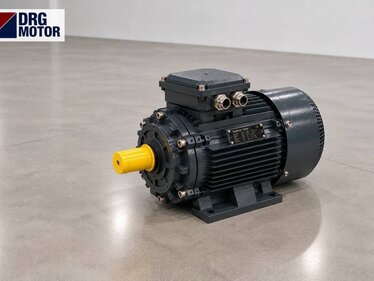
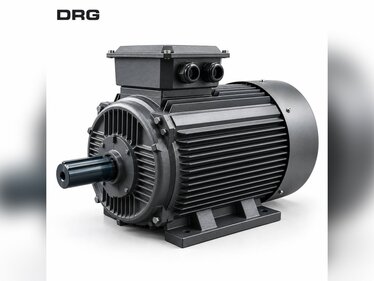
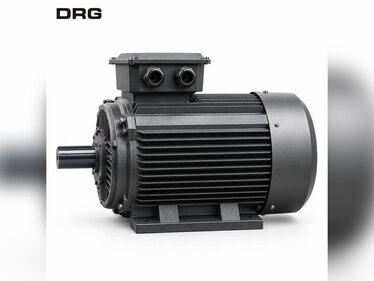
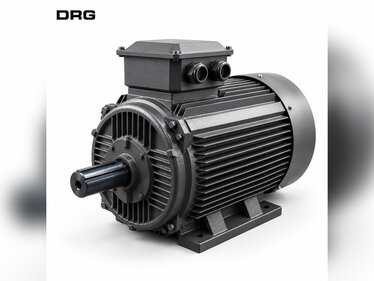
The power range used on workshop and small-production metal band saws is 0.75–3 kW, 4-pole motors. A cast-iron frame is a robust choice in a workshop with oil and coolant:
| Model | Power / speed | Frame | Current 400 V |
|---|---|---|---|
| DRG-802-4 | 0.75 kW / 1420 rpm | 80 · cast iron | 1.75 A |
| DRG-90S-4 | 1.1 kW / 1445 rpm | 90S · cast iron | 2.48 A |
| DRG-90L-4 | 1.5 kW / 1445 rpm | 90L · cast iron | 3.3 A |
| DRG-100L1-4 | 2.2 kW / 1450 rpm | 100L · cast iron | 4.52 A |
| DRG-100L2-4 | 3 kW / 1450 rpm | 100L · cast iron | 6.02 A |
For the gearbox flange, the B5 dimensions in the DRG catalogue are P 200 / M 165 / N 130 mm on frames 80 and 90 and P 250 / M 215 / N 180 mm on frame 100L; the shaft is 19 × 40 on 80, 24 × 50 on 90 and 28 × 60 mm on 100L. B14 small-flange dimensions are not in the catalogue, so measure and send them. For flange selection, see our article flange motor for gearbox: B5 and B14 selection. Pre-replacement checklist:
- kW, speed and voltage on the old motor's nameplate; single-speed or two-speed
- Gearbox input flange: B5 or B14; outer diameter, bolt circle, spigot diameter
- Motor shaft diameter and length (D × E), key width; gearbox input bore
- Gear ratio and wheel diameter (to confirm blade speed)
- Arm feed: gravity with valve, or hydraulic unit
- The coolant pump's separate motor and its supply
- Dahlander contactors in the panel, overload setting range, emergency stop
- Terminal box direction and protection from coolant
As an example, the model that stands out for a workshop machine with a 250 mm cutting capacity:
- Power: 1.5 kW
- Rated speed: 1445 rpm
- Frame: 90L · cast iron
- Current 400 V: 3.3 A
- Current 380 V: 3.47 A
- cos φ: 0.77
- Rated torque: 9.91 Nm
- Starting torque: 2.3 × Tn
- Shaft D × E: 24 × 50 mm
- Bearing: 6205-ZZ-C3
- Voltage: 230/400 V (Δ/Y)
DRG Motor is a manufacturer, supplier and seller of electric motors; our motors are guaranteed for 2 years from the delivery date against material and manufacturing defects (warranty certificate). For dimension checks, see the technical drawings page.
Motors in this power range
- DRG-802-4 – 0.75 kW – 1420 rpm – 80 cast iron
- DRG-90S-4 – 1.1 kW – 1445 rpm – 90S cast iron
- DRG-90L-4 – 1.5 kW – 1445 rpm – 90L cast iron
- DRG-100L1-4 – 2.2 kW – 1450 rpm – 100L cast iron
- DRG-100L2-4 – 3 kW – 1450 rpm – 100L cast iron
Click to see current prices and order these motors nowSEE PRICES →
Frequently Asked Questions
What kW should a metal band saw motor be?
0.75 kW is common for machines cutting sections and thin tube, 1.5 kW for workshop machines cutting 250 mm solid bar and 2.2 kW for large sections and series cutting. The exact value is on the old motor's nameplate.
What speed should a band saw motor have?
On metal band saws the motor is mostly 4-pole (about 1450 rpm); blade speed is reduced by the gearbox to the 20–80 m/min range. Changing the number of poles changes blade speed.
How many amps does a 1.5 kW band saw motor draw?
The 4-pole DRG-90L-4 draws 3.3 A at 400 V and 3.47 A at 380 V; its rated torque is 9.91 Nm. Set the overload relay to this rated current.
What replaces a two-speed band saw motor?
Two speeds can be obtained with a single-speed 4-pole motor and a frequency inverter; if the machine has a mechanical gear selector, a single-speed motor is enough. The Dahlander panel wiring must be rearranged by a qualified electrician.
Send us the old motor's nameplate or dimensions and we will narrow down the right DRG model together: phone +90 (542) 666 11 11, e-mail info@drgmotor.com, contact page. For all models and current prices, see Buy Electric Motors Online.