English
 Le français
 Türkçe




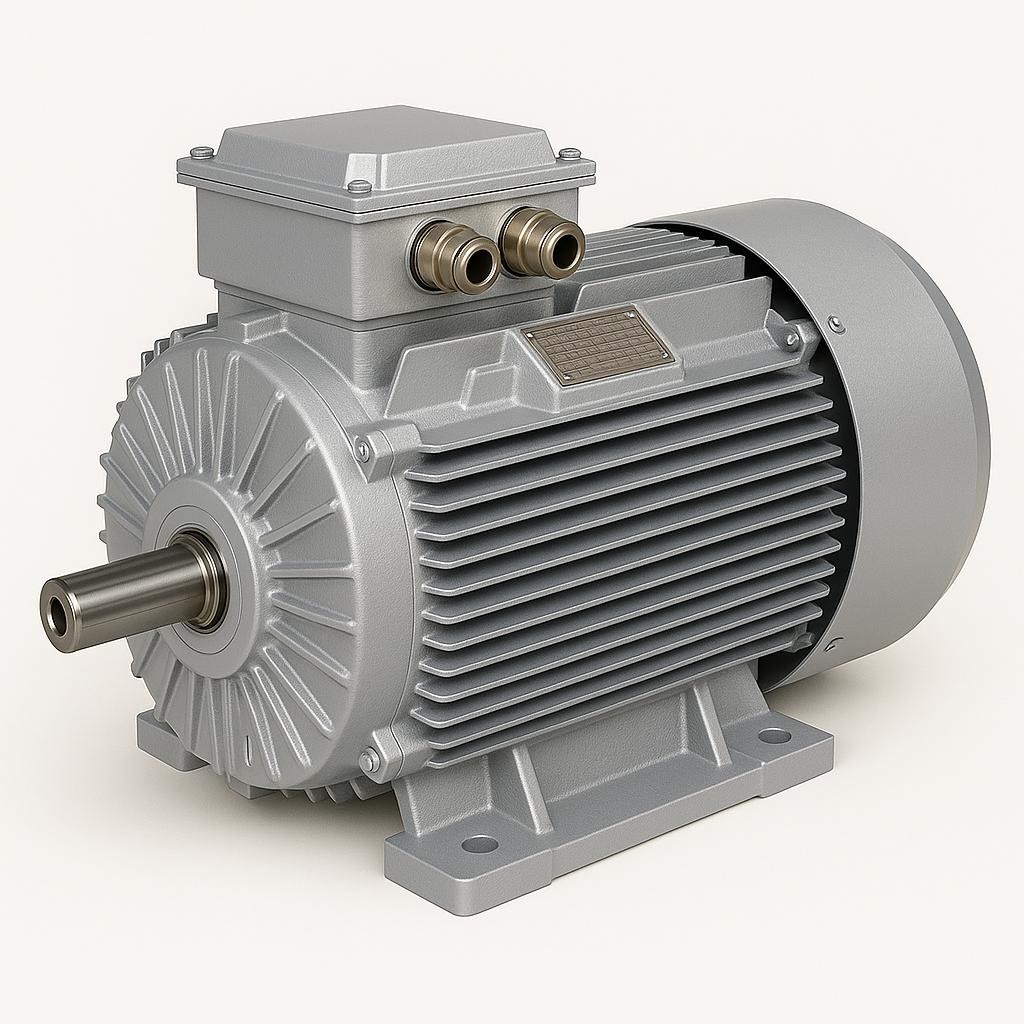

When ordering a replacement for a failed motor, the most reliable source of information is the metal nameplate riveted to the housing. Read its ten or so lines correctly and finding the exact match among more than a hundred rows in the store takes a few minutes. This article explains what each field on the plate tells you, which ones set the price directly and which ones only need to go into the order note. At the end, three sample nameplates are taken all the way to a model code and current price in the DRG Motor online store.
Nameplate Lines and Their Matches in the Store
Although layouts vary from manufacturer to manufacturer, the content is largely the same. The table below shows each line together with what it becomes during purchasing.
| Nameplate line | Typical marking | What it tells you | Match in the store |
|---|---|---|---|
| Power | kW and/or HP | Rated output at the shaft | The kW value in the product name |
| Voltage | 230/400 V Δ/Y or 400/690 V Δ/Y | Which supply and which connection the winding is designed for | Voltage pair to state in the order |
| Current | e.g. 7.95 A | Current drawn at rated load | Cross-check with the catalogue 400 V current column |
| Speed | e.g. 1450 rpm | Rotational speed under load | Number of poles, i.e. the 1000/1500/3000 rpm group |
| Frequency | 50 Hz | Supply frequency | The Turkish grid is 50 Hz |
| cos φ | e.g. 0.82 | Power factor | Compare with the catalogue row |
| IP | IP55 | Protection against dust and water | IP55 is standard; note any other need in the order |
| Insulation class | Ins. Cl. F | Temperature class of the winding insulation (F = 155 °C) | Class F is standard; note any other need in the order |
| Frame / type | e.g. 112M, IM B3 | IEC frame size and mounting arrangement | The frame in the model code (DRG-112M-…) |
The three values that set the price are power, speed and frame, plus the housing material (aluminium or cast iron). Voltage, protection class and insulation class are standard in most cases and only need a note in the order when there is a different requirement.
The Power Line: Not Getting Lost Between kW and HP
On newer plates power is written in kW, often with HP alongside. Older or imported motors may show HP only. 1 HP is about 0.746 kW, but the catalogue and the store give HP as a rounded nominal value: 5.5 kW corresponds to 7.5 HP, 7.5 kW to 10 HP, 11 kW to 15 HP. If the plate says 10 HP, the row to look for is 7.5 kW.
If the plate shows two different powers (for example separate lines for 50 Hz and 60 Hz), use the 50 Hz line for the Turkish grid.
From the Speed Line to the Number of Poles
The speed on the plate is slightly below synchronous speed; the difference is slip. A motor marked 1450 is therefore looked for in the 1500 rpm group, one marked 2930 in the 3000 rpm group. The rated speeds in the catalogue fall into these ranges:
| Speed read on the plate | Poles | Synchronous speed | Store group |
|---|---|---|---|
| 2730–2982 rpm | 2 | 3000 rpm | 3000 rpm |
| 1340–1490 rpm | 4 | 1500 rpm | 1500 rpm |
| 855–992 rpm | 6 | 1000 rpm | 1000 rpm |
Choosing the right group matters for the price: at the same power, more poles mean a larger frame and a higher price. At 2.2 kW, for example, the 3000 rpm model is in frame 90L, while the 1000 rpm equivalent moves up to frame 112M. Ordering on kW alone without checking the speed on the plate changes the speed of the machine.
On a plate made out for 60 Hz the speed is about 20% higher; a value around 1750 indicates a 4-pole motor. When replacing such a motor with a model suitable for the 50 Hz grid, talk the voltage and speed change through with us before ordering.
Voltage and Connection: 230/400 V or 400/690 V?
The two figures on the voltage line show that the winding can work with two different connections. Next to them you will find the Δ/Y (delta/star) symbol.
- 230/400 V Δ/Y: connected in star on a 400 V three-phase supply. Not suitable for star-delta starting.
- 400/690 V Δ/Y: connected in delta on a 400 V supply, so it can be run with star-delta starting.
The standard arrangement in the DRG catalogue is star connection at 3 kW and below, delta at 4 kW and above. If your panel has a star-delta starter and the old motor's plate says 400/690 V, ask for the same pair on the new one; otherwise the panel has to be modified. Our calculation tools help with cable cross-section and thermal relay settings.
Cross-Checking with the Current and cos φ Lines
The current line is the quickest way to confirm that you read power and speed correctly. The catalogue gives currents at 380, 400 and 415 V separately for each model. If the plate voltage is 380 V the current reads slightly higher, at 400 V slightly lower. The 4-pole 7.5 kW model, for example, draws 15.0 A at 380 V and 14.3 A at 400 V.
If the plate current is clearly far from the catalogue row for the same power and speed, there are two possibilities: the power line was misread, or the motor has previously been rewound to a different rating. In that case check the kW again. The cos φ value serves the same purpose; for the 4-pole models in the catalogue it ranges from 0.74 to 0.90.
IP, Insulation Class and Frame Code
In the IP55 marking the first digit describes protection against dust and the second against water; it is standard for the models in the store. If the plate says IP56 or IP65, state it in the order. The Ins. Cl. F line means the winding insulation is in the 155 °C class; if class H is needed, that also goes into the order note.
The frame line (112M, 160L, etc.) is the key to matching. Store codes carry this information directly: in DRG-112M-4, 112M is the frame and the final 4 the number of poles. On the plate, IM B3 means foot mounting and IM B5 flange mounting. Store prices apply to the standard foot-mounted model; a flanged requirement is confirmed through the order note.
Three Nameplates, Three Order Lines
The examples below do not belong to any real brand; they represent common nameplate types seen on site and are consistent with the model values in the catalogue.
Example 1: 4 kW motor on a conveyor drive
Read on the plate: 4 kW, 230/400 V Δ/Y, 50 Hz, 7.95 A (400 V), 1450 rpm, cos φ 0.82, IP55, Ins. Cl. F, frame 112M. The speed points to the 1500 rpm group and the frame to 112M; the current matches the catalogue row exactly. The corresponding model is DRG-112M-4.
| Model | Housing | Power | Speed | Current (400 V) | excl. VAT | incl. VAT (20%) |
|---|---|---|---|---|---|---|
| DRG-112M-4 | Aluminium | 4 kW | 1500 rpm | 7.95 A | 10,960.95 TRY | 13,153.14 TRY |
| DRG-112M-4 | Cast iron | 4 kW | 1500 rpm | 7.95 A | 11,482.90 TRY | 13,779.48 TRY |
Example 2: 15 kW fan motor with a star-delta panel
Read on the plate: 15 kW / 20 HP, 400/690 V Δ/Y, 50 Hz, 27.3 A, 1465 rpm, cos φ 0.86, IP55, frame 160L. At 15 kW the store lists cast iron housings only. The 400/690 V pair must be stated in the order because the panel uses star-delta starting.
| Model | Housing | Power | Speed | Current (400 V) | excl. VAT | incl. VAT (20%) |
|---|---|---|---|---|---|---|
| DRG-160L-4 | Cast iron | 15 kW | 1500 rpm | 27.3 A | 30,610.80 TRY | 36,732.96 TRY |
Example 3: old pump motor marked in HP
Read on the plate: 10 HP, 380 V, 14.4 A, 2930 rpm, frame 132S. 10 HP corresponds to 7.5 kW; 2930 rpm belongs to the 3000 rpm group. The 380 V current of 14.4 A is consistent with the catalogue's 400 V value of 13.7 A. The corresponding model is DRG-132S2-2.
| Model | Housing | Power | Speed | Current (400 V) | excl. VAT | incl. VAT (20%) |
|---|---|---|---|---|---|---|
| DRG-132S2-2 | Aluminium | 7.5 kW | 3000 rpm | 13.7 A | 15,918.00 TRY | 19,101.60 TRY |
| DRG-132S2-2 | Cast iron | 7.5 kW | 3000 rpm | 13.7 A | 16,676.00 TRY | 20,011.20 TRY |
Prices are taken from the DRG Motor online store list dated 24.09.2026; a 3% discount applies to bank transfer/EFT payments, shipping is not included in the price and is paid by the buyer. Please check the store page for the current price.
Payment options and delivery terms are explained on separate pages.
If the Nameplate Is Missing or Unreadable
When a plate is painted over, corroded or missing, matching is done by measurement. Stand the motor on a flat surface and measure the height of the shaft axis above the ground; this is the frame number (112, 132, 160, etc.). Also note the shaft diameter and the longitudinal distance between the foot holes. For speed, the known operating speed of the machine or the plate of the driven equipment can help. Even a photo of a partly readable plate speeds up matching; you can send it to our WhatsApp line.
Frequently Asked Questions
The plate only shows HP; which row should I look at in the store?
Convert the HP value to its kW equivalent: 3 HP matches the 2.2 kW row, 5.5 HP the 4 kW row, 10 HP the 7.5 kW row and 20 HP the 15 kW row. Then confirm with speed and frame.
The plate says 380 V; is a 400 V model suitable?
Models rated at 400 V are used on the three-phase grid in Turkey. Older plates commonly say 380 V; make sure the connection (star/delta) and the voltage pair are the same.
With the same nameplate values, how do I choose between aluminium and cast iron?
The electrical values are the same for both housings; the difference is the housing material. If the old motor is cast iron and works in a heavy, vibrating environment, staying with the same material makes sense. In the store, aluminium options are listed up to 11 kW.
Is the serial number on the plate useful when ordering?
Yes. Especially for spare parts or like-for-like replacement, the serial number and a photo of the plate speed up finding the right model.
If you cannot read your nameplate or are unsure of the match, call +90 (542) 666 11 11 or send a photo of the plate via WhatsApp; you can also write to [email protected] or use our contact page.